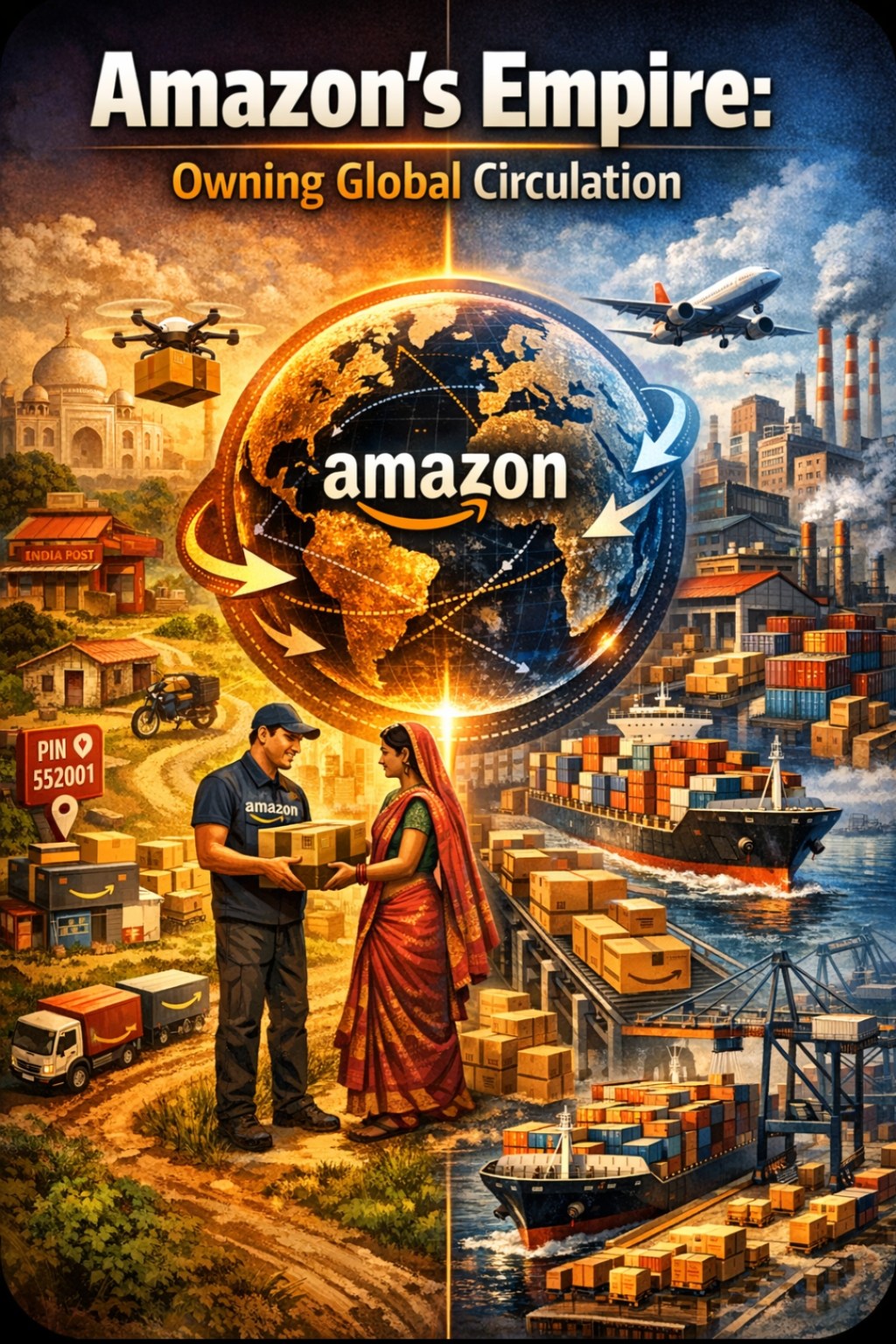
Amazon is no longer merely an e-commerce company; it is mutating into a planetary logistics organism—an infrastructure beast that does not simply sell products but seeks to own their movement. Its expansion today is unfolding through a fascinating dual strategy, almost like a geopolitical pincer attack. In India, Amazon is seeping downward into rural pin codes, village-level sellers, and low-ticket consumption. In China, it is climbing upward into factories, manufacturers, and export logistics. The irony is delicious: Amazon is growing aggressively in India despite regulatory suspicion, while simultaneously embedding itself deeper into China’s supply chain even after failing spectacularly in China’s consumer marketplace.
This is not a story of Amazon pushing products. It is the story of Amazon trying to control the journey of products. India represents demand waiting to be awakened, and China represents supply waiting to be optimised. Amazon’s real ambition is not to dominate shopping; it is to dominate circulation. Whoever controls circulation controls markets, prices, habits, and eventually even state-level bargaining power. In this worldview, the marketplace is just the front-end theatre. The real empire is built in warehouses, delivery routes, seller networks, and invisible algorithms that decide what moves, when, and at what cost.
India is Amazon’s demand laboratory. With nearly 700 million internet users and yet surprisingly low e-commerce penetration, India is not a mature market—it is a runway. The next e-commerce revolution here will not be urban India upgrading from malls to mobile apps; it will be rural households transitioning from informal kirana trust to digital delivery trust. That shift is slow, culturally delicate, and logistically brutal. Yet Amazon behaves as if it is inevitable. Its investment pattern reflects that confidence: around ₹2,000 crore in 2025 alone, within a larger pledge of $26 billion by 2030. This is not a company chasing quarterly market share; it is a company buying long-term infrastructure sovereignty.
The clearest symbol of Amazon’s psychological warfare is ultra-fast delivery. Services like “Amazon Now,” promising delivery within minutes, are not simply convenience—they are behavioural conditioning. When delivery becomes instantaneous, e-commerce stops being an occasional transaction and becomes a daily reflex. Prime users reportedly triple their shopping frequency once hooked into fast delivery cycles. This is how platforms colonise human routine: not through persuasion, but through dependency. Once the consumer begins to “need” Amazon for everyday immediacy, the consumer no longer shops—they orbit.

But the true battlefield is not urban India; it is rural India. Rural India is a geography of low density, fragile warehousing economics, delivery friction, and trust sensitivity. A failed delivery is not merely a missed transaction—it becomes village-wide gossip, a reputational collapse. Amazon’s rural strategy therefore is not advertising-led; it is distribution-led. Its plan to reach over 13,000 pin codes by 2026, expand delivery stations, and triple its network is significant. Even more strategically brilliant is its partnership with India Post, giving access to nearly 19,300 pin codes including remote regions like Ladakh. Amazon is not replacing institutions—it is integrating with them until the boundary disappears. That is how modern empires expand.
On the supply side, Amazon is quietly rewriting the rules of participation. By eliminating referral fees on over 12.5 crore low-priced products under ₹1,000 across 1,800+ categories, it has engineered affordability for sellers and dominance for itself. This is not generosity; it is market architecture. Low-ticket products dominate Bharat’s consumption, and whoever owns low-ticket volume owns the entry gate into digital commerce. The first delivery is the real product Amazon sells. Once trust is built with a ₹199 item, the consumer’s resistance collapses. Through initiatives like “Karigar” and “Saheli,” and training MSMEs in export readiness with DGFT and state partnerships, Amazon is attempting something deeper: not merely bringing rural India to Amazon, but exporting rural India through Amazon.
Yet India remains a hostile playground. Competition Commission probes, allegations of deep discounting, FDI restrictions, and the rise of quick-commerce predators like Zepto and Blinkit ensure Amazon operates under permanent scrutiny. But Amazon persists because India is not merely a market—it is the future consumption engine of the world. Now contrast this with China, where Amazon failed in the consumer space and shut its domestic marketplace in 2019. Many saw it as retreat. That reading was shallow. Amazon did not abandon China; it abandoned the wrong battlefield. The new battlefield is not Chinese consumers—it is Chinese manufacturers.
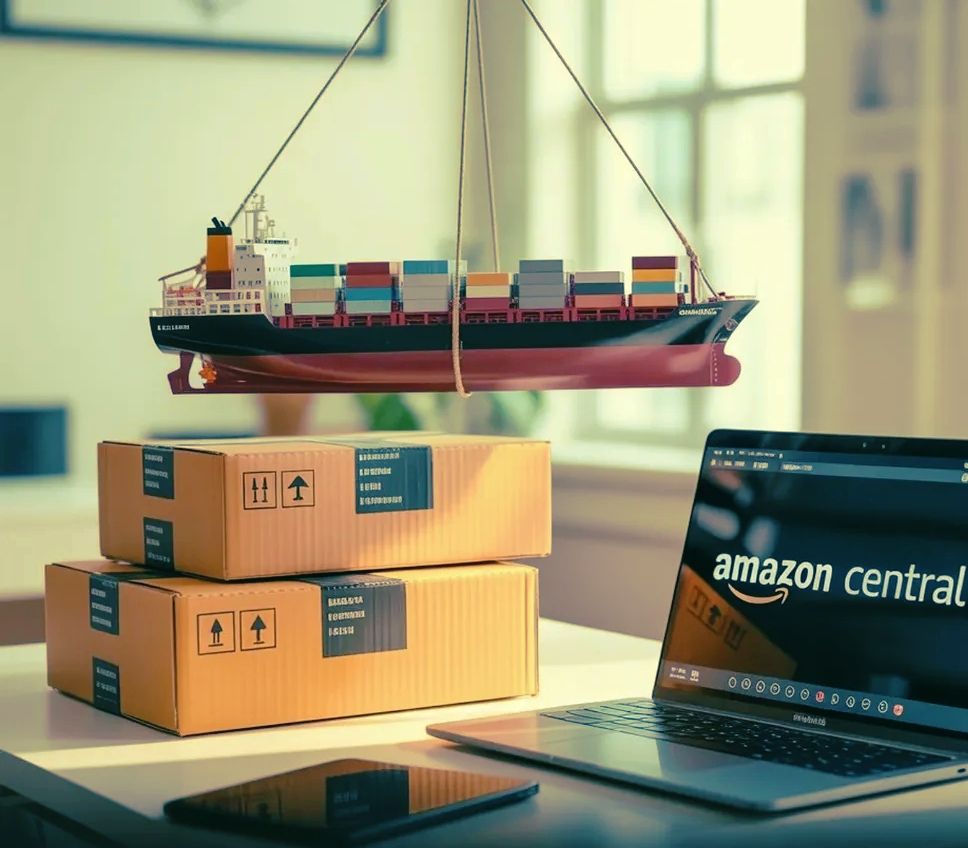
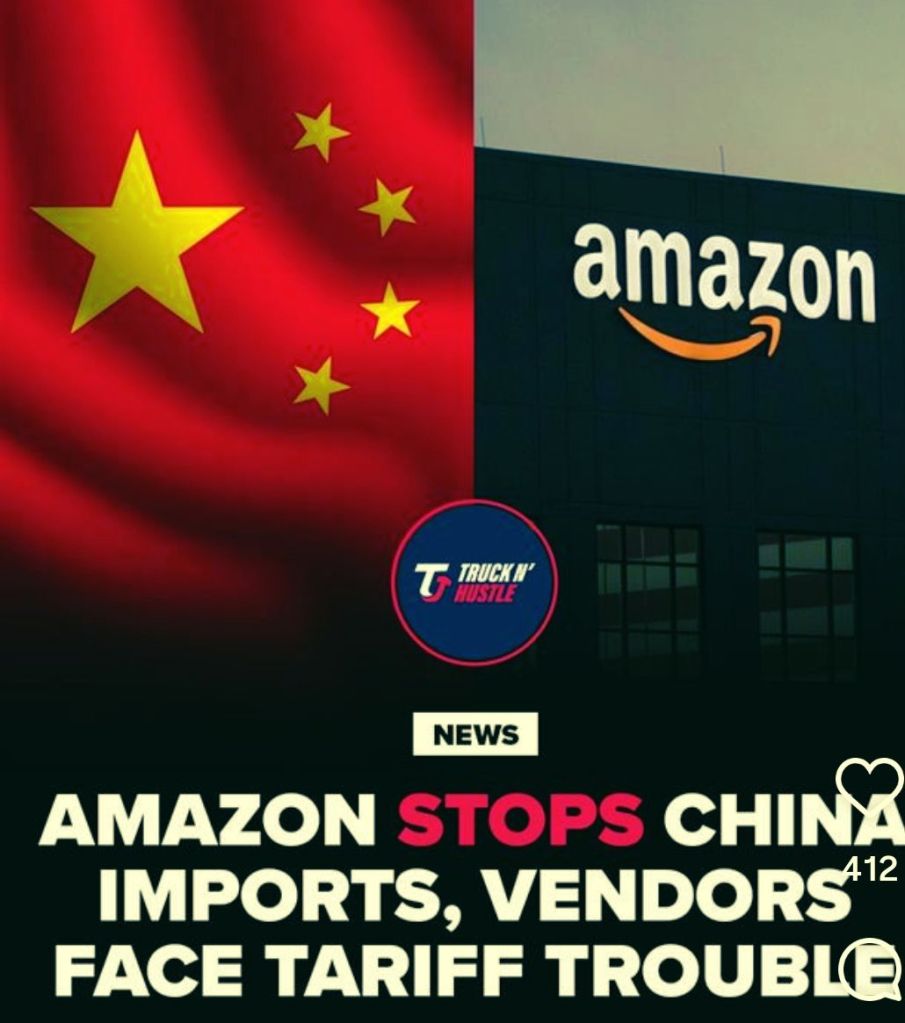
Even after Amazon’s consumer collapse, Chinese sellers quietly conquered Amazon’s global marketplace. Amazon became their export highway into Western consumption. But now direct-from-China shipping models threaten Amazon’s traditional dominance by bypassing overseas warehousing. Amazon’s response has been surgical: move closer to production. Its Global Warehousing and Distribution hub in China is not retail revival—it is supply-chain conquest. Inventory stays near factories and moves only when demand arrives, reducing seller costs by nearly 45% and insulating the system against trade-policy shocks such as possible tightening of duty-free import thresholds. Amazon cannot control geopolitics, but it can control logistics economics. It is not competing with Alibaba inside China—it is competing for the mindshare of Chinese manufacturers deciding who will carry their goods to the world.
So Amazon is burrowing into Bharat’s villages and drilling into China’s factory floors. One strategy captures demand. The other captures supply. Both converge toward a single outcome: Amazon becoming the corridor through which global goods must travel. The future contest is no longer about who sells the product; it is about who owns the route from production to doorstep. And Amazon is quietly building itself into that route—one rural pin code at a time in India, and one warehouse near a Chinese assembly line at a time in Shenzhen.
VISIT ARJASRIKANTH.IN FOR MORE INSIGHTS

