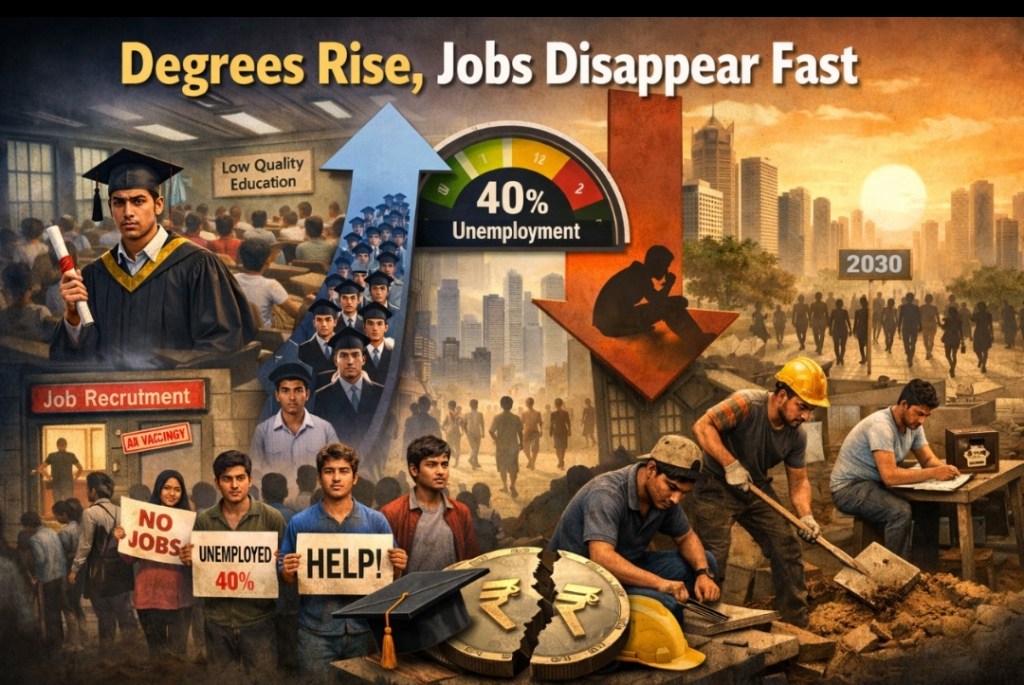
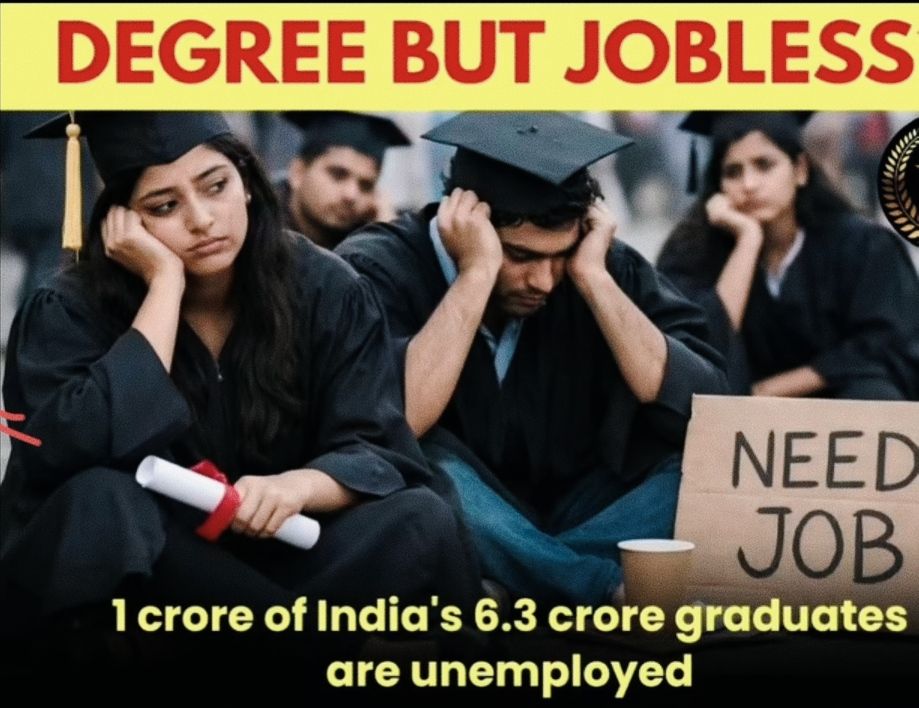
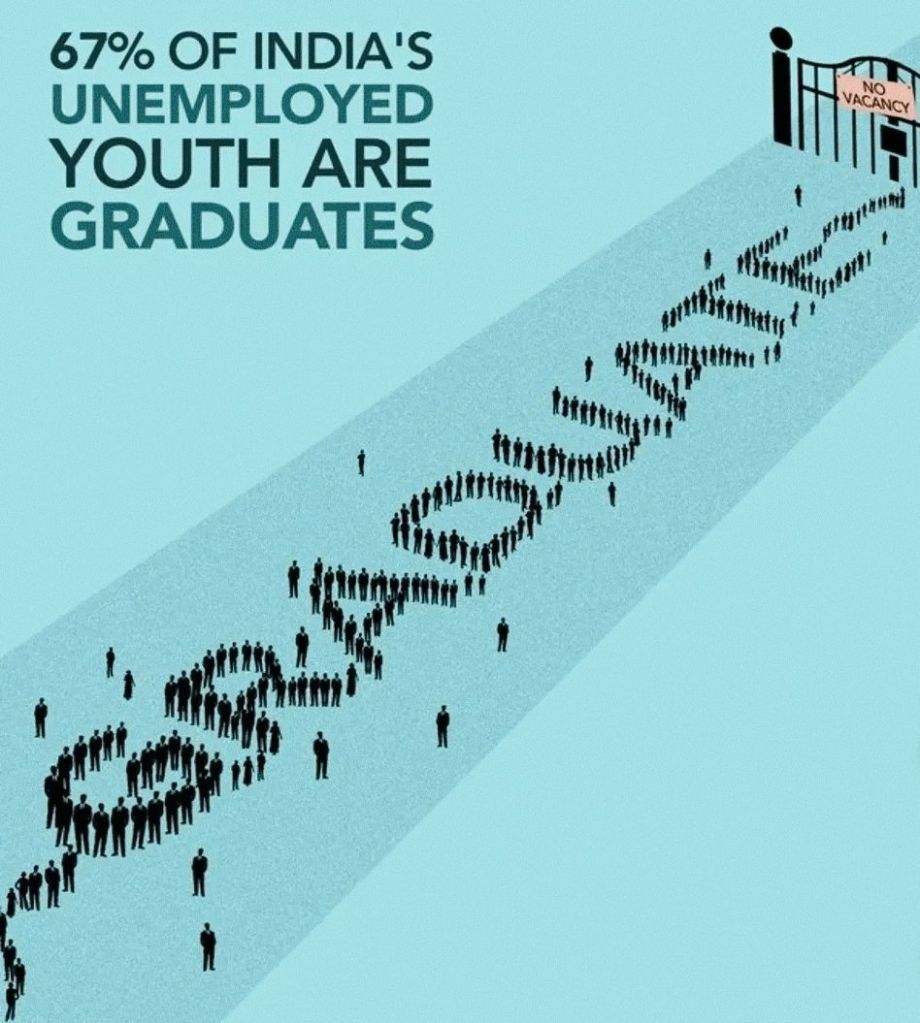
India is witnessing one of the most unsettling labour market paradoxes in modern economic history: the more educated a young person becomes, the more likely they are to remain unemployed. For illiterates, unemployment is roughly 3%. For graduates in the 15–24 age group, it approaches 40%. At first glance, this seems like an indictment of education itself. But the truth is harsher and more revealing: education is not failing because it is useless, it is failing because it manufactures aspirations faster than the economy can manufacture dignified jobs. A degree today is not merely a qualification—it is a promise made by society. And India’s economy is increasingly unable to honour that promise.
What makes this contradiction dangerous is its stubborn permanence. The State of Working India 2026 report, drawing on four decades of labour market evidence, shows that graduate unemployment among the youngest cohort has remained trapped between 35% and 40% since 1983. Through liberalisation, the IT boom, Make in India, and the startup era, the figure barely moved. This is not a cyclical downturn that will heal with better growth numbers. This is structural dysfunction embedded in the architecture of India’s development model. It signals a deep mismatch between what the education system produces and what the labour market is structurally designed to absorb.
7This dysfunction arrives at a moment of historic demographic pressure. India has about 36.7 crore people between the ages of 15 and 29, the largest youth population on Earth and nearly one-third of its working-age citizens. If we exclude those still studying, roughly 26.3 crore young Indians must be productively absorbed into the economy. The demographic dividend is not a permanent asset; it is a time-bound economic window. The dependency ratio is expected to reach its most favourable point around 2030 and then begin declining permanently as the population ages. India is therefore racing against a biological clock. If the pipeline from learning to earning continues to leak at every stage, the dividend will not disappear quietly—it will mutate into a generational crisis of frustration, underemployment, and wasted potential.
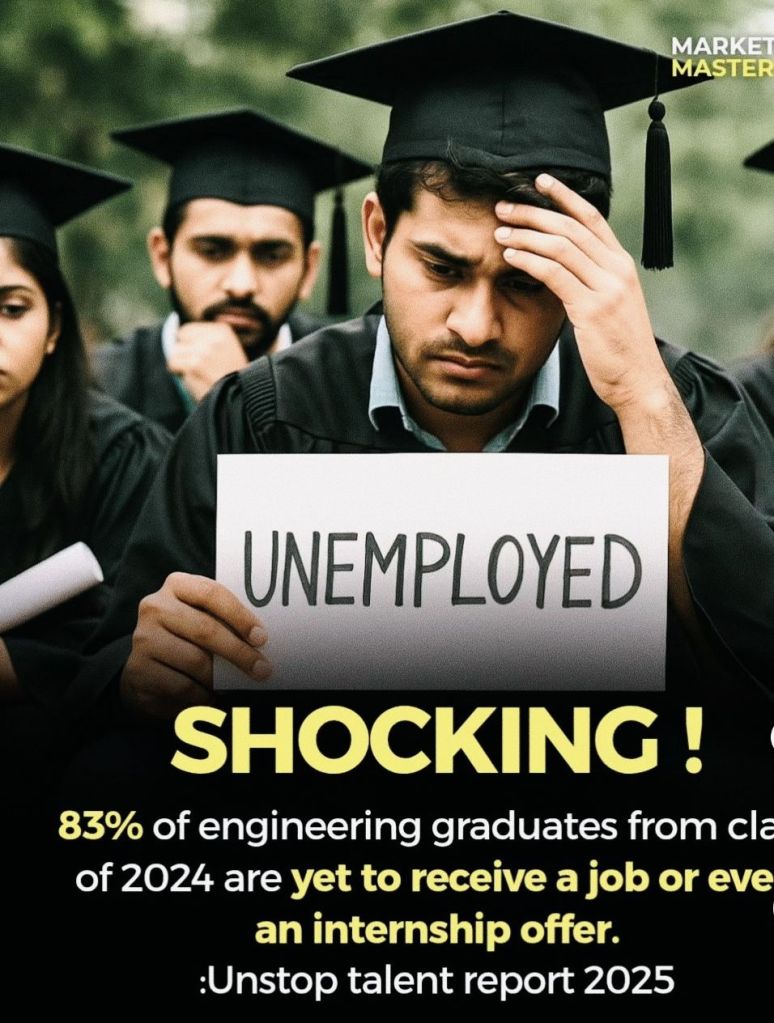
To be fair, education is not the only determinant of employment outcomes. Nutrition, geography, caste networks, household wealth, and social capital all shape opportunity. Yet education and skilling remain the two levers that both the state and the market have attempted to pull most aggressively for decades. If even these levers fail to generate mobility, the implications are profound: India’s development story begins to resemble a system that expands access without expanding outcomes. Since liberalisation, India has built one of the world’s largest higher education systems. Institutions multiplied nearly 42 times, with almost 80% of the expansion driven by private providers. Institutional density improved from 29 per lakh population in 2010 to 45 per lakh by 2021. Enrolment surged: among men aged 15–19, it rose from 49% in 1983 to 73% in 2023; among women, from 38% to 68%. With a gross enrolment ratio close to 28%, India is no longer a laggard. It has achieved mass higher education at scale—an extraordinary national achievement.
But the report delivers a brutal diagnosis: quantity has been purchased at the cost of quality, and expansion has been purchased at the cost of equity. The quality crisis is visible in the classroom. AICTE norms recommend 15–20 students per teacher, yet private colleges average around 28, while public institutions average nearly 47. This is an education system running two to three times beyond its design capacity. Predictably, attendance may rise, but learning collapses. The India Skills Report 2026 suggests only about 43% of graduates are job-ready. India is therefore producing degrees faster than it is producing competence—turning education into credential inflation. When a degree becomes common but skills remain scarce, the degree loses signalling value and graduates enter the labour market not as assets but as disappointed applicants.
Equity is the second fracture, and perhaps the most politically explosive. Between 2007 and 2017, enrolment from the poorest quarter of households doubled from 8% to 15%. This looks like progress until one examines the distribution of opportunity. Wealthier families dominate high-return professional courses such as engineering and medicine. Poor households are crowded into low-cost humanities and commerce degrees with weak employment outcomes. The median cost of an engineering degree—around ₹1.3 lakh per year—exceeds the annual per capita expenditure of India’s poorest families. For millions, professional education is not difficult; it is mathematically impossible. This creates a new injustice: the poor are entering higher education, but they are entering the part of higher education that offers the least mobility. Inclusion is occurring, but it is inclusion into low-return tracks.
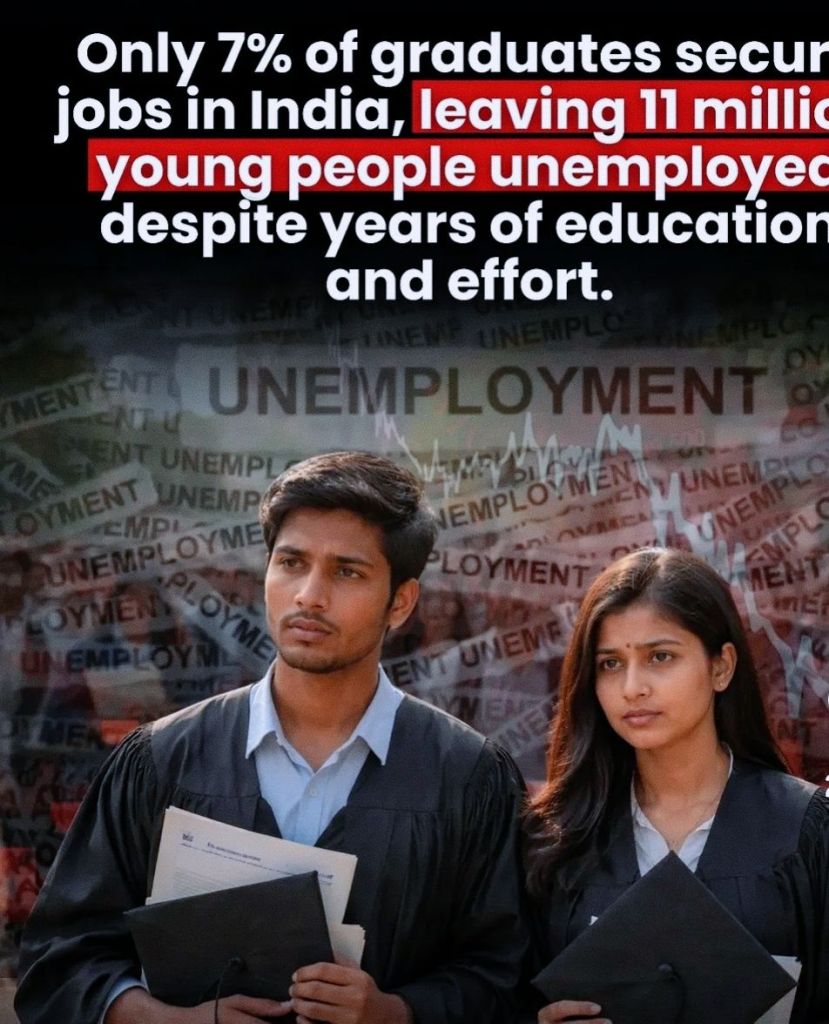
The consequences are now visible in behavioural shifts. Young men are beginning to abandon the system. Between 2017 and 2024, male enrolment declined from 38% to 34%. When asked why, 72% cited the need to support household income, up from 58% in 2017. This is not cultural regression; it is economic rationality. For many families, the cost-benefit calculation of a tier-three private degree has collapsed. The tragedy deepens after education. Between 2004–05 and 2023, nearly 50 lakh graduates entered the labour market annually. Only around 28 lakh found employment of any kind, and only a fraction entered salaried work. Among young male graduates who begin unemployed, about half find work within a year—but only 7% secure permanent salaried employment, and barely 3.7% obtain regular jobs. The rest are absorbed into informal, temporary arrangements that do not reward education and do not build long-term stability.
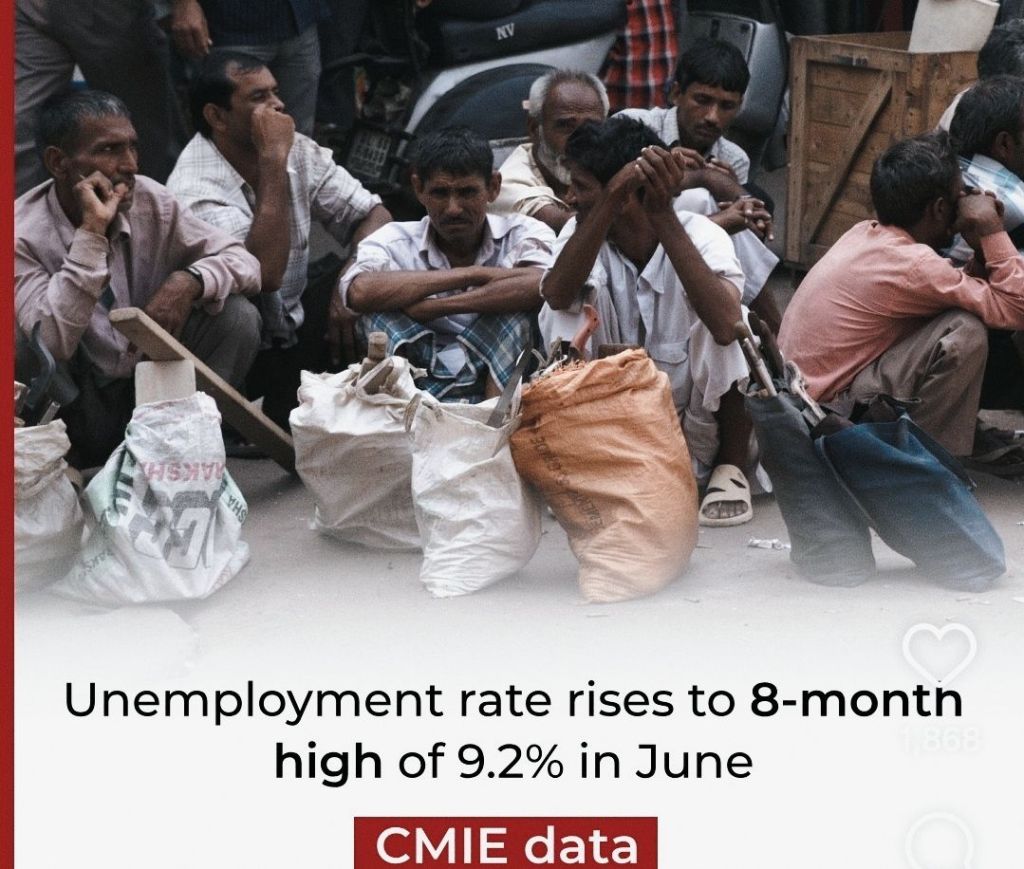
India’s labour market thus functions like parallel universes. One is a small formal sector that offers stability, dignity, and upward mobility. The other is a vast informal economy where workers cycle between self-employment, daily wages, and joblessness. The bridge between these worlds is weak, and young people respond through two survival strategies. The first is withdrawal: exiting the labour force to prepare for government exams. Government jobs offer prestige and security unmatched by private employment, turning them into the ultimate aspiration. But this is a lottery with collapsing odds—millions invest years of youth into preparation, accumulating neither earnings nor work experience. The second strategy is immediate compromise: taking informal work because waiting is unaffordable. But informal work often becomes permanent, trapping individuals in low productivity sectors where skills stagnate and formal transition becomes even harder.
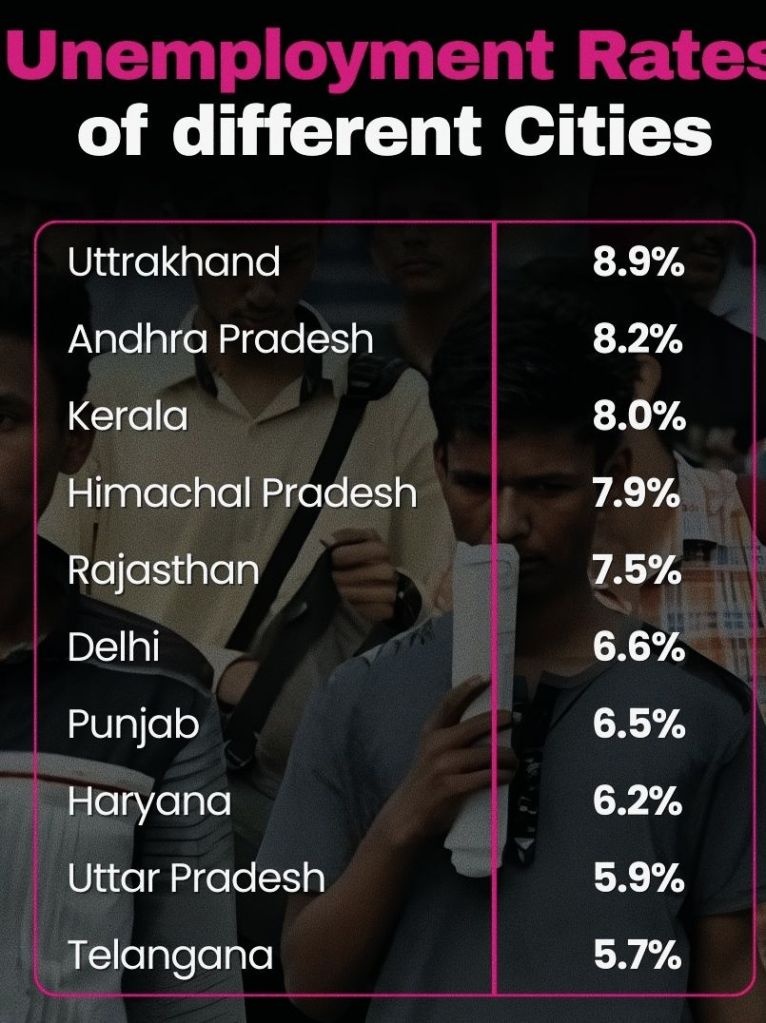
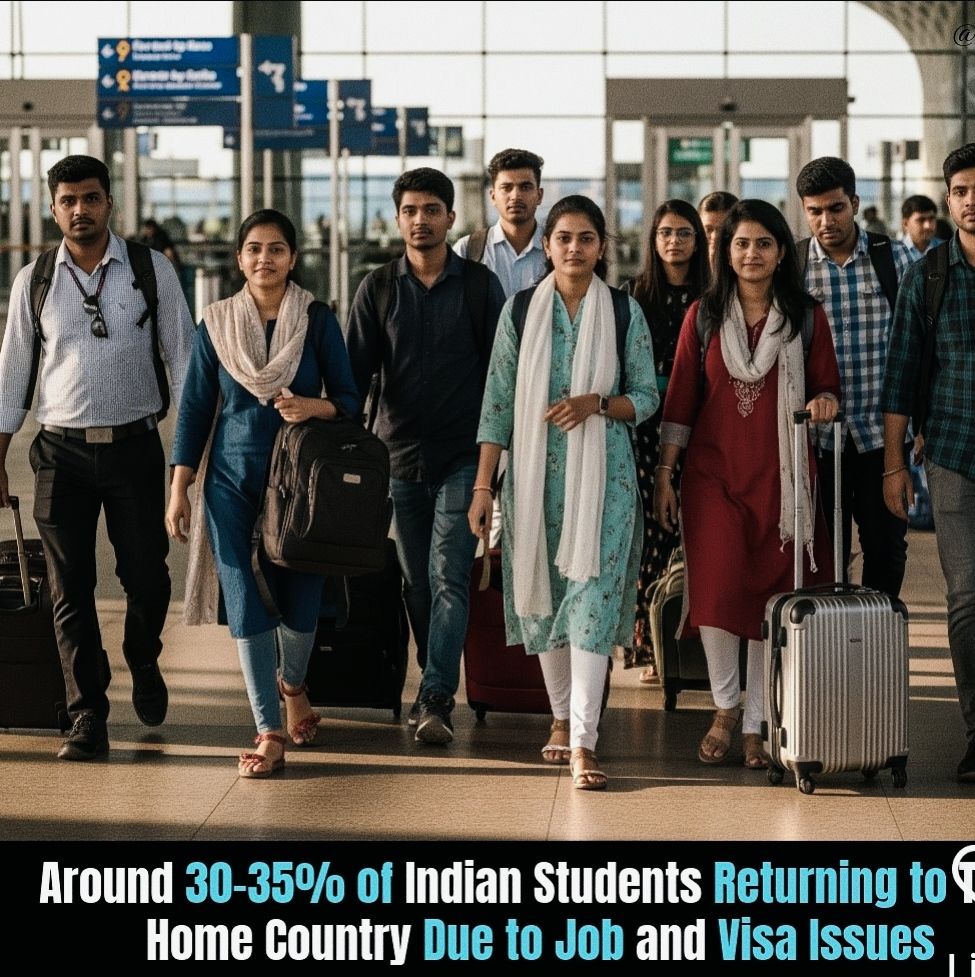
Migration offers partial relief but creates a new layer of imbalance. Poor states like Bihar carry the youth bulge but lack job creation capacity; richer states like Maharashtra, Delhi, and Haryana have jobs but aging workforces. Migration improves individual prospects, yet it drains poorer states of the human capital required to build their own economies, deepening regional inequality. Structural transformation is occurring, but imperfectly. Young Indians are leaving agriculture rapidly—young men in agriculture fell from 57% in 1983 to 27% in 2023, and young women from 75% to 49%. This is the right direction. The problem lies in the destination. Instead of manufacturing absorbing youth as it did in China or South Korea, India’s workers are flowing into construction, retail trade, and transport—low productivity sectors historically designed for older, less educated labour.
Women’s employment trends provide one rare bright spot. Education is enabling young graduate women to enter higher productivity sectors such as IT services, healthcare, business support services, and advanced textile manufacturing. The gender wage gap among graduates has narrowed significantly, and young graduate women now earn nearly as much as men. Yet this progress rests on a stubborn national reality: female labour force participation remains around 35%, and the rise in women’s self-employment since 2017 reflects distress more than entrepreneurship. Even caste-based occupational rigidity has weakened—SC/ST concentration in leather and footwear fell from 40% in 1983 to 24% in 2023—suggesting aspiration is slowly replacing inheritance. But whether these transitions consistently deliver dignity and higher wages remains unresolved.
In the end, India’s pathway from learning to earning resembles an Indian highway: wide in promise, narrow in execution, and full of potholes. The country is producing credentials without capabilities, aspirations without absorption, and education without mobility. If this trajectory continues, the demographic dividend will not become a dividend at all—it will become a demographic liability. Between now and 2030 lies India’s decisive window. Either the economy builds the capacity to absorb 26 crore young workers into productive, formal employment, or the nation risks a historic outcome: growing old before growing rich.
VISIT ARJASRIKANTH.IN FOR MORE INSIGHTS

