
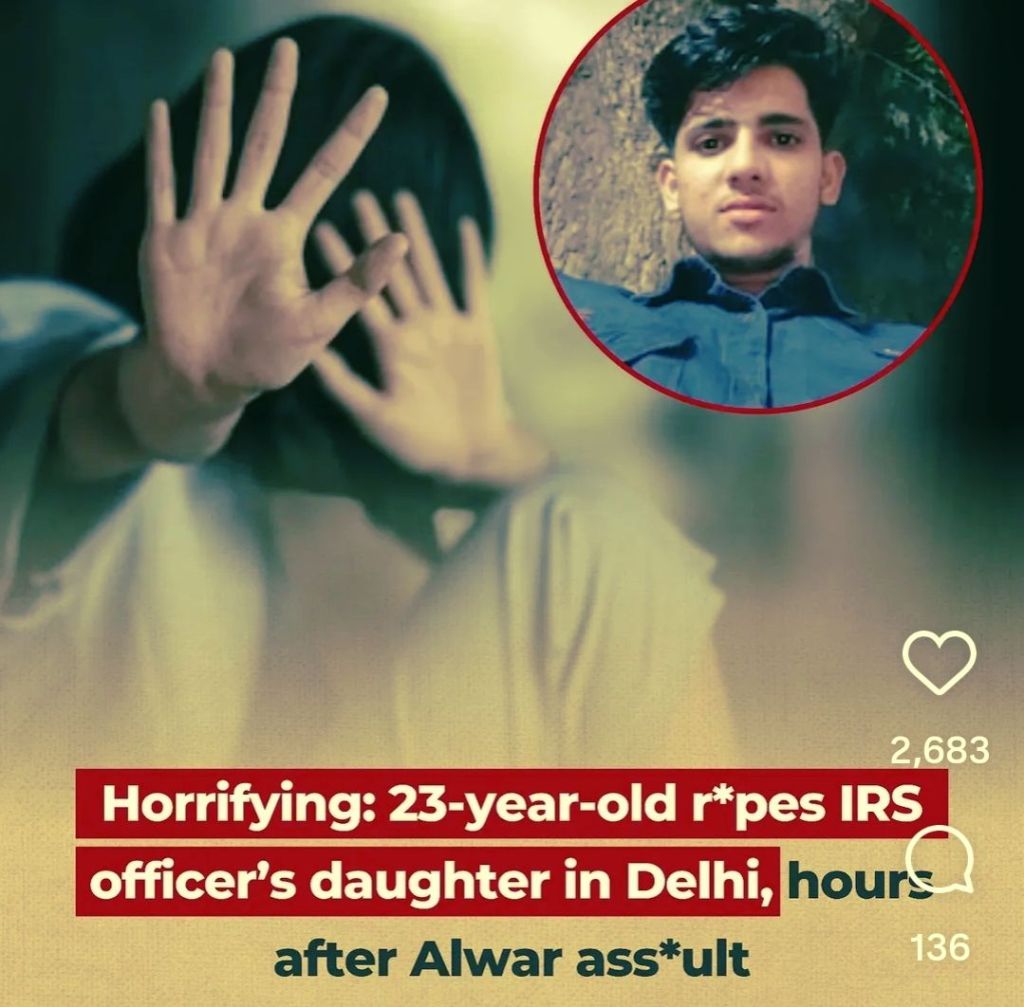
The alleged sexual assault and killing of a twenty-year-old girl inside her home in Southeast Delhi has ignited outrage not merely because of its cruelty, but because of what it exposes: the collapse of the “safe home” illusion. The victim was the daughter of an IRS officer, living in an upscale locality guarded by gated entry points, apartment security, and the invisible comfort of social privilege. Yet the crime did not unfold in a deserted alley or an unsafe street. It occurred inside the home, in the morning, without forced entry. That is the defining horror. The threat did not invade from outside—it emerged from familiarity.
The accused, 23-year-old Rahul Meena, was arrested within hours. Police sources indicate he had worked at the family’s residence for nearly 18 months and had been terminated around six weeks earlier. Investigators suggest the termination was linked to financial misconduct and unpaid debts arising from online gambling. This detail is not peripheral—it reflects a widening urban crisis. Across metropolitan India, addiction-driven debt spirals are quietly expanding within informal labour ecosystems, invisible to employers until desperation erupts into violence.

What makes the incident especially disturbing is its structural precision. The reconstruction of events suggests the crime was not impulsive; it was engineered around routine. The accused reportedly arrived around 6 AM, when household patterns were predictable. He allegedly waited nearly half an hour before entering around 6:30 AM. That waiting period signals calculation, confidence, and psychological preparedness. Crimes of this magnitude are rarely spontaneous—they are rehearsed long before they are executed. He did not rely on brute force. He relied on architectural memory. Investigators state he knew of a rooftop room and initially attempted entry through deception. When the door was not opened, he reportedly shifted tactics—moving through an adjoining bathroom, removing a shaft panel, and entering through an internal breach point. This was not random burglary. This was familiarity weaponised. The home’s layout became a blueprint for intrusion.
Inside, he allegedly demanded money and attempted to force the child to open a biometric locker using her fingers. This detail is chilling because it reflects intimate awareness of household security arrangements and the location of valuables. It shows a mind that understood the private infrastructure of trust—where the family stored wealth, how access functioned, and how vulnerability could be exploited. Investigators believe a struggle followed, after which he allegedly stole cash and committed the assault and murder. The crime occurred in a premium neighbourhood at a socially “safe” hour, shattering the myth that danger belongs only to midnight streets.
The accused’s profile highlights a modern paradox of urban employment. Reports indicate he had completed a distance-learning graduation in economics, history, and sociology—credentials that would appear reassuring to most employers. Yet investigators suggest he was trapped in online gambling addiction, with liabilities reportedly nearing ₹7 lakh. Such addiction produces a volatile mix of shame, financial panic, resentment, and reckless risk-taking. The governance lesson is stark: domestic employment in India is not a regulated labour market; it is a trust-based informal economy. When trust collapses, the home becomes the crime scene.

The police response was swift. The accused was reportedly tracked through CCTV and field intelligence, arrested within hours, and found to have attempted escape via railway routes towards Rajasthan. He allegedly took brief shelter in a hotel in Dwarka, indicating a desperate but calculated attempt to disappear before law enforcement sealed the perimeter. While motive appears linked to theft, investigators will now determine whether the violence was an escalation or premeditated. The sequence suggests a mindset prepared to eliminate witnesses.
This case reflects a larger national vulnerability. Domestic workers are implicated in urban crimes not because domestic labour is inherently criminal, but because informal employment grants unchecked access. The greatest risk often lies not with strangers, but with insiders—caretakers, former staff, and workers who possess informational power: routines, blind spots, spare keys, passcodes, and family behaviour. India’s urban middle class has outsourced domestic life to an informal labour ecosystem without building corresponding security discipline.

The solution is not paranoia—it is procedure. Police verification must become non-negotiable. Employers must insist on identity checks, reference verification, written agreements, and clear exit protocols. Most importantly, locks, access codes, and security permissions must be changed immediately after termination, especially following misconduct. RWAs must maintain staff registries, coordinate verification drives with police, and strengthen surveillance in common areas. A modern home cannot run on emotional trust alone; it must operate on verified trust.
The murder of a twenty two-year-old child is not only a tragedy—it is a warning to India’s urban governance culture. Modern locks, elite neighbourhoods, and prestigious designations cannot substitute for basic due diligence. The real collapse is not just of one household, but of institutional caution across thousands of homes still living under the illusion that familiarity equals safety. In the 21st century, the safest home is not the one with the strongest door. It is the one with the strongest verification.
VISIT ARJASRIKANTH.IN FOR MORE INSIGHTS

