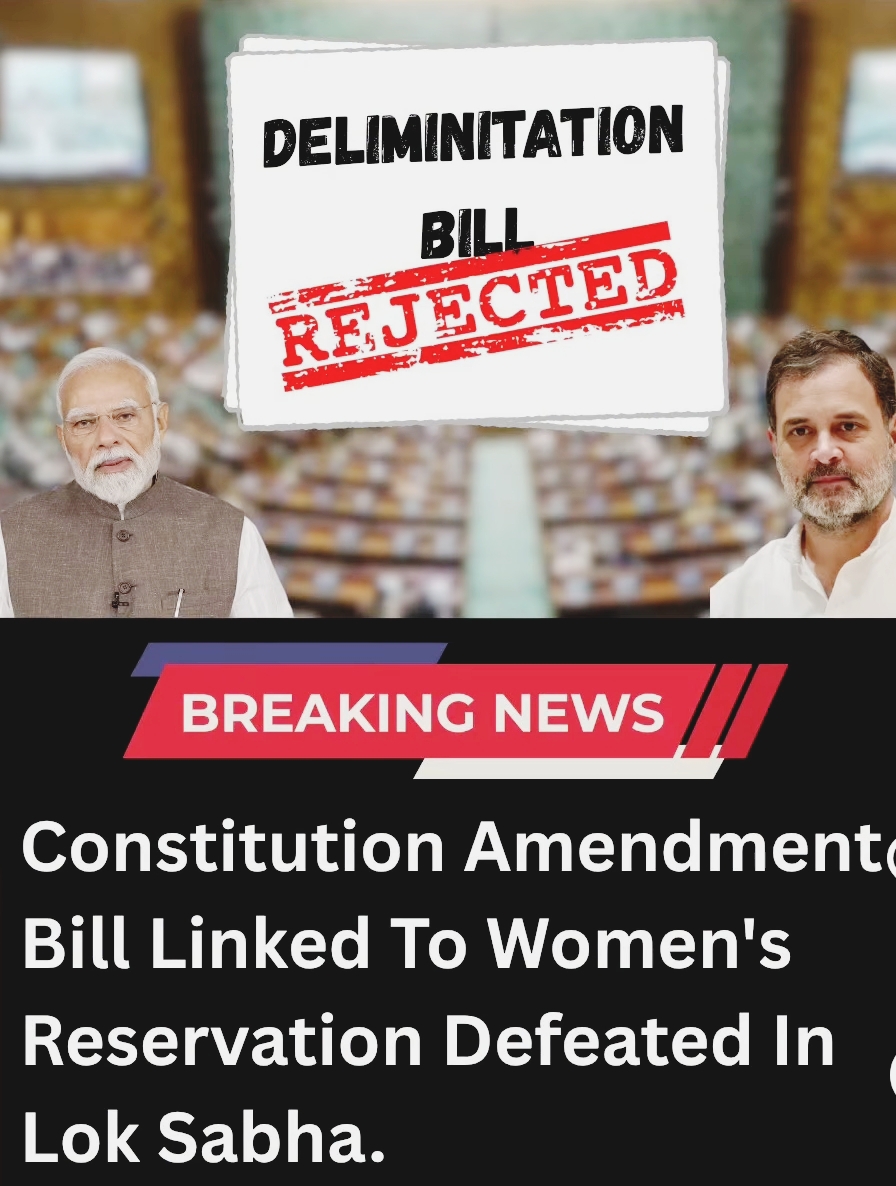
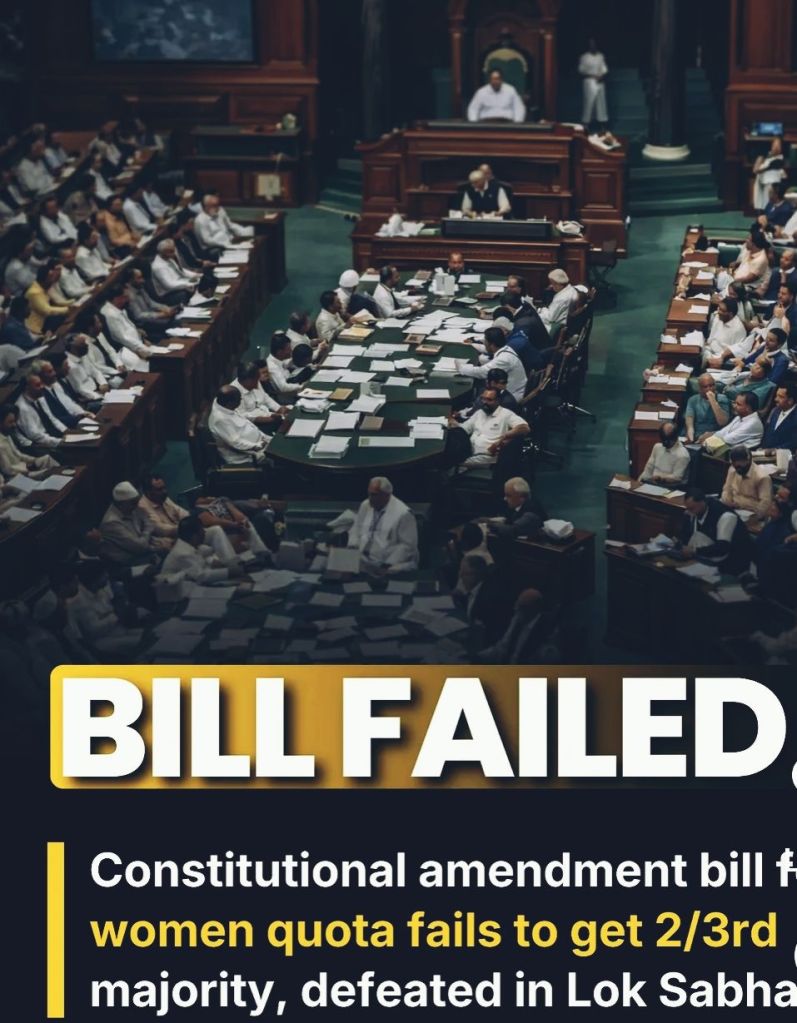
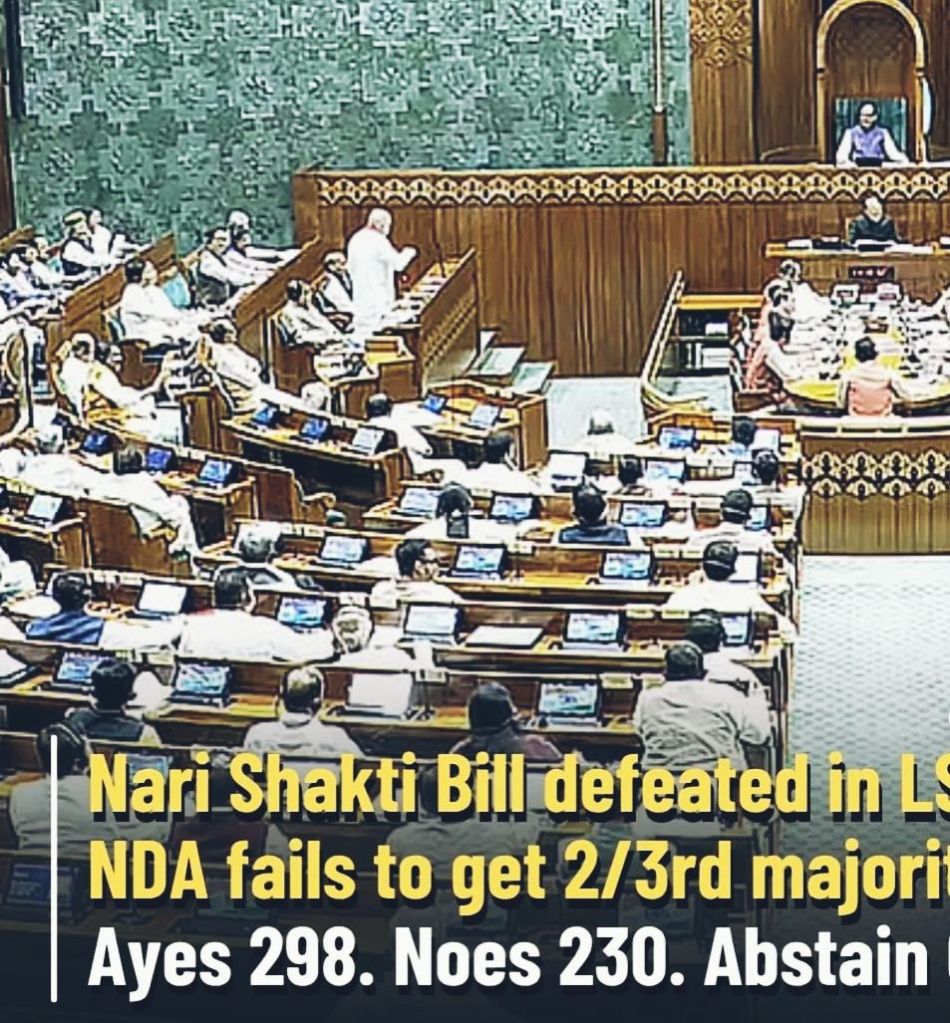
On 17 April 2026, Indian democracy witnessed something rare: a constitutional amendment defeat in the Lok Sabha. The Constitution (131st Amendment) Bill, 2026—projected as a historic instrument of women’s empowerment—collapsed on the floor of the House. It secured 298 votes in favour and 230 against, yet failed to cross the constitutional two-thirds threshold of roughly 352 votes. In a system where governments usually bulldoze amendments through brute arithmetic, this was not merely a legislative defeat. It was a political unmasking—an institutional moment where Parliament briefly refused to sign a cheque it did not fully understand.
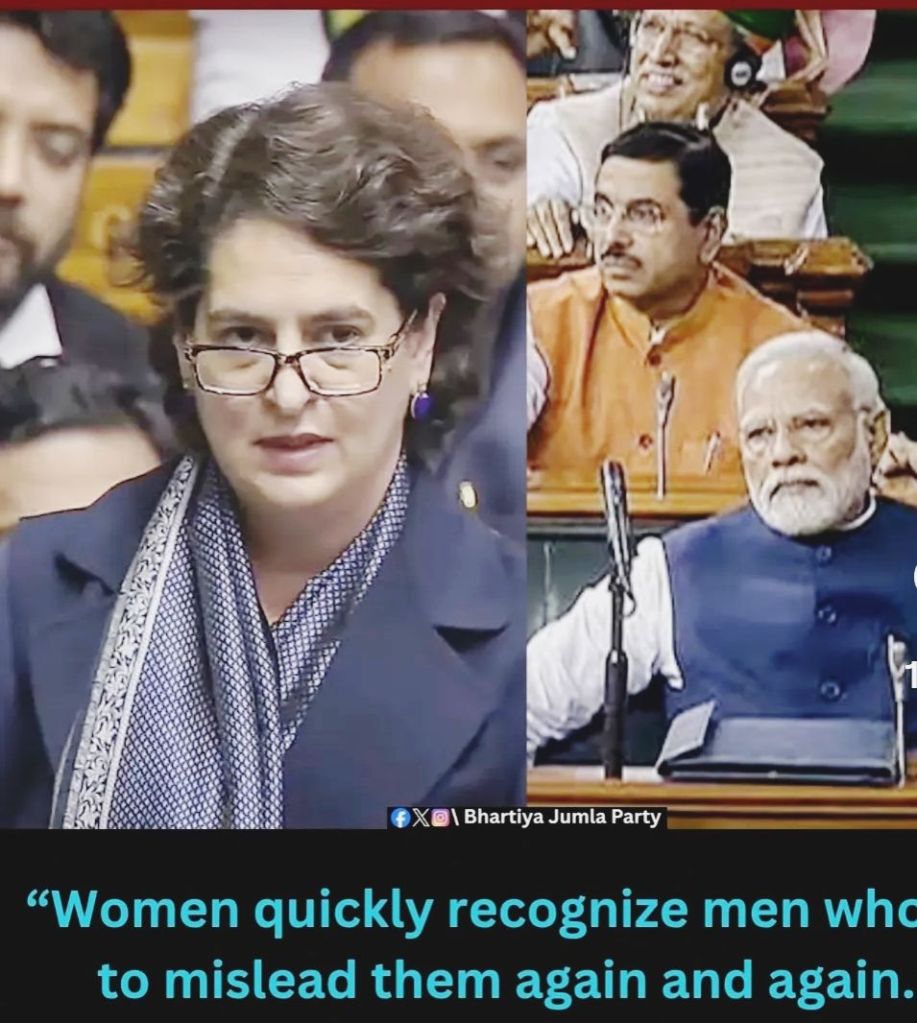
Because behind the grand slogan of “33% reservation for women” lay an uncomfortable truth: the political class does not fear women entering politics. It fears men leaving it. The anxiety was never about empowerment; it was about displacement. And that is where the entire drama becomes less about Shakti and more about survival. India’s Parliament was not debating justice alone—it was negotiating its own future occupancy.
The promise of women’s reservation is not new. It has circulated in India’s political bloodstream for decades like an unfinished sentence. Even the Women’s Reservation Act, 2023, carried a brilliant political escape hatch: reservation would come into effect only after delimitation. Meaning, women were offered a promise wrapped in procedural barbed wire. First census. Then delimitation. Then a commission. Then new boundaries. Then implementation. In Indian politics, “after delimitation” is the most sophisticated way of saying: not now, not soon, and preferably not before the next election cycle.
But the 2026 proposal was not one bill—it was a coordinated trio, like a constitutional magic trick performed with legislative paperwork. The Constitution (131st Amendment) Bill would enable the framework for reservation and delimitation. The Delimitation Bill, 2026 would establish the machinery for a Delimitation Commission. And the Union Territories Laws Amendment Bill, 2026 would extend women’s reservation to assemblies in Delhi, Puducherry, and Jammu & Kashmir. On paper, it resembled accelerated gender justice. In political reality, it resembled a strategic redesign of India’s electoral map under the moral umbrella of empowerment.
That is why opposition voices argued that women’s representation was being held hostage to delimitation. Delimitation is not a technical exercise; it is a redistribution of political power. Redrawing constituencies based on population growth means states with higher population growth gain seats while those that successfully controlled population growth lose representation. For southern states that consciously pursued family planning since the 1970s, delimitation appears less like reform and more like punishment for governance discipline. The fear was not imaginary—it was structural: the federal balance could be rewritten through arithmetic, not debate.
The controversy deepened because delimitation discussions appeared tied to outdated population datasets, effectively redesigning the Republic using numbers already stale by 2026. Yet the real political earthquake was not about census dates—it was about scale. The Lok Sabha strength is expected to rise from 543 to around 850 seats, a jump so massive it feels like Parliament is preparing for a population of another planet. And here lies the silent brilliance of the design: if 33% reservation is implemented on 543 seats, around 180 seats must be reserved—meaning 180 sitting male MPs face uncertainty. But if Parliament expands to 850 seats, around 307 new seats appear, allowing reservation to be implemented largely through new constituencies. Women receive representation, while incumbents retain comfort. Reform happens, but without sacrifice.
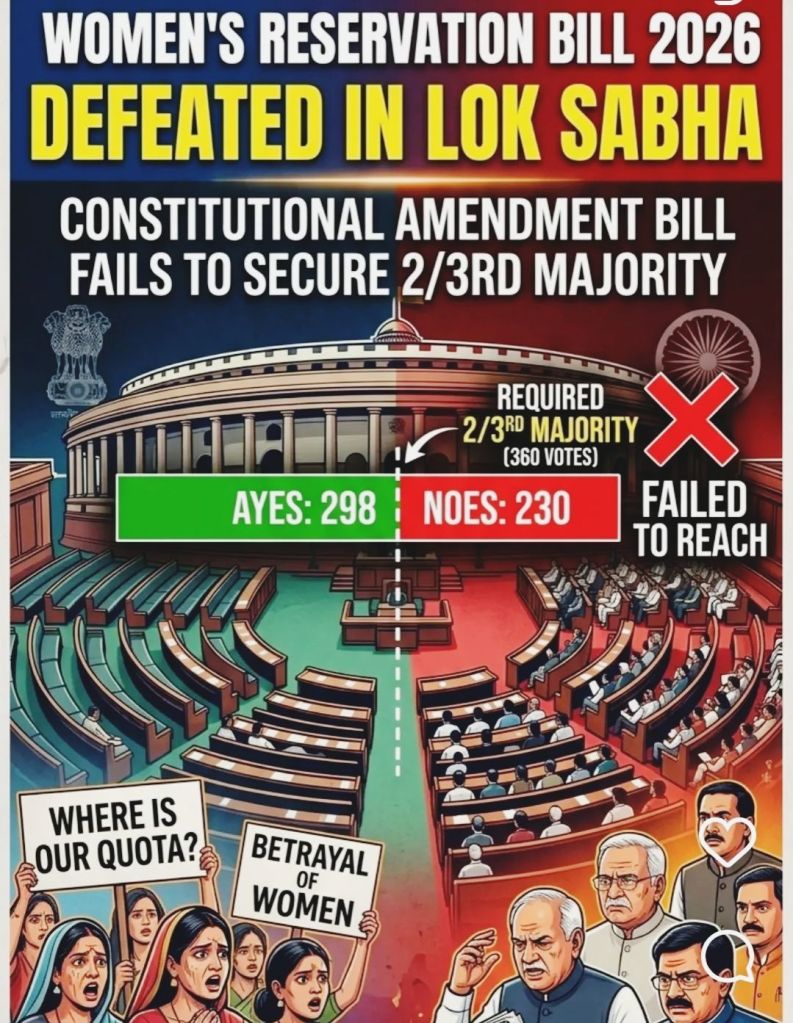
This is not empowerment. This is accommodation. It is like announcing “reservation in the dining hall” but building a new dining hall so the old diners never have to share their plates. It is diversity without discomfort, justice without consequences, reform without political pain. The government defended the move under the language of “one person, one vote,” but experts pointed out the contradiction: increasing seats does not automatically resolve constituency size inequality. It delays structural imbalance while still shifting political gravity over time. The defeat of 17 April, therefore, was not simply the failure of a bill—it was Parliament resisting a political earthquake disguised as a gender reform package.
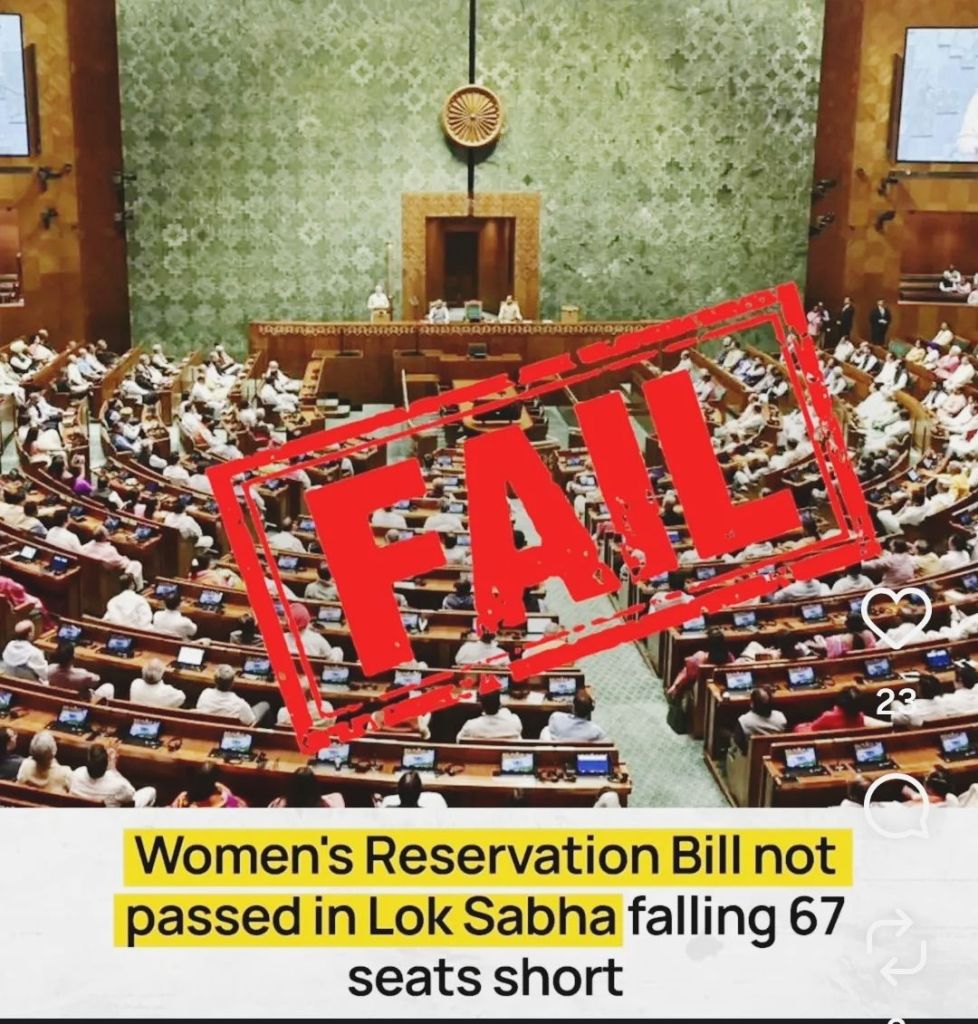
In the end, the House did not reject women’s empowerment. It rejected empowerment being used as camouflage for redrawing the Republic. India’s women have waited long enough. They do not need representation packaged as a constitutional puzzle with hidden clauses. If the political class truly believes in 33%, it should begin with the seats it already holds—not with an expansion designed to ensure the same incumbents return smiling, congratulating themselves for empowering women while quietly securing their own next term. That is not democracy evolving. That is democracy being reupholstered.
VISIT ARJASRIKANTH.IN FOR MORE INSIGHTS

