The silent crisis of fiscal federalism and the politics of survival over sustainability
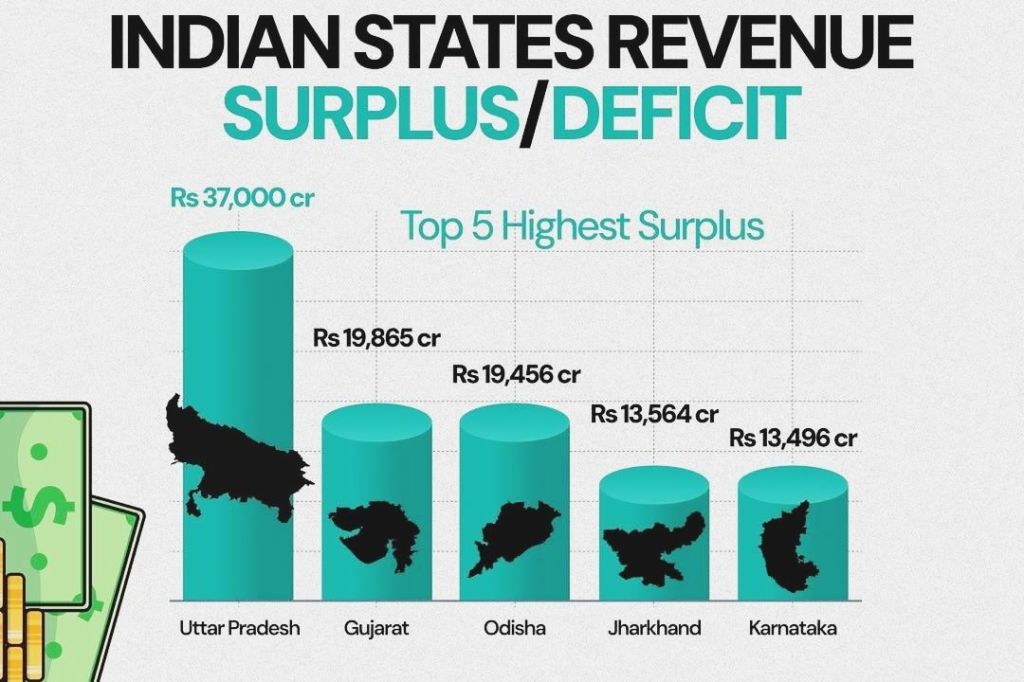
India’s latest report on state finances reads less like a spreadsheet and more like a fiscal thriller — a federation gasping for breath under the weight of its own promises. Beneath the reassuring macroeconomic calm lies a story of growing imbalance, where fiscal prudence is being quietly overpowered by political populism. The numbers tell the story with brutal clarity: India’s states are spending not to build their futures but to merely survive their present. The aggregate fiscal deficit of states has climbed from 2.6% of Gross State Domestic Product (GSDP) in 2023–24 to nearly 3% in 2024–25 — dangerously brushing against the Finance Commission’s upper ceiling. Yet this figure hides a far deeper crisis. Nearly 62% of states’ total revenue receipts in 2023–24 were consumed by salaries, pensions, interest payments, and subsidies.
Punjab, the stark outlier, spent an astonishing 107% of its revenue receipts on these heads — literally borrowing to pay salaries. Haryana followed with 71%. Across India, states together ran a revenue deficit of 0.4% of GSDP, signalling an alarming trend — governments are borrowing not to invest, but to operate.
The heart of the crisis lies in the uneasy marriage between economics and politics. Salaries and pensions are non-negotiable obligations, interest payments are legally binding, and subsidies are politically sacrosanct. Cutting any of these is electoral suicide. The latest wave of populism — notably, direct benefit transfers to women amounting to ₹1.68 lakh crore across twelve states — though socially progressive, has added enormous fiscal strain. Between 2015–16 and 2023–24, revenue expenditure surged by 27%, while capital outlay, the spending that builds roads, irrigation, and power infrastructure, grew by a meagre 7%. The equation is disastrous: states are spending heavily to maintain the machinery of governance while starving long-term investment. Each welfare announcement, however well-intentioned, chips away at fiscal sustainability. The irony is painful — empowerment schemes meant to lift people often erode the very fiscal base needed to sustain them.
But the problem is not only one of spending; it is structural. The introduction of the Goods and Services Tax (GST) in 2017 — hailed as a landmark reform — has unintentionally shackled state finances. Before GST, states enjoyed significant autonomy over taxation; they could tweak rates, structure levies, and mobilise their own resources.
Post-GST, those powers have been diluted under the collective framework of the GST Council. The share of GST in India’s GDP has fallen from 6.4% in 2015–16 to 5.5% in 2023–24, well short of the Finance Commission’s projected 7%. The fallout has been uneven. Richer states like Maharashtra, Gujarat, and Kerala still manage robust collections, while poorer states such as Bihar and Uttar Pradesh remain perennially dependent on central transfers. This imbalance has created a dual-speed India — one where the rich states are building ahead while the poorer ones are merely staying afloat. Fiscal federalism, once a model of cooperative strength, now risks becoming an instrument of competitive dependence.
To fill the investment vacuum, the Centre has stepped in with the Scheme for Special Assistance to States for Capital Investment (SASCI). Conceived in 2020–21 with a modest ₹12,000 crore, it has ballooned to ₹1.5 lakh crore in 2025–26, offering 50-year, interest-free loans to states for infrastructure. Today, nearly 20% of state capital expenditure is funded through this central lifeline. Yet, what began as assistance has increasingly become oversight. The share of unconditional funds under SASCI has plunged from 80% in 2022–23 to just 38% in 2025–26, with most allocations now tied to centrally dictated conditions.
For north-eastern states, dependence is particularly acute — nearly 68% of their total revenue receipts flow from the Centre. Cooperative federalism, it appears, is quietly mutating into fiscal centralisation. States are left with diminishing choices, their autonomy traded for assistance, their budgets micromanaged by distant bureaucracies.
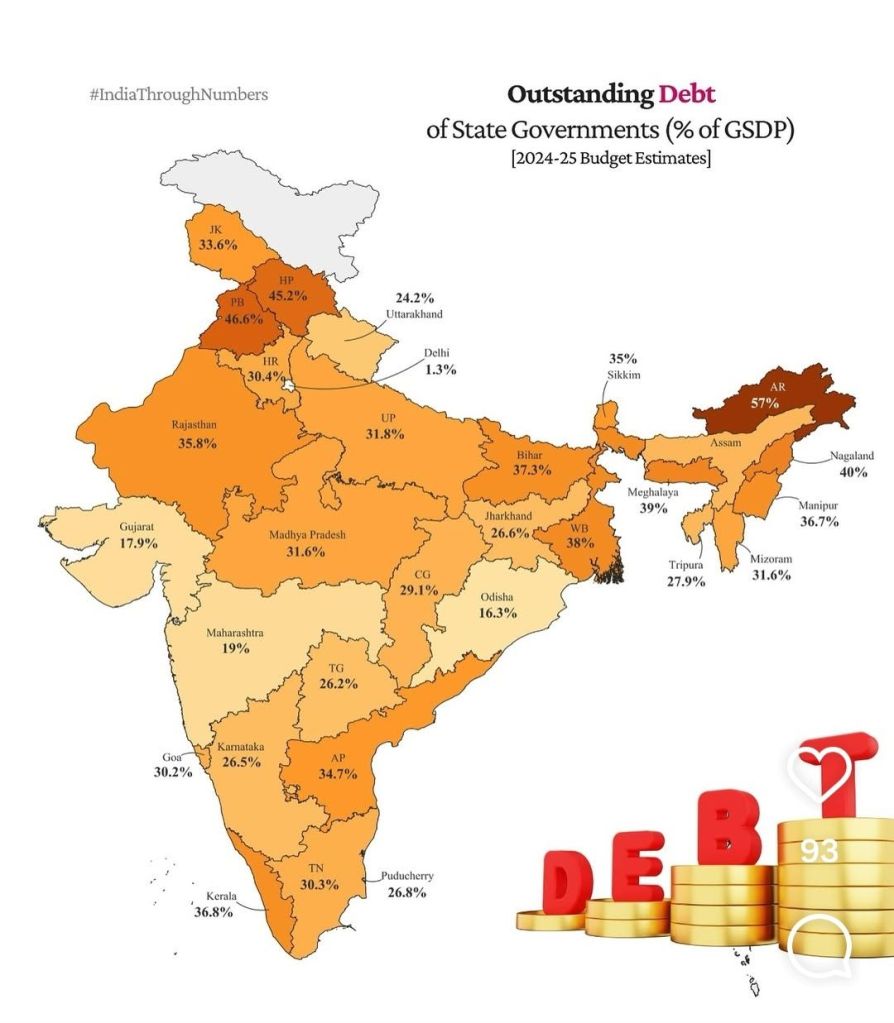
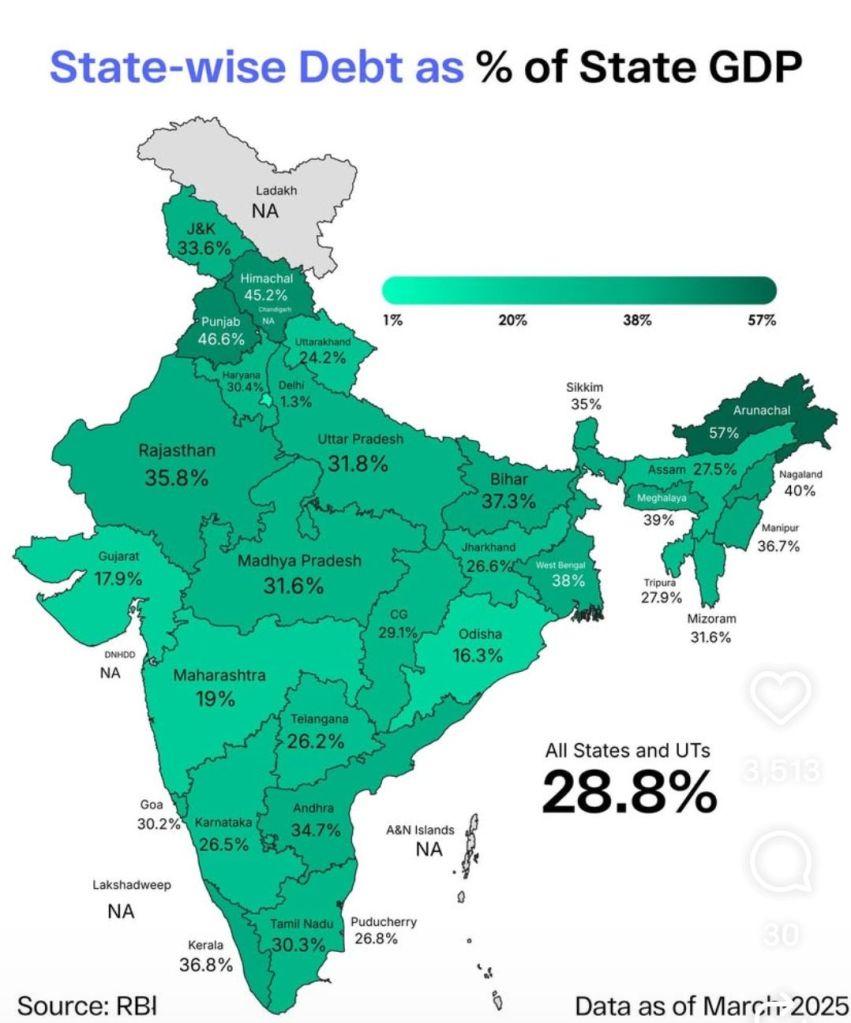
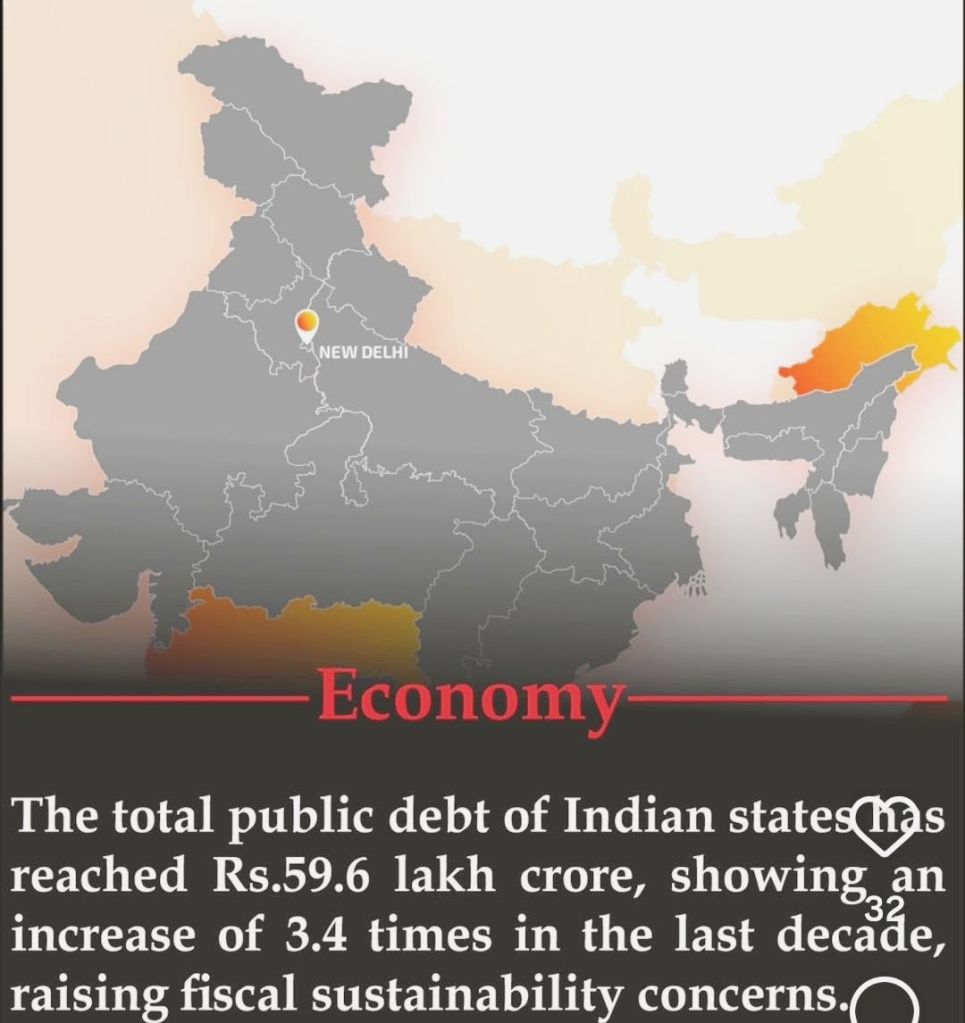
Meanwhile, a volcano brews beneath this fiscal landscape — debt. State debt now stands at 27.5% of GDP, far exceeding the Fiscal Responsibility and Budget Management (FRBM) Committee’s recommended cap of 20%. While fiscally disciplined states such as Gujarat, Maharashtra, and Odisha remain within safe bounds, several others — notably Punjab, Himachal Pradesh, and Arunachal Pradesh — are burdened with debt ratios exceeding twice the advisable level. Worse still are the hidden liabilities — state guarantees to loss-making public sector undertakings, particularly in the power sector. As of March 2024, these off-budget guarantees equalled 4.4% of GSDP. State electricity distribution companies (DISCOMs), perennially in crisis, lost ₹34,000 crore in 2023–24 and collectively owe ₹7.4 lakh crore. Each time these entities default, the liability rolls back to state treasuries. The fiscal volcano smoulders quietly, its eruption only a question of when.
India’s fiscal federalism now stands at a turning point. The GST unified the economy but diminished fiscal independence; central loans have accelerated capital investment but eroded autonomy. Yet, the way forward is not retreat but reform. States must strengthen their own revenue generation through digital tax tracking, better compliance, and improved valuation of property and excise.
Expenditure must shift from universal subsidies to smart, targeted support using data platforms like the JAM trinity — Jan Dhan, Aadhaar, and Mobile. Most critically, each state should implement its own Fiscal Responsibility Framework, ensuring that every borrowed rupee funds productive investment, not political promises. India’s states are not bankrupt, but they are bending under the pressure of expectations they can no longer afford. The coming decade will test not their ability to spend, but their will to choose wisely. For in the end, balancing the books will demand more than arithmetic — it will demand political courage.
Visit arjasrikanth.in for more insights

