
Once the city of speed and start-ups, Hyderabad now performs a daily drama of fumes, fury, and frayed patience — where progress idles in first gear.
Once the city of speed and startups, Hyderabad now crawls at a painful 31 minutes per 10 kilometers — throttled by 9 million vehicles, cratered roads, and civic chaos. The tech capital of dreams has turned into an asphalt jungle where ambition idles in first gear, and the melody of progress has been replaced by an orchestra of horns, fumes, and frayed nerves.
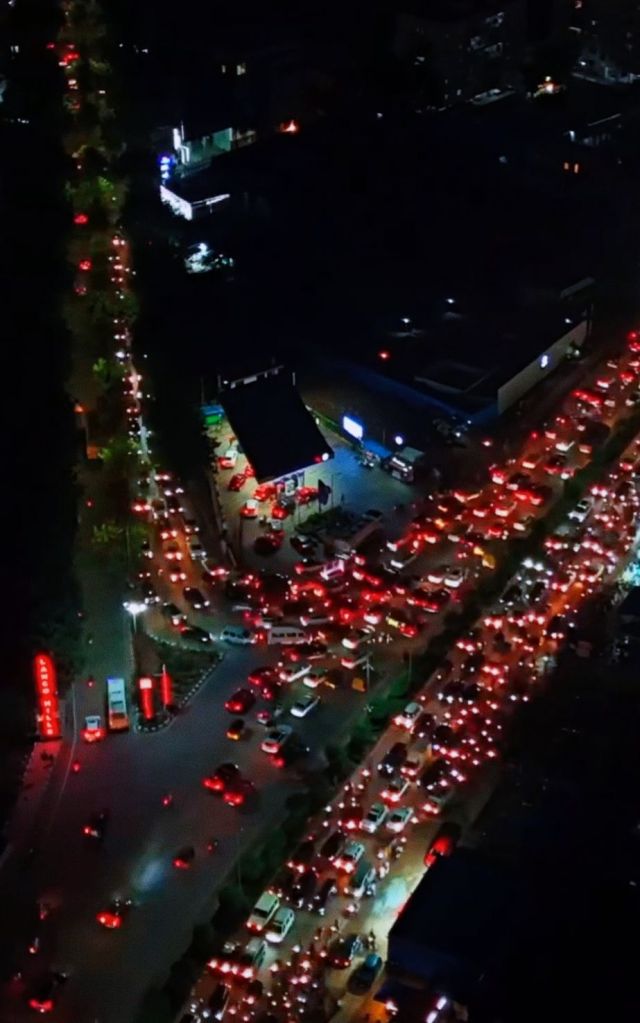
Hyderabad, once hailed as India’s tech-fueled powerhouse, now feels less like a city on the move and more like one permanently stuck in first gear. What used to be a brisk, breezy commute through its wide boulevards has mutated into an urban endurance test — a slow crawl through a maze of flashing headlights, blaring horns, and restless drivers. The city that built global IT dreams is now battling its own asphalt nightmare, a tragic reflection of how India’s urban ambition has raced far ahead of its infrastructure.
With a congestion level of 54%, Hyderabad now rubs shoulders with the most gridlocked metropolises — Bengaluru at 64%, Pune at 62%, Delhi at 60%, and Mumbai at 59%. The average travel time of 31 minutes to cover just 10 kilometres tells a story of paralysis. Once-glamorous corridors like Hi-Tech City, Madhapur, and Banjara Hills have become traffic trenches, symbolizing not prosperity but exhaustion. The very roads that once connected innovation to opportunity now connect frustration to fatigue.

The statistics are as suffocating as the traffic itself. With over 9 million registered vehicles — and nearly 2,000 more joining the fleet every single day — Hyderabad has become the densest traffic ecosystem in the country, with around 9,500 vehicles packed into every kilometre of its major roads. Two-wheelers form the army, 6.3 million strong, followed by 1.6 million cars, each one fighting for its patch of asphalt in a city never designed for this mechanical invasion.
But the problem isn’t just an overdose of wheels; it’s a deficit of wisdom. Chronic underinvestment and reactive planning have left the city’s road network gasping. Narrow lanes that once carried a fraction of today’s load now choke under pressure. Poor road geometry — like the infamous Yashoda Hospital–Chaderghat stretch — adds to the chaos. Illegal parking, rampant encroachments, and the casual disdain for traffic signals have turned even structured junctions into arenas of anarchy. Add to this the perpetual presence of barricades, diversions, and half-finished flyovers, and Hyderabad’s roads resemble a battlefield between metal and patience.
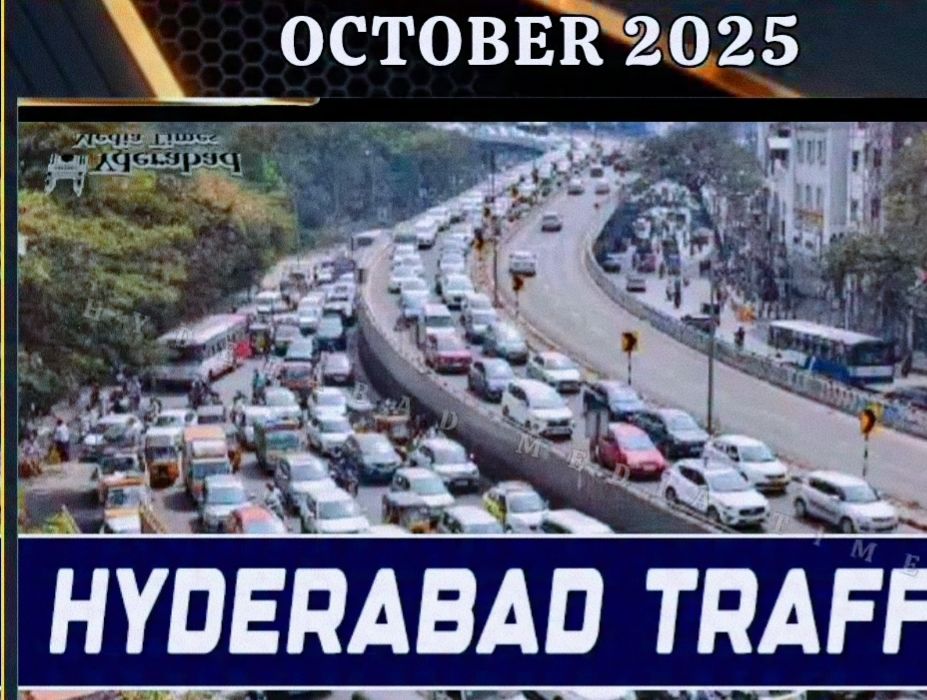
Behind this mechanical mayhem lies a deeper administrative ailment — the absence of a unified mobility master plan. The GHMC, RTO, and Traffic Police all operate in splendid isolation, each solving a fragment of a puzzle without seeing the whole picture. Some zones have state-of-the-art sensor-driven signals; others still depend on manual whistle control. The much-touted Adaptive Traffic Control Systems (ATCS), designed to optimize traffic flow, often function erratically due to software mismatches and patchy coverage — a technological symphony hopelessly out of tune.
Yet, in this fog of frustration, flickers of hope do exist. The Hyderabad Traffic Integrated Management System (HTRIMS) — a locally developed innovation — has begun orchestrating some order amid the chaos. By synchronizing signals and creating “green waves” across major corridors, it has already improved average speeds by over 30%. The system is now evolving into an AI-powered platform capable of predicting congestion, rerouting vehicles, and even prioritizing emergency transport. It’s the digital brain Hyderabad desperately needs, though the body — the urban fabric itself — still resists cooperation.
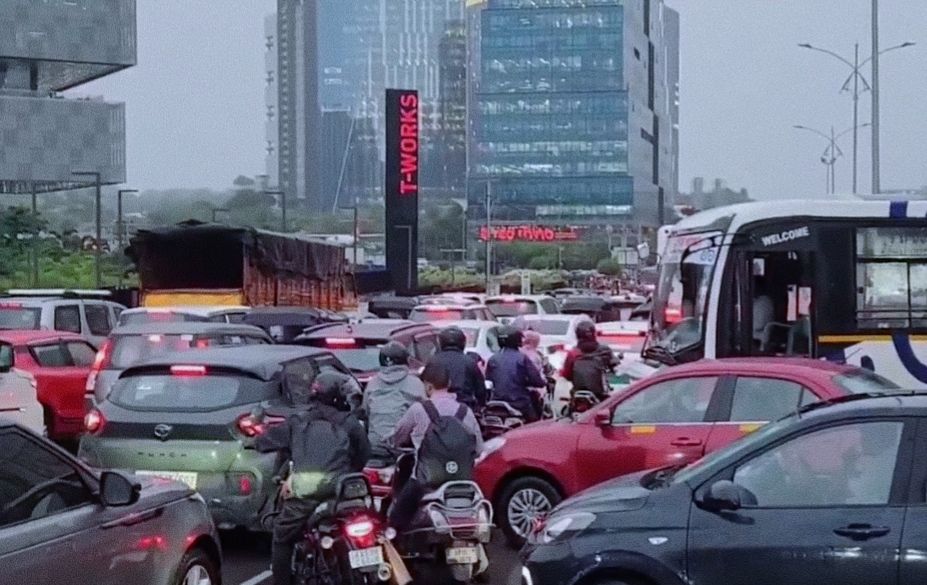
Because technology can only do so much when behaviour is the real bottleneck. Hyderabad’s traffic is as much a social dysfunction as it is a civic one — a reflection of a culture that prizes personal convenience over collective discipline. Without consistent enforcement, even the smartest systems collapse. The city needs a zero-tolerance approach to illegal parking, encroachments, and habitual traffic offenders. Harsher fines, public penalties, and restrictions on multiple-vehicle ownership could turn deterrence from theory into practice.
Equally vital is a total rethink of public transport. The mantra must shift from moving cars to moving people. Hyderabad must invest in expanding its metro lines, increasing the TSRTC bus fleet, and ensuring reliable last-mile connectivity through shared mobility and cycling lanes. Mumbai’s suburban trains didn’t just move passengers — they moved a city’s pulse. Hyderabad needs its own version of that collective heartbeat if it hopes to breathe again.

For the long term, the city’s arteries need widening and redesigning. Smarter junctions, reversible lanes on corridors like Begumpet, and dedicated tracks for buses and two-wheelers can restore order. The completion of the Outer Ring Road, expansion of flyovers, and creation of peripheral corridors must be viewed not as vanity projects but as lifelines of survival. Urban planning must finally recognize that mobility is not a luxury — it’s the heartbeat of urban existence.
Hyderabad’s traffic chaos is, in essence, the mirror of its meteoric rise — a city that sprinted toward success without pacing itself for sustainability. Its gridlocked roads are metaphors for modern India itself: ambition without alignment, growth without governance, innovation without introspection.

But redemption is still possible. If Hyderabad can blend data-driven planning with disciplined citizenship and cohesive governance, it can once again find its rhythm — the rhythm that once made it dynamic, dazzling, and distinct. Until that day, the soundtrack of the city remains the same: engines revving, tempers flaring, horns blaring — and millions of commuters performing in Hyderabad’s grandest tragedy, The Traffic Opera, where everyone plays a part, but no one wants an encore.
Visit arjasrikanth.in for more insights
 SOCIAL PERSPECTIVES
3 responses to “🚗💥 Clutch, Brake, Repeat: Hyderabad Stalled Its Own Dream ”
A well described piece highlighting Hyderabad’s growing traffic chaos. Rightly captures how rapid development has outpaced infrastructure, urging the need for smart and sustainable transport solutions.
LikeLike
Kudos to the author for raising such a useful and appropriate topic for discussion. Need of the hour, use the younger minds in IIIT and IITs to use their technical knowledge and reward them for their ideas to develop a sustainable model for traffic.. and infrastructure maintenance and planning by the authorities for transport and mobility of citizens should be taken as priority and penalties should be used not to fill the traffic police coffers but to mend the law breaking citizens to fall in line..
Dr Kiran Kumar Vallam
LikeLike
this is a great problem in all metro cities. Responsible authorities are not bothered to look into this as they are always busy in their own financial growth
LikeLike