On the birth anniversary of Smt. Chandana Khan, IAS, I remember with profound respect, affection and gratitude an exceptional civil servant whose innovative and visionary initiatives helped transform the tourism and cultural landscape of united Andhra Pradesh. I had the privilege of working with her as Additional Secretary and Commissioner of Culture, and witnessed her administrative ability, artistic sensibility and commitment to public service at close quarters. Remembering her is more than commemorating an illustrious career; it is a personal tribute to a colleague whose vision, encouragement and professional example left a lasting impression on me. Her work demonstrated that when imagination is joined to administrative resolve, governance can create institutions that enrich society for generations.
As Special Chief Secretary handling Tourism, Youth Advancement and Culture, she worked in close alignment with the developmental vision of then Chief Minister Shri N. Chandrababu Naidu. During the Vision 2020 period, Hyderabad was emerging as an international destination for information technology, investment and business. She recognised that this transformation would remain incomplete without corresponding investment in tourism, entertainment and cultural infrastructure. Her achievement was to translate a broad developmental ambition into tangible public assets through innovative planning, institutional partnerships and determined execution. An accomplished painter, sculptor trained at Santiniketan and poet, she brought a rare creative perspective to governance. Tourism, in her understanding, was not merely about attracting visitors; it could shape experiences, reinforce identity, generate livelihoods and improve urban life.
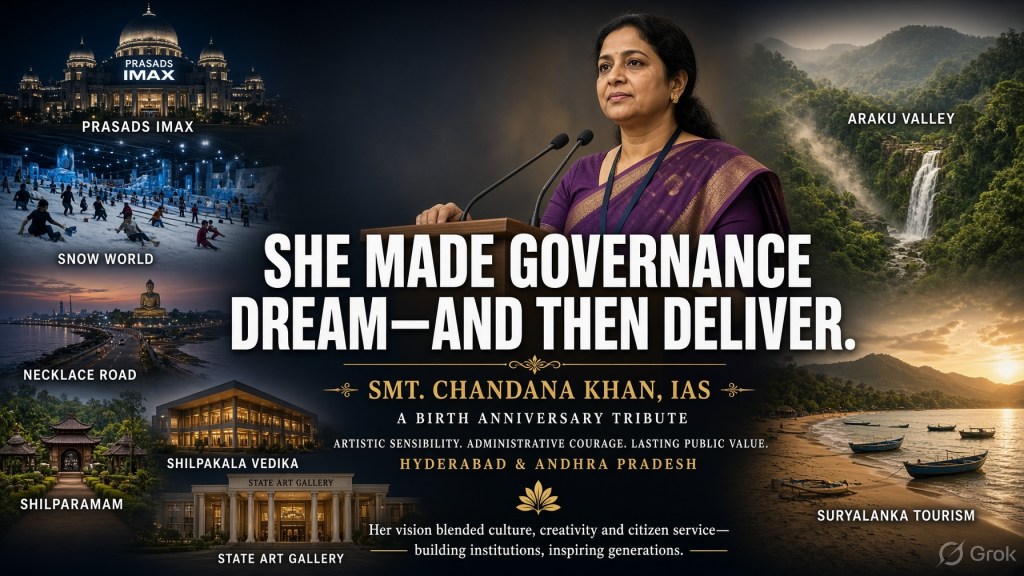
Her contribution to Hyderabad’s urban transformation was particularly significant. Initiatives associated with her stewardship included Prasads IMAX, Central Mall, Snow World and the Necklace Road waterfront. These developments helped turn the Hussain Sagar surroundings into a lively recreational destination, combining entertainment, leisure and public spaces. Prasads IMAX introduced large-format cinematic entertainment, while Snow World offered a distinctive recreational experience. Necklace Road enhanced the waterfront with promenades and leisure facilities. Together, these projects broadened Hyderabad’s appeal to residents, domestic visitors, tourists and business travellers. They also stimulated activity across hospitality, retail, entertainment and employment. The underlying insight was progressive: cities must not simply accommodate economic growth; they must offer attractive, accessible and enjoyable places in which people can live, gather and participate.
Her commitment to culture was equally enduring. Shilparamam, Shilpakala Vedika and the State Art Gallery exemplify the cultural infrastructure associated with her vision. Shilparamam strengthened links between traditional artisans and urban markets; Shilpakala Vedika provided a platform for performances, conferences and public events; and the State Art Gallery supported visual arts and contemporary expression. These institutions helped bring folk artists, craftspeople, classical performers and contemporary creators into Hyderabad’s public life. As Commissioner of Culture, I had the privilege of working within this institutional environment and seeing her conviction that culture required permanent platforms, not occasional celebrations. Her appreciation of Cheriyal scroll painting, Nirmal paintings and Kalamkari reflected a deeper understanding: heritage is not merely an inheritance to preserve, but a living resource that sustains livelihoods, strengthens identity and inspires new generations.
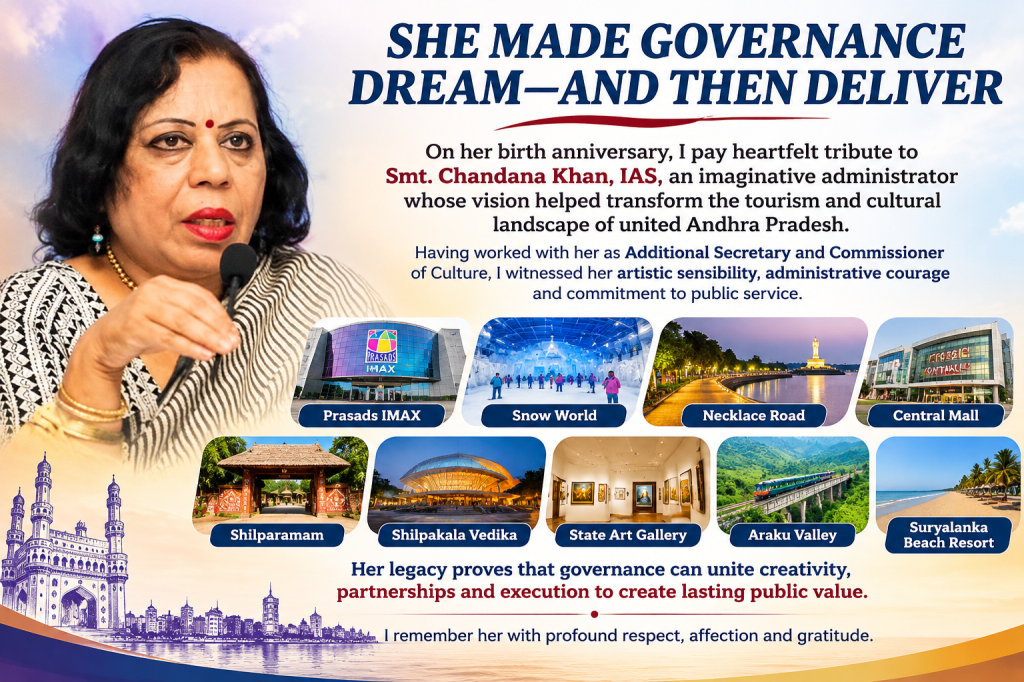
Her vision extended beyond Hyderabad. She recognised that tourism development had to engage the varied regions of united Andhra Pradesh, including its tribal, ecological and coastal destinations. Initiatives associated with her leadership included the Araku Valley tourism circuit and Suryalanka Beach Resort at Bapatla. Araku offered opportunities for nature-based tourism and the promotion of tribal culture; Suryalanka demonstrated the potential of structured coastal tourism infrastructure. Such geographic diversification mattered in a State endowed with distinctive landscapes, natural resources and cultural traditions. Tourism could become an instrument of balanced development, connecting communities with visitors, markets and economic opportunities. Her support for civic participation through initiatives such as the Hyderabad 10K Run and marathon further revealed her ability to connect urban development with public engagement, fitness and wider visibility.
What distinguished her administrative style was the convergence of creative thinking, proactive execution and institutional purpose. She recognised that public resources alone could not deliver every ambitious tourism asset and that private investment, appropriately structured, could complement public objectives. Her approach to public-private partnerships helped bring private capital and professional expertise into tourism and entertainment projects. Yet she understood that success required more than financial viability: it also demanded aesthetic sensitivity, cultural authenticity and attention to visitor experience. Having worked with her, I remember her ability to combine conceptual clarity with practical determination. She encouraged officers to look beyond routine, identify possibilities and pursue implementation with commitment. Her example underscored collaboration, field-level accountability and institutional continuity—lessons vital wherever outcomes depend on government, enterprise and cultural communities working together.
The lasting relevance of her contribution is visible in the institutions and infrastructure that continue to shape Hyderabad’s identity and Andhra Pradesh’s tourism landscape. The finest achievements of administration are not measured only by expenditure or completed projects, but by opportunities created, institutions strengthened, heritage sustained and public experiences improved. On her birth anniversary, I reflect with gratitude on the privilege of working alongside her during a formative phase of united Andhra Pradesh’s cultural and tourism development. I remember not only her achievements but also the inspiration of an administrator who brought creativity, initiative and deep respect for heritage into public service. Her life reminds us that governance can be purposeful and imaginative, and that visionary leadership can convert developmental aspirations into lasting public value.
I offer my respectful homage to Smt. Chandana Khan, IAS, with deep affection, admiration and gratitude. Her legacy is not confined to a list of projects; it lives in cultural platforms that nurture artists, public spaces that welcome citizens and possibilities opened for tourism and regional development. For civil servants, her example remains a compelling lesson in seeing beyond files and procedures without losing sight of implementation. She showed that public administration can make room for beauty, culture and civic joy while remaining disciplined, accountable and outcome-oriented. Her innovative initiatives will continue to inspire generations of administrators, and her contribution to Andhra Pradesh will endure as a testament to the transformative power of imagination in public service.
VST ARJASRIKANTH.IN FOR MORE INSIGHTS

