The coordinated intervention to rescue the Japanese yen in late July and early August 2026 was not merely another foreign exchange operation; it was a dramatic confession about the changing hierarchy of global finance. When Japan and the United States jointly entered currency markets for the first time in more than a decade, the world witnessed a rare moment of monetary cooperation between two economic giants. Beneath the headlines of yen purchases and market stabilization was a deeper message: major currencies are increasingly struggling against the overwhelming gravitational force of the US dollar. The episode revealed a fundamental transformation in global finance—currency markets are no longer simply reflecting economic strength; they are reflecting a worldwide shortage of confidence in alternatives to the dollar.

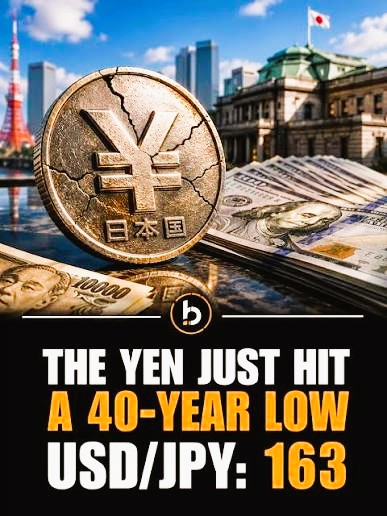
The crisis unfolded when the yen weakened dramatically toward nearly 164 per US dollar, reaching levels unseen in four decades. The Bank of Japan reportedly deployed nearly $59 billion to purchase yen, while the involvement of the US Treasury added an extraordinary geopolitical dimension. Rather than directly selling dollars, the United States reportedly used euro holdings to fund yen purchases, avoiding disruption to US Treasury markets while supporting its strategic partner. The intervention produced an immediate psychological shock, strengthening the yen by almost 5 percent and forcing investors to reconsider aggressive speculative positions. However, the temporary recovery also demonstrated a harsh reality: central banks can influence currency movements, but they cannot permanently override global economic forces.
The most revealing aspect of the yen crisis was the vulnerability created by the global carry trade. For years, investors borrowed in low-interest-rate yen and invested in higher-yielding US assets, exploiting the enormous interest-rate gap between Japan and America. This strategy generated massive profits during periods of currency stability but created a fragile financial structure dependent on a continuously weak yen. Once intervention triggered a sharp currency reversal, investors rushed to close positions, creating a powerful wave of yen buying. The episode demonstrated how modern currency markets are increasingly controlled by leveraged global capital flows rather than traditional economic indicators alone. A single policy announcement can now trigger billions of dollars of rapid repositioning across continents.

The yen’s weakness also represents a broader crisis affecting major currencies. The Japanese currency, once regarded as one of the world’s safest assets, has gradually lost its traditional strength due to demographic pressures, prolonged monetary easing, and Japan’s dependence on imported energy. The euro faces its own structural challenges, including fragmented fiscal policy and incomplete financial integration among member states. Commodity-linked currencies remain exposed to fluctuations in global resource prices, while even the Swiss franc faces limitations due to the scale of Switzerland’s economy. Across the world, central banks are discovering that maintaining currency stability requires increasingly larger reserves, sophisticated interventions, and international coordination.
The extraordinary strength of the US dollar, however, is not simply a reflection of American economic dominance. It is equally a consequence of the weakness and limitations of competing currencies. The dollar benefits from unmatched advantages: the world’s deepest financial markets, enormous liquidity, reserve currency status, strong institutional credibility, and the global demand for US Treasury securities. Even when the United States faces economic uncertainty, investors often move towards the dollar because alternatives appear less reliable. The dollar’s supremacy is therefore not only a story of American power—it is also a story of global monetary fragmentation and the absence of a credible replacement.
The consequences of currency instability extend far beyond Japan. A sharply weaker yen creates competitive pressure on Asian exporters such as South Korea and China, potentially encouraging defensive currency adjustments across the region. Such movements can trigger a cycle of competitive depreciation, where countries attempt to protect exports by allowing their currencies to weaken. This creates complications for inflation management, trade relationships, and financial stability. The United States’ decision to participate in the intervention was therefore not merely an act of alliance support; it was also a strategic attempt to prevent disorderly currency movements from damaging global markets and destabilizing the international economic system.
India’s experience provides an important contrast in managing currency pressure. The rupee remains exposed to global dollar strength, crude oil prices, and international capital movements. However, the Reserve Bank of India has adopted a measured approach through foreign exchange reserve accumulation, calibrated market intervention, and prudent monetary management. Instead of relying only on crisis-time responses, India has gradually built financial buffers that provide greater stability during global shocks. The Indian approach demonstrates that currency resilience is not created by defending a particular exchange rate but by strengthening economic fundamentals, maintaining investor confidence, and ensuring institutional credibility.
Ultimately, the yen rescue should be viewed not simply as a successful market intervention but as a warning signal about the future of global monetary competition. Currency strength cannot be manufactured indefinitely through foreign exchange operations. Long-term stability depends on productivity, fiscal discipline, technological leadership, energy security, and confidence in institutions. While discussions around digital currencies, alternative payment systems, and diversified reserve assets suggest a gradual evolution of the monetary order, the dollar remains dominant because the world has not yet found a convincing alternative. The silent currency war unfolding today is therefore not merely about exchange rates—it is a struggle for economic credibility. Nations that build trust, resilience, and competitiveness will define the next era of global financial power.
VISIT ARJASRIKANTH.IN FOR MORE INSIGHTS

