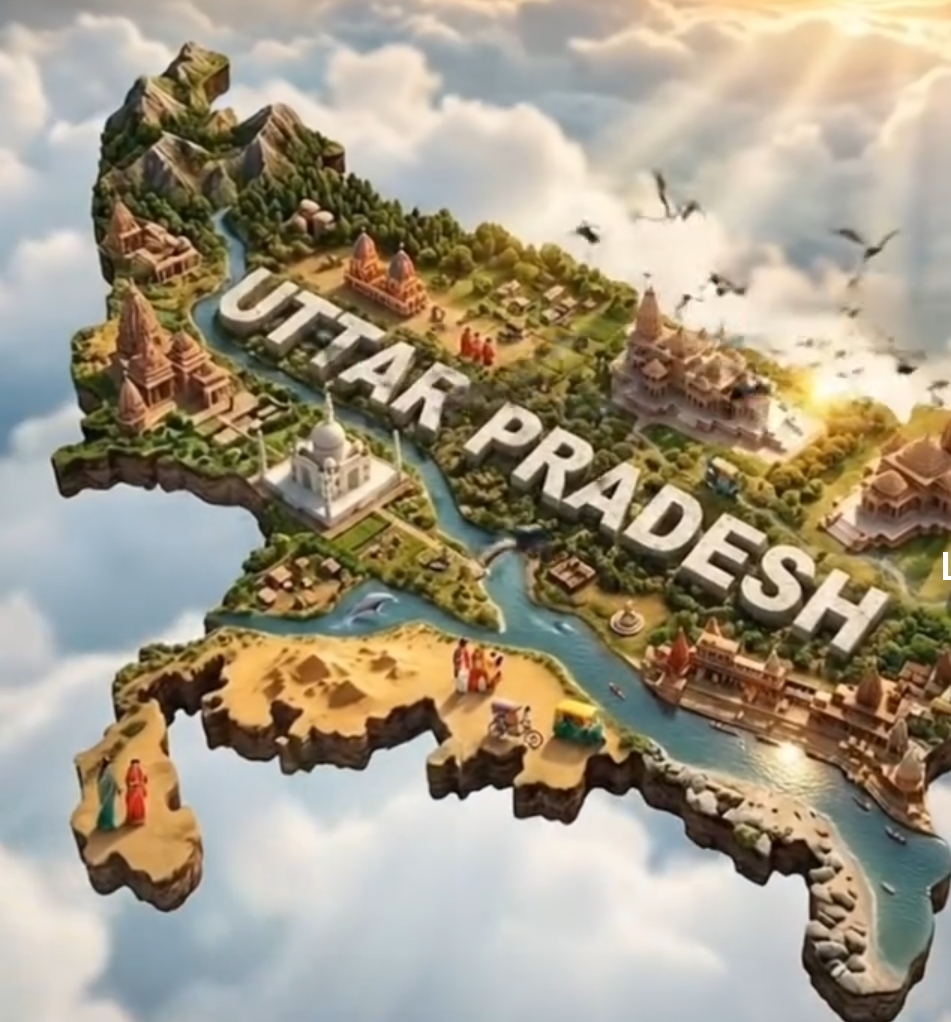
India has never treated its internal borders as sacred scripture. The Republic has repeatedly redrawn its own map—splitting, carving, and reorganizing states whenever governance demanded a new administrative logic. From the bifurcation of Madhya Pradesh and Bihar to the creation of Uttarakhand and the division of Andhra Pradesh, India has demonstrated that state boundaries are tools, not temples. Yet one anomaly stands out like a constitutional paradox that refuses to resolve itself: Uttar Pradesh, the most populous sub-national unit on the planet outside a nation-state, remains intact. It is politically oversized, administratively stretched, and economically uneven, but still undivided. The question today is no longer whether UP is governable as one unit. The sharper question is whether India can afford not to restructure it—especially as the next delimitation threatens to turn UP into an electoral superpower capable of tilting India’s federal balance permanently.
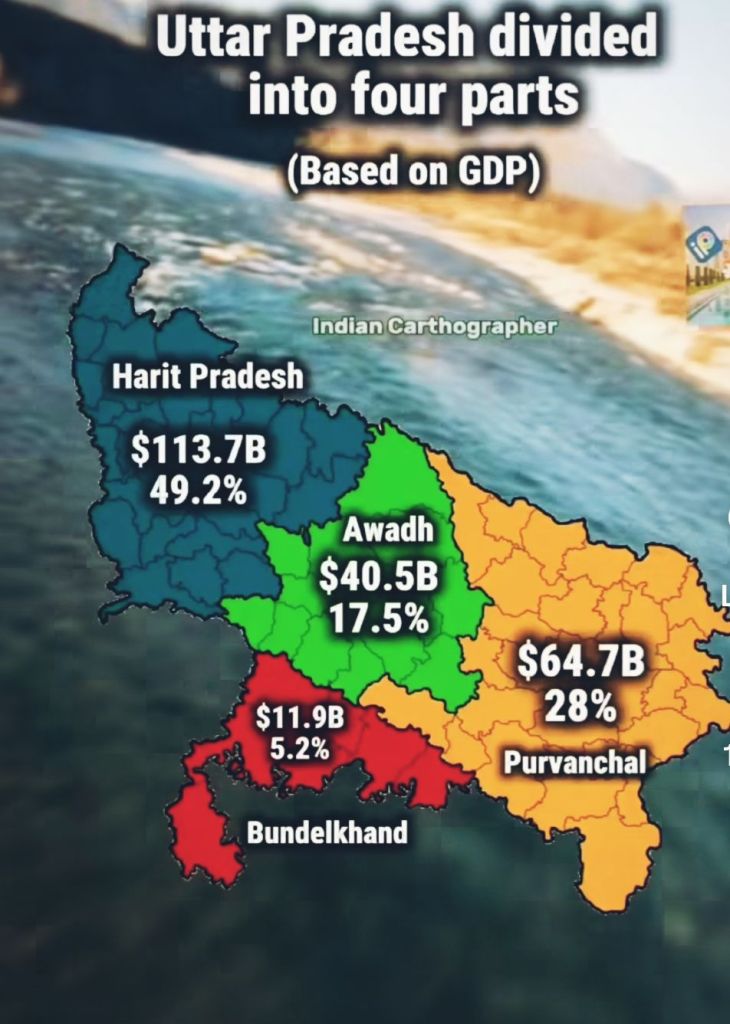
Uttar Pradesh is not merely a state; it is a demographic empire. With a population exceeding 240 million, it is larger than most nations represented in the United Nations. It is often called “Mini India,” a phrase that functions as both praise and political armor. Supporters of the status quo argue that UP’s diversity makes it a natural microcosm of the Union and that breaking it could be interpreted as weakening national unity. But the “Mini India” narrative hides a blunt administrative truth: governance from Lucknow becomes distant governance for vast parts of the state. When a political unit becomes too large, its capital becomes a remote planet. Villages in Bundelkhand and Purvanchal do not merely feel neglected—they experience the state itself as a bureaucratic abstraction. In such a structure, development becomes episodic, politically selective, and structurally slow.
At the same time, the romantic belief that state bifurcation automatically produces prosperity is intellectually shallow. Economic evidence is sobering. Research has repeatedly shown that division is not a miracle machine. Uttarakhand performed relatively well, but that success was linked to geography, strategic investment flows, and policy advantages—not merely the act of separation. Madhya Pradesh faced an initial slowdown after Chhattisgarh was carved out. The uncomfortable truth is that growth depends more on governance quality, institutional discipline, and leadership competence than on the number of states. A new boundary does not automatically create new accountability. It can sometimes simply change the postal address of failure.
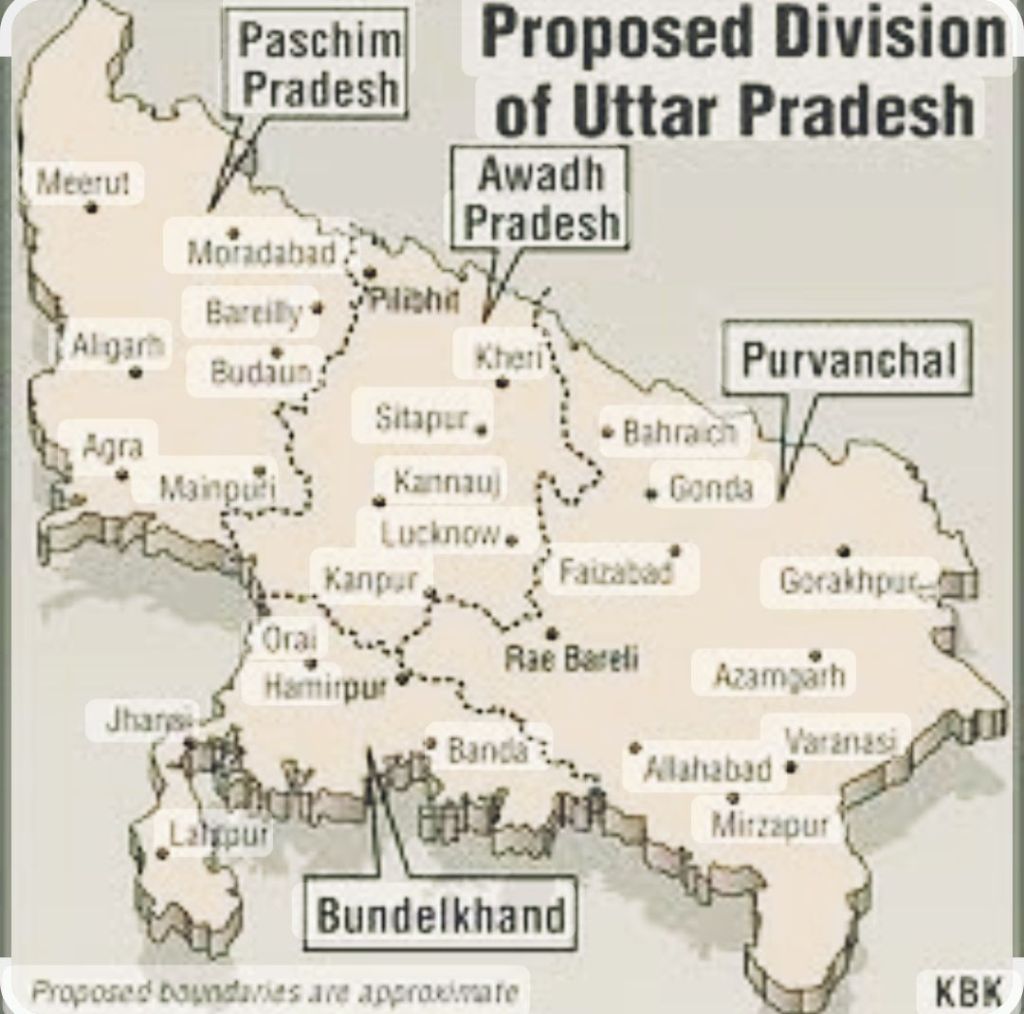
So why has UP not been divided despite recurring demands for Purvanchal, Bundelkhand, and Harit Pradesh? The answer is not constitutional complexity. Article 3 gives Parliament sweeping authority to create new states. A state assembly may offer its opinion, but it does not have a veto. In theory, UP could be divided tomorrow through parliamentary arithmetic. In practice, the obstacle is political consensus. There is no unstoppable mass movement cutting across all regions. The demands rise like seasonal storms and dissolve into electoral bargaining. Politicians invoke bifurcation as rhetoric but hesitate to execute it because UP’s sheer political weight is useful. In India, governance is not only about efficiency—it is also about arithmetic. And that arithmetic is about to explode.
The coming delimitation exercise, expected after the first census conducted post-2026, is not a routine rearrangement of constituencies. It is a democratic earthquake waiting to happen. UP currently holds 80 Lok Sabha seats—the single largest bloc in Parliament. If the total seats in Parliament expand significantly, UP could potentially climb toward 110–120 seats. Meanwhile, several southern states may witness far smaller gains. This is not just redistribution; it is the re-engineering of India’s political gravity. A federal democracy does not collapse when one region gains representation—it collapses when other regions begin to feel structurally irrelevant.
This is where the North–South fault line becomes more than a political slogan. Southern states invested heavily in population control, education, and health, and succeeded. Their reward, paradoxically, may be a reduced voice in national decision-making. The message becomes perverse: those who controlled population growth lose influence, while those who did not gain dominance. This is not an insult to UP; it is a structural challenge for the Union. A democracy must represent people, but a federation must also preserve balance. When one state becomes overwhelmingly dominant, it begins to resemble a “state within the state,” shaping national policy disproportionately. The risk is not UP’s growth—it is the political perception of imbalance that can generate long-term federal resentment.
Those who casually demand bifurcation of UP into multiple states underestimate the complexity of the surgery. The biggest challenge is not drawing lines but dividing capitals, assets, bureaucracies, and natural resources. Water disputes could erupt along the Ganga-Yamuna belt. Bundelkhand will raise legitimate questions about drought funding and irrigation priorities. Mineral and industrial belts could become contested zones. India has already witnessed such complications after state creation elsewhere. Administrative division creates new institutions, but it also creates new rivalries. Every new state becomes a new negotiation table, and negotiation tables do not disappear—they become permanent friction points.
There is also a hidden political cost that bifurcation enthusiasts ignore: UP’s current bargaining power. Eighty MPs give Uttar Pradesh unmatched leverage in central allocations, railway projects, national attention, and ministerial weight. If UP is broken into four smaller states, each will lose that collective leverage. Ironically, division could weaken the very regions demanding autonomy by reducing their ability to negotiate with Delhi. The state might become administratively smaller but politically fragmented. In India’s competitive federalism, size often translates into negotiating strength.
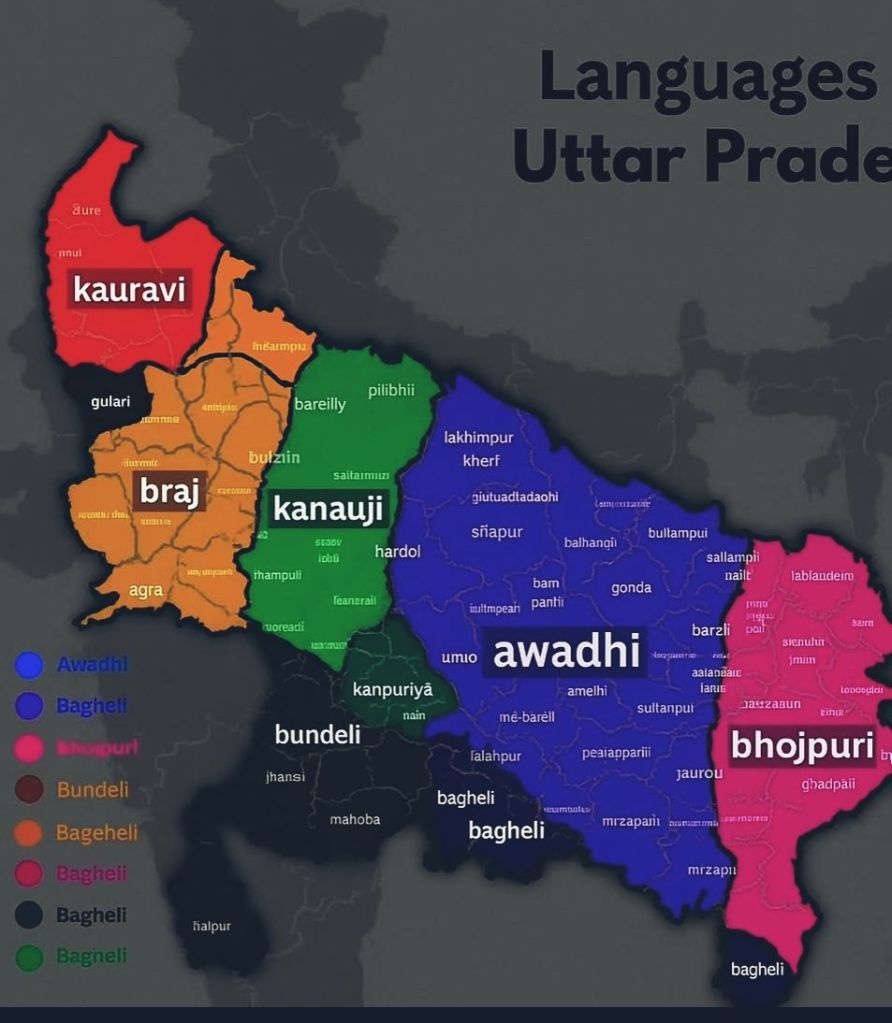
Therefore, India needs a smarter path—one that improves governance without triggering border chaos. A hybrid model of decentralization can deliver the benefits of bifurcation without the trauma of redrawing maps. Germany offers a useful analogy: certain metropolitan regions span multiple states but operate through joint governance bodies. India can build empowered Regional Development Councils for Purvanchal, Bundelkhand, and Western UP with real executive authority over infrastructure, health, education, and industrial planning. Such councils must not be symbolic committees; they must be backed by budgets, timelines, and decision-making power.
Equally important is empowering local governance. Panchayats and urban bodies in UP often exist as weak extensions of the state government. If real fiscal autonomy and administrative authority are transferred downward, governance becomes local without changing borders. Villages do not need a new state name. They need functioning roads, drainage, schools, hospitals, and policing systems. The democratic unit that matters most is not the state—it is the citizen’s daily experience of governance.
Special Purpose Vehicles can also bypass bureaucratic paralysis. Industrial corridors, logistics clusters, and urban development projects in western UP or the Lucknow-Agra belt can be managed through professional SPVs with transparent funding and time-bound delivery. Instead of waiting for statehood, development can be engineered through administrative innovation. This is how modern states reduce friction: not by endlessly debating borders, but by redesigning governance mechanisms.
But decentralization is not only a technical idea—it is a political project. It requires leaders who can execute reforms, survive backlash, and defend federal balance without provoking unnecessary identity wars. The coming delimitation-driven India will require stabilizers—leaders capable of negotiating between regions, not exploiting divisions for applause. Because if southern India begins to feel politically disposable, the unity of the economic union will slowly corrode into bitterness. And if UP becomes too dominant in national arithmetic, India risks evolving into a federation of resentment rather than a federation of cooperation.
The future is not about breaking UP for dramatic headlines. It is about preventing India from becoming hostage to demographic concentration. Delimitation will redraw the political map regardless. Either India redesigns governance structures now through decentralization and regional empowerment, or it will enter an era where electoral arithmetic dominates national strategy.
The question, therefore, is not whether UP should be divided. The real question is whether India has the intellectual maturity and political leadership to manage UP’s coming dominance without destabilizing the federal equilibrium. Because national growth is not merely GDP expansion. National growth is balance. And balance is what keeps a Republic alive.
VISIT ARJASRIKANTH.IN FOR MORE INSIGHTS
 SOCIAL PERSPECTIVES