
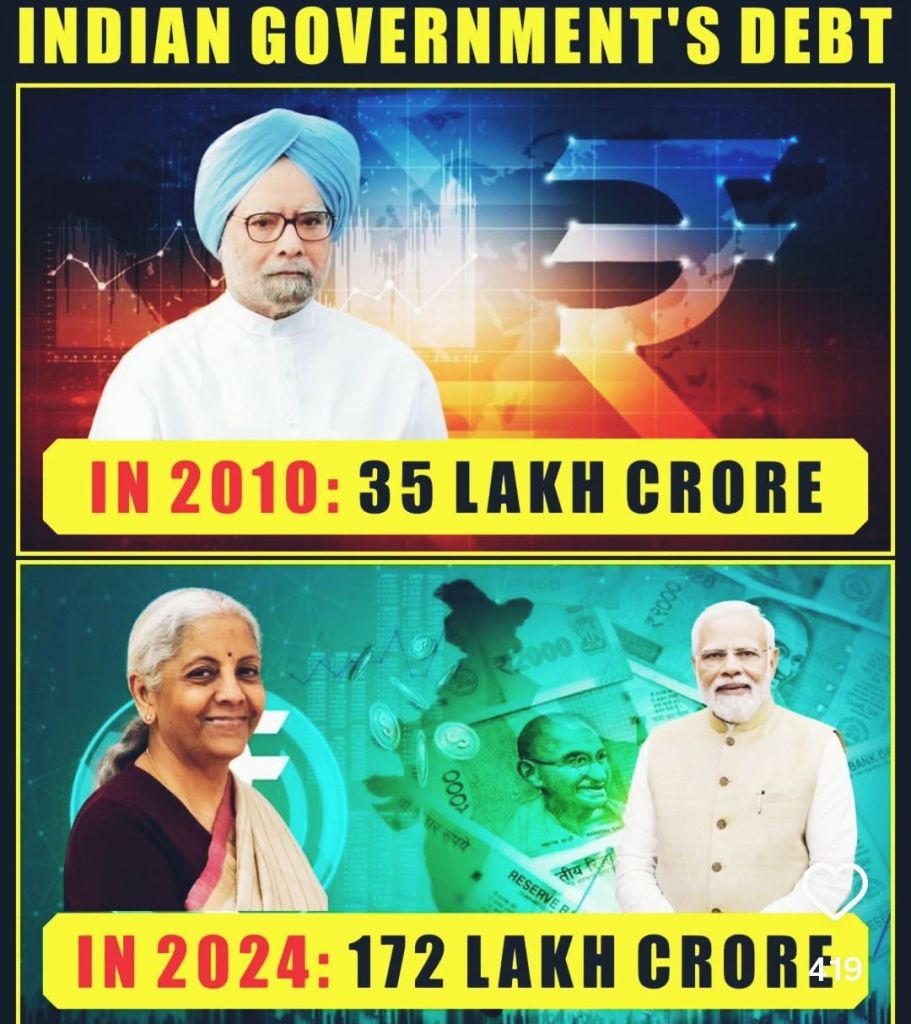
India’s public debt numbers are so vast that they often defy ordinary comprehension. Yet behind these staggering figures lies a story deeply connected to the financial lives of millions of citizens. Over the last few years, government borrowing has expanded dramatically. Between 2020–21 and 2024–25, the outstanding stock of central government securities surged from about ₹4.5 lakh crore to over ₹115 lakh crore, marking an increase of nearly 25 percent. According to Union Budget projections, the total central government debt may approach ₹200 lakh crore by the end of the current financial year, while the government plans to borrow around ₹17 lakh crore in the next fiscal cycle alone. These figures inevitably provoke a crucial question: who ultimately finances this enormous debt, and how does it affect the ordinary citizen whose savings sustain the financial system?

At first glance, the situation appears reassuring. When governments borrow heavily, investors usually demand higher interest rates as compensation for increased risk. Surprisingly, India has witnessed the opposite trend. Over the past two decades, interest rates on government borrowing have fallen from around 12 percent in 2000 to nearly 6 percent today. At the same time, the maturity profile of government debt has lengthened, with the share of ten-year bonds rising from roughly 25 percent to nearly 40 percent. In practical terms, the government is borrowing larger sums at cheaper rates and repaying them over longer periods. On the surface, this suggests strong investor confidence in India’s fiscal stability and economic prospects.

A closer examination, however, reveals a more complex reality. Studies of India’s government bond market indicate that only about 5 percent of public debt is held by genuinely voluntary investors who choose to lend purely on market considerations. The remaining 95 percent is largely absorbed by domestic financial institutions such as banks, insurance companies, pension funds, and provident funds. Many of these institutions operate under regulatory frameworks that encourage or require them to invest heavily in government securities. As a result, a substantial portion of the country’s financial savings is automatically channelled toward financing the state’s borrowing requirements.
Understanding this structure requires examining how governments normally fund deficits. One option is for the central bank to create money and purchase government debt, a method known as monetisation of deficits, which risks long-term inflation. India largely ended this practice in 1994 through an agreement between the Ministry of Finance and the Reserve Bank of India. Another model is a fully market-based system where private investors—domestic and foreign—decide whether to lend based on risk and return. Such systems impose fiscal discipline because reckless borrowing pushes interest rates upward. India’s approach lies somewhere between these two models, relying heavily on regulated financial institutions whose investment decisions are partly shaped by policy mandates.
This framework effectively creates what economists describe as financial repression, where the domestic financial system becomes a stable funding source for government borrowing. Banks, for example, must maintain a Statutory Liquidity Ratio (SLR), requiring them to hold a portion of their assets in government securities. Although this requirement has declined from about 33 percent in the late 1980s to around 18 percent today, other institutions have gradually filled the gap.
Insurance companies and pension funds together now hold nearly 40 percent of government securities, up from about a quarter two decades ago, while the Reserve Bank of India itself holds roughly 11 percent. In essence, India’s financial architecture ensures that a large share of national savings finds its way into government bonds.
For the ordinary citizen, this arrangement carries subtle but important implications. A significant portion of money deposited in banks, provident funds, pension schemes, or life-insurance policies is indirectly invested in government securities. When individuals believe they are saving for retirement or financial security, part of those funds is effectively financing public borrowing. Government bonds are generally considered safe investments, but if financial institutions are compelled to hold them in large quantities, competitive market forces that normally determine interest rates become weaker. In such a system, India’s massive public borrowing may operate as an “invisible tax” on savings, quietly mobilising household wealth to sustain government finances. Thus, the towering structure of India’s ₹200-lakh-crore debt ultimately rests not only on fiscal policy but also on the savings habits of millions of citizens.
VISIT ARJASRIKANTH.IN FOR MORE INSIGHTS
 SOCIAL PERSPECTIVES