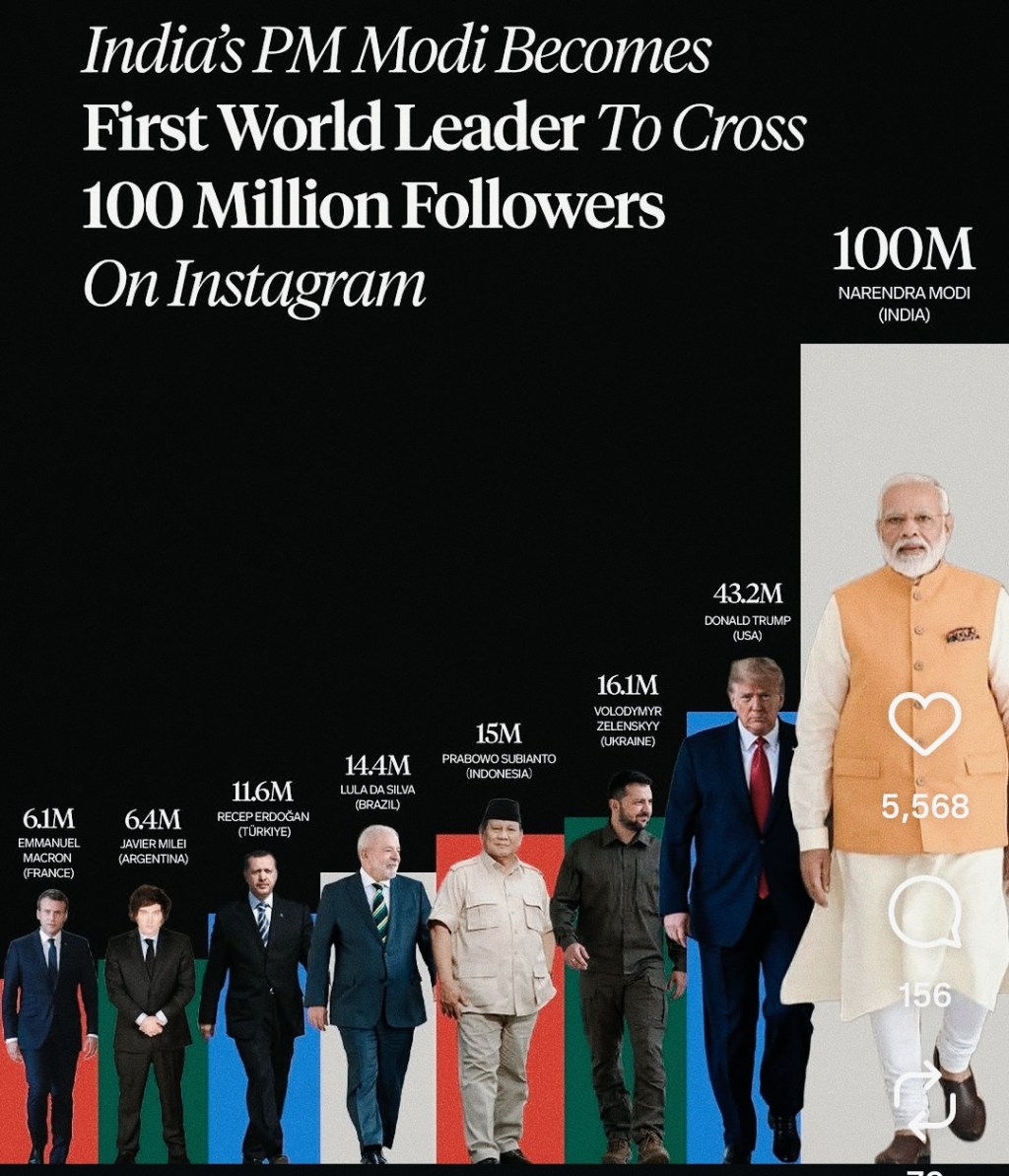
When Narendra Modi crossed the staggering threshold of 100 million followers on Instagram, it was not merely a personal milestone; it was a geopolitical signal. In an era where influence is increasingly measured in pixels, impressions, and engagement rates, Modi became the first elected leader to command a digital audience larger than the population of most sovereign states. The scale borders on the surreal. Donald Trump, one of the most media-saturated political figures of the 21st century, stands at roughly 43 million followers—less than half. Joko Widodo trails further behind at about 14 million. Even an aggregated sum of several global leaders’ followings would struggle to match this digital congregation. This is not a marginal lead; it is a different stratosphere of political communication.
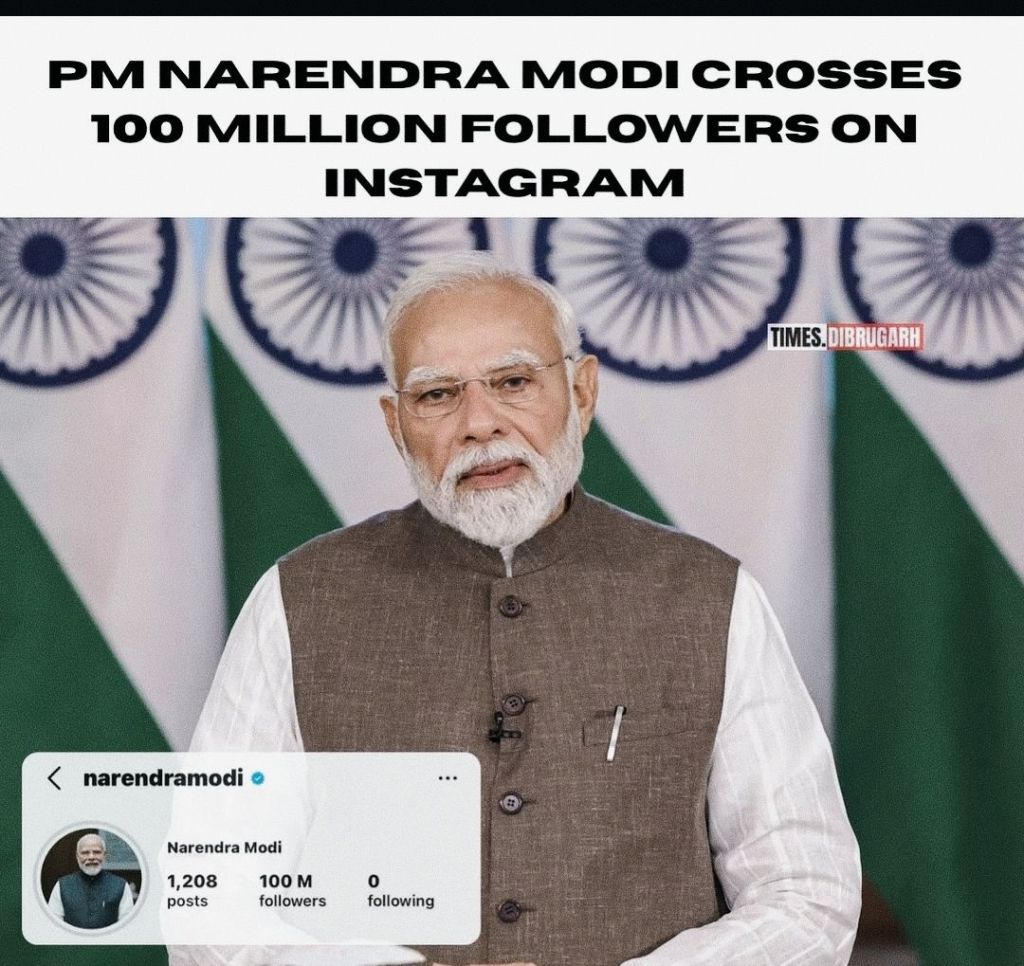
Within India, the asymmetry is equally dramatic. Rahul Gandhi commands a respectable presence in the low tens of millions, and various chief ministers and party handles have cultivated formidable digital constituencies. Yet the Prime Minister’s account operates on a planetary scale compared to domestic rivals. The explanation lies not in demographic arithmetic alone but in strategy. Modi’s Instagram presence is not a bureaucratic extension of office; it is a curated ecosystem. Diplomatic handshakes coexist with temple visits, cultural tributes blend with youth interactions, and reflective captions collapse the distance between sovereign authority and smartphone intimacy. The feed is not random—it is architected statecraft rendered in high resolution.
This phenomenon must be situated within the infrastructural revolution unleashed by India’s expanding internet penetration. The Digital India mission, affordable data plans, and the mass diffusion of smartphones have produced a young, hyper-connected electorate. Instagram, fundamentally visual and youth-centric, becomes the ideal theatre. By mastering reels, stories, and image-driven storytelling, Modi bypasses editorial gatekeepers and speaks directly to a generation that may neither read broadsheets nor endure prime-time cacophony. The politician is no longer merely covered; he becomes the primary broadcaster. The grammar of politics shifts: less press conference, more perfectly framed photograph; less mediated commentary, more algorithmic amplification. The medium does not just carry the message—it shapes it.
This recalibration has transformed the entire political ecosystem. Rahul Gandhi’s recent digital reinvention—through yatras documented in cinematic reels and appearances on lifestyle platforms—signals acknowledgment of the new battlefield. The Bharatiya Janata Party has built what observers describe as a disciplined digital machinery, operating across WhatsApp networks and micro-targeted campaigns with industrial efficiency. Strategists such as Prashant Kishor have experimented with monetized “digital warrior” models, compensating content creators based on engagement metrics. Campaigns now resemble start-ups: analytics guide messaging, volunteers are networked through data dashboards, and communication is segmented with surgical precision. Elections are no longer fought only at rallies; they are contested in the relentless marketplace of attention.
Yet the attention economy carries structural vulnerabilities. The direct-to-voter model cultivates an illusion of intimacy—millions feel personally addressed—but it erodes the mediating function of independent journalism. Algorithms reward emotional intensity, often privileging polarizing narratives over deliberative nuance. The rise of AI-generated imagery and deepfakes introduces ethical fault lines that democracies are only beginning to comprehend. Paid digital amplification blurs the line between organic support and engineered virality. In a society where digital literacy remains uneven, a hyper-connected urban electorate coexists with digitally excluded populations, risking a two-tiered democracy. Data privacy concerns compound the dilemma: micro-targeting voters using behavioral insights without transparent safeguards challenges the principle of informed consent that anchors electoral legitimacy.
The hundred-million milestone, therefore, is not merely a triumph of branding; it is a civilizational inflection point. It signals the consolidation of a post-broadcast era in which political authority is measured not only by parliamentary arithmetic but by algorithmic reach. The question confronting India is whether digital dominance will mature into digital responsibility. Ethical disclosure for AI-generated content, robust data protection regimes, and institutional investments in digital literacy are no longer optional—they are democratic imperatives. Leaders must transcend the compulsive chase for virality and cultivate values-based storytelling that fosters civic trust rather than spectacle. India now inhabits a vast digital republic where the feed is as influential as the floor of Parliament. Whether this republic evolves into a forum for participatory citizenship or devolves into a theatre of curated illusion will define the next chapter of the world’s largest democracy.
Visit arjasrikanth.in for more insights
 SOCIAL PERSPECTIVES