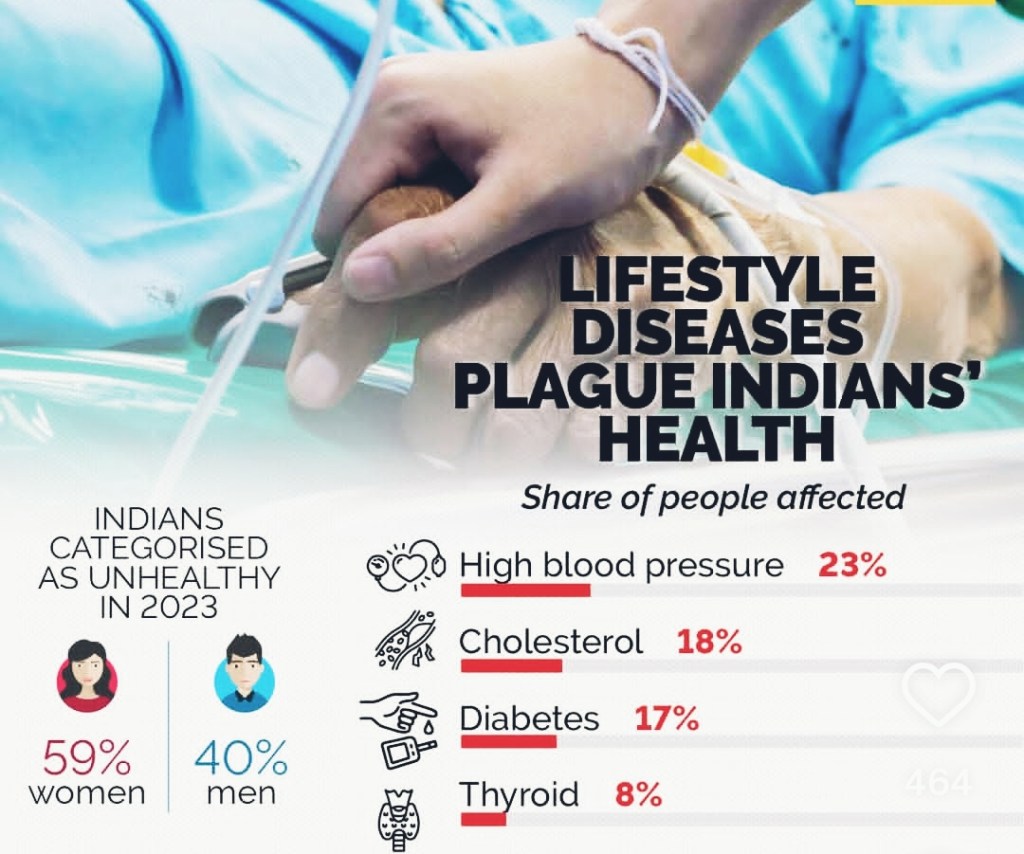
The defining public health crisis of the twenty-first century is not an abrupt catastrophe but a quiet acceleration of risk embedded within the architecture of modern life. Lifestyle diseases—cardiovascular disorders, cancers, chronic respiratory conditions, and diabetes—now account for nearly 74 percent of global mortality. With cardiovascular illnesses alone claiming around 17.9 million lives annually and diabetes-related deaths crossing two million, the statistics no longer reflect isolated clinical challenges; they reveal a deeper structural imbalance between development and wellbeing. What once appeared as personal health choices has evolved into a systemic phenomenon shaped by urban planning, food economics, digital culture, and governance priorities.

The paradox of lifestyle diseases lies in their preventability and persistence. The dominant risk factors—unhealthy diets, sedentary behaviour, tobacco use, and harmful alcohol consumption—are reinforced by environments designed for convenience rather than vitality. Industrial food systems favour scale over nutrition, cities privilege motorized mobility over walkability, and digital ecosystems reward passive engagement. Consequently, nearly 77 percent of lifestyle-related deaths now occur in low- and middle-income countries, where healthcare systems remain oriented toward episodic treatment rather than sustained prevention. This shift signals a transformation of global health inequities: modernization is no longer merely lifting living standards; it is redistributing risk.
The economic implications are profound.

Non-communicable diseases consume between 2 and 8 percent of GDP in many nations through healthcare costs and productivity losses, gradually eroding the demographic dividends that younger populations promise. A generation once expected to drive growth now confronts chronic illness earlier in life, reshaping labour markets and fiscal sustainability. The deeper irony is that technological progress—while extending life expectancy—has simultaneously intensified exposure to sedentary lifestyles and ultra-processed consumption. Development, once synonymous with prosperity, increasingly carries hidden biological costs.

Beyond policy frameworks, the drivers of the epidemic are rooted in culture and psychology. Food embodies identity and celebration, while comfort-oriented leisure has become a marker of aspiration in urban societies. Ultra-processed products engineered for taste and digital platforms optimized for engagement create behavioural loops that blur the line between choice and design. Economic insecurity, chronic stress, and widening inequality amplify vulnerability, influencing metabolic responses and coping behaviours such as overeating or substance use. Emerging epigenetic research suggests that early-life nutrition and maternal health can predispose future generations to metabolic disorders, transforming lifestyle risks into intergenerational legacies.

Governance remains a critical fault line. Health systems across the world continue to prioritize curative interventions over preventive architecture, leaving chronic conditions to expand quietly until they overwhelm capacity. Preventive programs are often fragmented and politically fragile, overshadowed by short-term policy cycles. Meanwhile, industries spanning food, tobacco, alcohol, and segments of the digital economy shape consumption patterns at a scale that complicates regulatory reform. Policies across agriculture, urban development, and education frequently operate in isolation despite their collective influence on public health outcomes.
Yet global experiences demonstrate that systemic redesign is possible. Singapore’s whole-of-government campaign against diabetes, Chile’s bold front-of-package warning labels that significantly reduced sugary drink purchases, and Finland’s North Karelia Project—credited with dramatic reductions in coronary mortality—illustrate how sustained, cross-sector strategies can reshape population behaviour. Urban models such as Copenhagen, where a majority of residents commute by bicycle, reveal that physical activity can be embedded into infrastructure rather than left to individual discipline. Community-driven initiatives, from Brazil’s household health workers to India’s mobile-based lifestyle education, show that local engagement can translate policy into everyday practice.

The path forward requires reframing health not as a sectoral concern but as a foundational principle of governance. Policymakers must move beyond disease prevention toward designing systems where healthy choices become the default outcome of economic and social structures. This includes integrating health considerations into agricultural subsidies, urban design, and digital regulation; expanding preventive care models that embed lifestyle screening into routine services; and reimagining cities with walkability, green spaces, and active mobility at their core. Technology, too, must shift from being a driver of sedentary behaviour to an enabler of wellness through predictive analytics, digital therapeutics, and ethically designed engagement tools.
Ultimately, the lifestyle disease crisis is less a failure of individual willpower than a reflection of collective design. Societies that confine health to hospital walls will confront escalating costs, declining productivity, and widening inequalities. Those that embed wellbeing into infrastructure, education, and economic policy can transform not only disease trajectories but the quality of human life itself. The lesson emerging from global experience is unmistakable: the epidemic is not an inevitability of modernity. It is a product of choices—political, economic, and cultural—and therefore it can be redesigned into a future where progress no longer runs faster than health.
Visit ajrasrikanth.in for more insights
 SOCIAL PERSPECTIVES