The Economic Survey 2026 reads less like a victory lap and more like a strategic warning, carefully wrapped in macroeconomic optimism. Released ahead of the Union Budget, it functions as India’s most comprehensive economic stress test—auditing growth, inflation, fiscal discipline, trade balances, and capital flows. On headline numbers, India remains the world’s fastest-growing major economy for the fourth consecutive year, expanding in the 6.3–6.8% range and brushing close to 7% despite global slowdown, trade fragmentation, and geopolitical turbulence. This sharply outpaces advanced economies growing near 2% and exceeds the global average of roughly 3%.
Yet the Survey’s deeper message is unsettling: growth alone no longer guarantees stability. The older equation—strong fundamentals automatically translate into currency strength and investor confidence—is weakening. India is growing fast, but global finance is now pricing resilience, not just speed.
The first engine of this growth story is domestic consumption, which has emerged as the economy’s principal shock absorber. Private final consumption expenditure now accounts for about 61.5% of GDP—the highest share in over a decade—and expanded by roughly 7.5% in the first half of FY26, comfortably exceeding pre-pandemic trends. The key driver is inflation compression. Headline household inflation has fallen dramatically, from around 6.7% earlier to near 1.7% by late FY26, easing pressure on food and fuel budgets. A strong agricultural year supported rural demand, while tax rationalisation and GST rate corrections lifted urban disposable incomes. This consumption-led resilience increasingly resembles the US growth model, where household demand stabilises economic cycles. The lesson is direct: inflation management is not merely macro prudence—it is a powerful growth stimulus when it protects purchasing power.
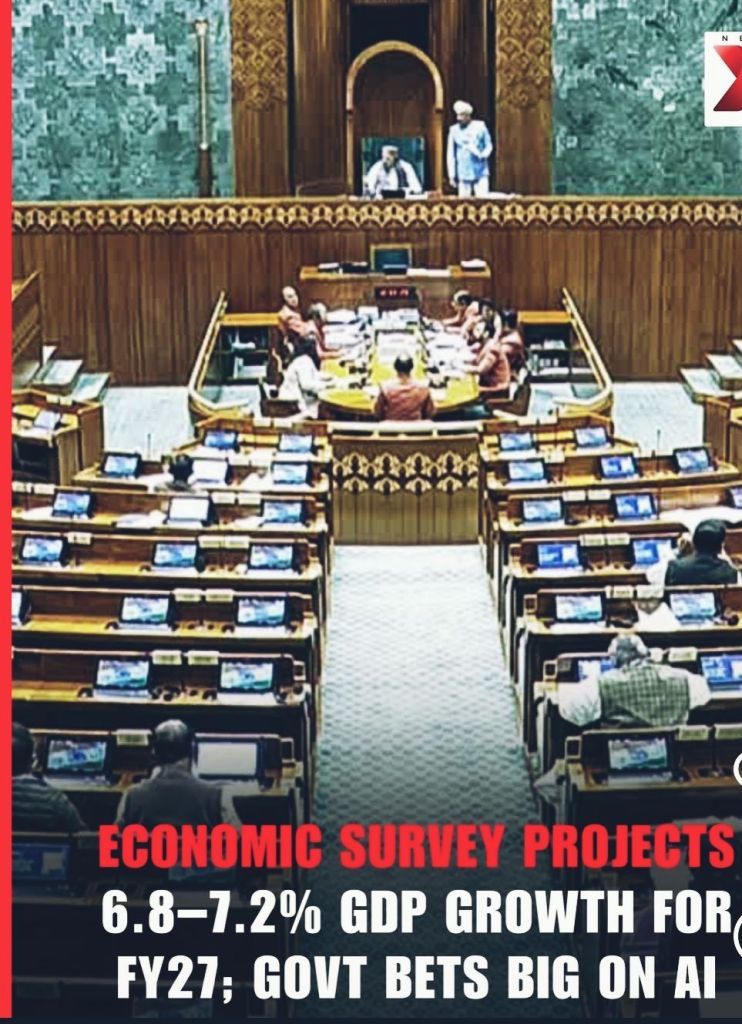
The second pillar is an investment revival. Gross capital formation contributes close to 30% of GDP and is expanding faster than recent historical averages. Public infrastructure spending, manufacturing capacity expansion, and logistics investment are driving new asset creation in machinery, factories, and transport networks. On the supply side, services continue to lead, growing near 9% on the back of trade, transport, finance, and professional services. Manufacturing is strengthening as consumption demand feeds factory output, while agriculture, growing at a modest 3.1%, provides income stability and rural demand support. This three-engine structure—consumption, investment, and services—resembles the diversified growth models seen in economies such as South Korea during its structural transformation phase. The unresolved question is whether investment momentum converts into export-competitive productive capacity.
Exports offer partial insulation but also expose structural constraints. India exported roughly $825 billion in goods and services in FY25, with momentum continuing despite tariff conflicts and supply-chain disruptions. Exports now account for about 21% of GDP and grew nearly 5.9% in the first half of FY26. Services exports—particularly IT, business services, and travel—expanded faster at around 6.5%, cushioning merchandise volatility. However, imports rose just as quickly, widening the goods trade gap. Despite remittances and services surpluses, India recorded a total trade deficit of nearly $95 billion. The Survey implicitly echoes a global lesson demonstrated by Japan, Germany, and later China and Vietnam: long-term currency and external stability rest on manufacturing export depth. Services generate income; manufacturing generates foreign-exchange scale and supply-chain leverage.
The most revealing contradiction lies in the external and financial account. Despite fiscal discipline—with the Union fiscal deficit at about 4.8% of GDP, better than budgeted, and a glide path toward 4.4%—the rupee weakened to record lows near ₹92 per US dollar, depreciating roughly 6.5% over the year. Gross FDI inflows rose over 16%, yet net inflows softened due to outward investments and profit repatriation. Portfolio flows turned cautious: inflows fell to about $3.9 billion from over $10 billion the previous year as global capital chased AI-driven returns in the US and East Asia. India recorded a balance-of-payments deficit near $6.4 billion in the first half of FY26, financed through reserve drawdowns. Bond markets are sending a similar signal. Investors demand higher yields on India’s 10-year government bonds—around 6.7%, compared with Indonesia’s roughly 6.3% despite similar sovereign ratings—reflecting a rising resilience premium. The message is clear: in a fragmented and geopolitically tense capital market, macro discipline is necessary but no longer sufficient.
The Survey’s prescription is blunt and structural. India must choose competitive integration over comfortable protection. Tariff walls, it argues, breed inefficiency and “zombie firms,” while exposure to global competition builds productivity and export capability. Recent trade agreements and selective tariff reductions—including in automobiles, food products, and beverages—signal a tentative pivot toward competitiveness. Global exemplars are instructive. Germany’s Industry 4.0 demonstrates how technology-driven manufacturing sustains export leadership. Vietnam shows how openness combined with supply-chain integration attracts durable FDI. Singapore’s SkillsFuture illustrates how continuous workforce upskilling anchors productivity transitions.
The core takeaway from the Economic Survey 2026 is not that India is winning, but that it is entering a harder league. In this phase, endurance, export depth, institutional credibility, and the ability to absorb external shocks will determine whether today’s near-7% growth matures into tomorrow’s economic power—or stalls at the limits of comfort-zone success.
Visit arjasrikanth.in for more insights
 SOCIAL PERSPECTIVES