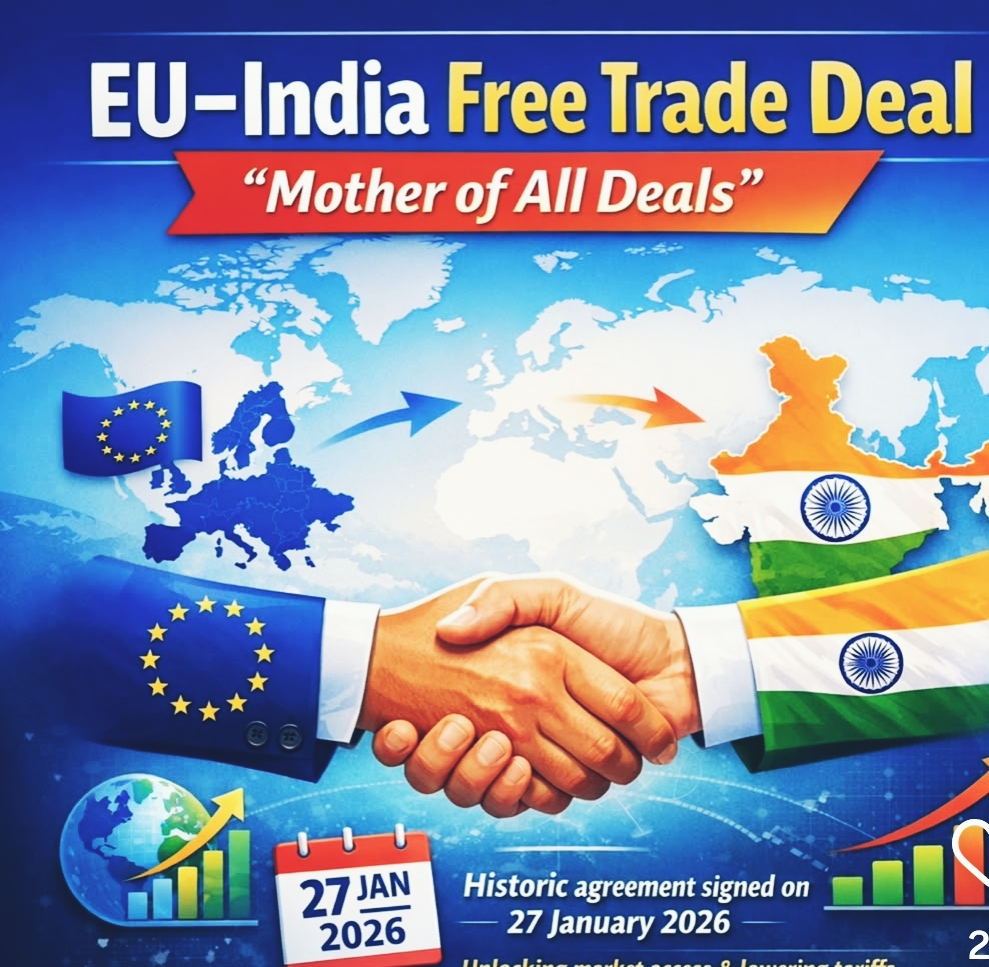
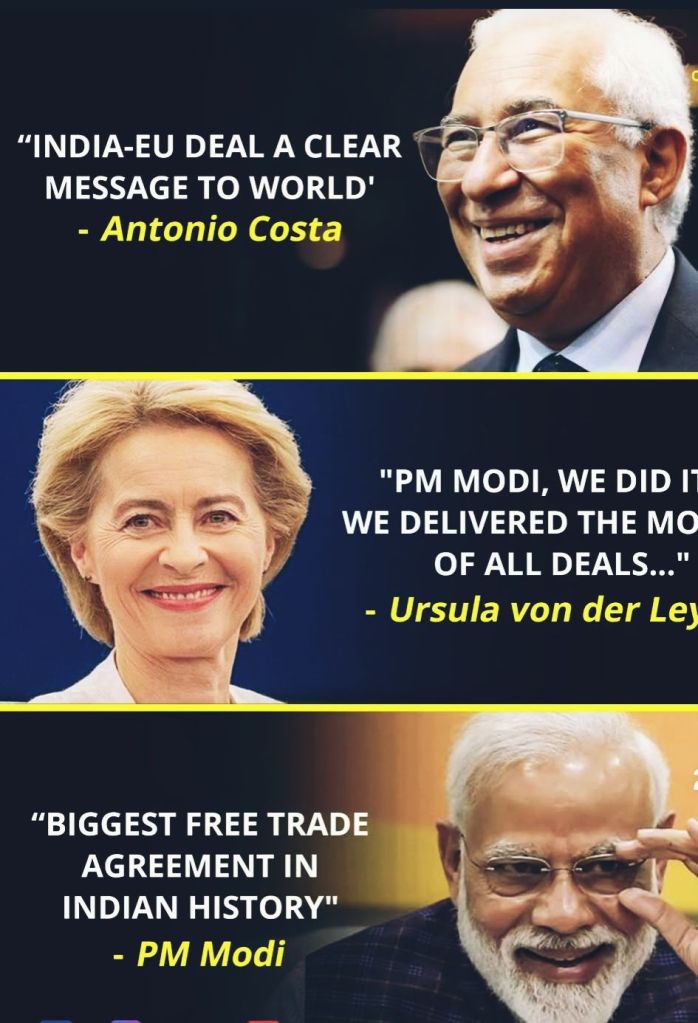
After more than two decades of hesitation, reversals, and strategic anxiety, India and the European Union have sealed what can justifiably be called the mother of all free trade agreements. This is not ceremonial diplomacy marketed as transformation; it is a structural reset. When the European Commission President stood beside Prime Minister Narendra Modi and invoked a combined market approaching two billion people, the statement reflected economic mass, not metaphor. Two regulatory superpowers have chosen interdependence over insulation. For India, this agreement is not merely about tariff lines and export volumes; it marks a psychological shift—an admission that defensive economics cannot power a competitive century.
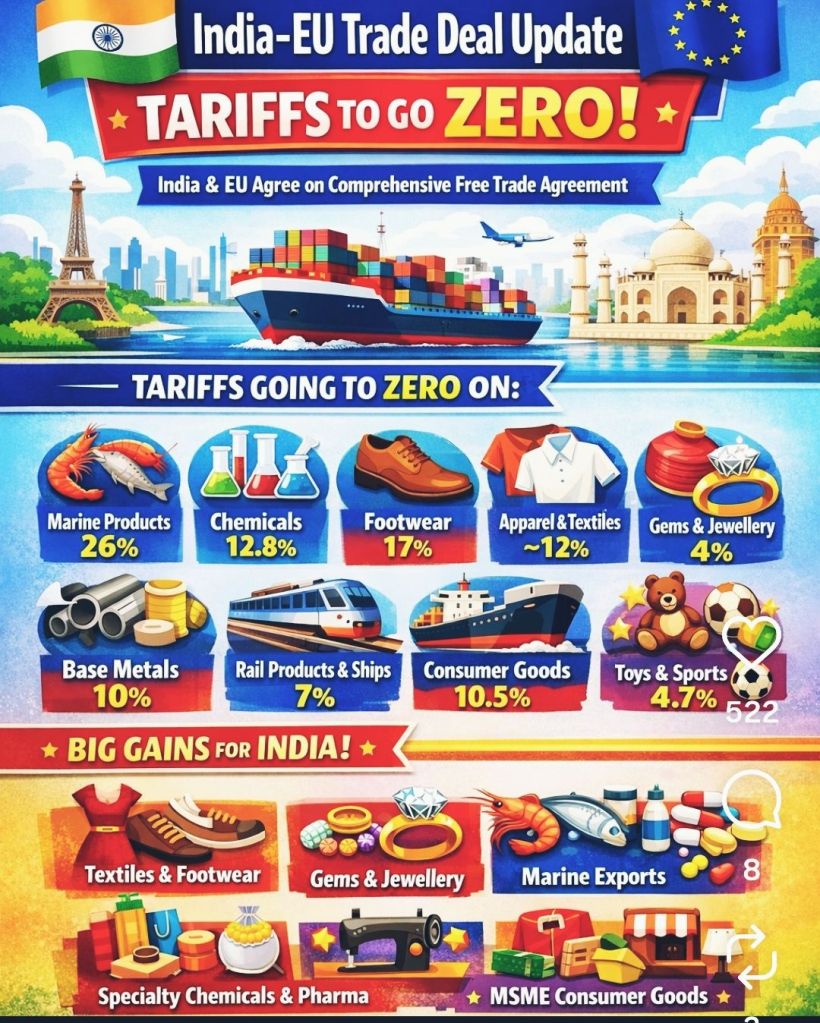
The scale of ambition distinguishes this agreement from routine trade compacts. Nearly all tariff lines on both sides move toward zero or near-zero over calibrated timelines, creating one of the deepest market-access frameworks attempted between advanced and emerging blocs. This is systemic liberalisation, not selective accommodation. Indian sectors such as marine products, pharmaceuticals, textiles, chemicals, engineering goods, and processed foods gain entry into one of the world’s most quality-sensitive consumer markets. Europe is not just large; it is exacting. It prices reliability, traceability, sustainability, and standards discipline. By accepting this gateway, India is effectively committing its producers to global-grade performance metrics rather than price-led competitiveness alone.
The consumer-side implications are equally transformative. High-end European automobiles, precision medical devices, specialty machinery, wines, and spirits will gradually become more accessible as legacy tariff barriers are dismantled. These barriers were historically defensive—designed to incubate domestic capacity—but extended protection often mutates into structural complacency. This agreement signals a policy-level recognition that prolonged shelter distorts incentives. Indian consumers gain choice and quality; Indian producers inherit urgency. Competitive pressure will now operate as a reform engine, rewarding firms that modernise processes, upgrade technology, and optimise supply chains, while steadily marginalising those dependent on regulatory cushioning.
At a deeper level, the agreement represents a philosophical pivot in India’s trade doctrine. The objective is shifting from security-through-protection to resilience- through-competition.
Compliance with European norms on labour, environment, safety, digital traceability, and product integrity becomes a passport to global markets, not a bureaucratic burden. The deal thus functions as an external discipline mechanism, compelling domestic reform in logistics, certification, testing infrastructure, and production governance. It exposes chronic inefficiencies—fragmented supply networks, high transaction costs, uneven quality control—that tariff walls once concealed. Integration, in this sense, becomes an instrument of internal correction.
The political economy of the deal is as significant as its economics. Negotiations first launched in the mid-2000s and stalled for years over automobiles, services mobility, data rules, and regulatory asymmetry. The earlier hesitation was not irrational; exposing MSMEs and labour-intensive sectors to mature European competition carried real risk. What changed was India’s strategic calculus. China’s manufacturing ascent through global value-chain integration, Vietnam’s post-2019 export surge after its EU pact, and recurring protectionist cycles in the United States collectively underscored the cost of exclusion. Diversification of markets became a strategic necessity. The EU pact emerges as the anchor of that diversification strategy.
Sectoral opportunity, however, comes with regulatory intensity.
Labour-intensive exports—footwear, marine products, garments, chemicals—gain tariff relief, but they also enter the world’s most compliance-heavy marketplace. European carbon border measures, chemical safety regimes, sustainability disclosures, and supply-chain due diligence rules will test exporter readiness. Pharmaceuticals and engineering goods may benefit from regulatory cooperation and recognition pathways, yet documentation and audit burdens will rise. The agreement therefore tests not only corporate adaptability but also state capacity—whether India can deliver certification ecosystems, testing labs, logistics upgrades, and financing tools fast enough to prevent compliance from becoming the new tariff.
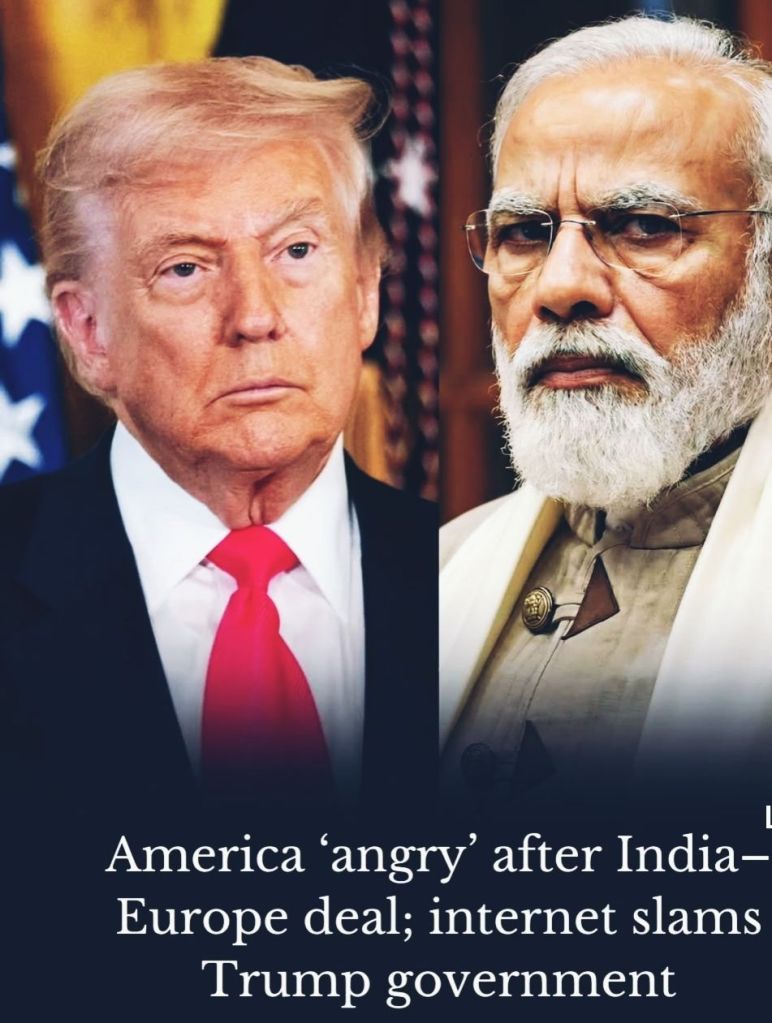
Trade agreements do not create competitiveness; they reveal its absence or reward its presence. India’s mixed export response to some earlier FTAs stands as a cautionary precedent. Market access is an opportunity, not an outcome. The EU–India pact is best understood as a high-stakes invitation to industrial adulthood. It withdraws comfort, expands possibility, and institutionalises competition. For Indian enterprise, the message is unambiguous: quality is mandatory, efficiency is strategic, and global standards are the new domestic baseline. The walls are lowering. Performance must rise.
Visit arjasrikanth.in for more insights
 SOCIAL PERSPECTIVES