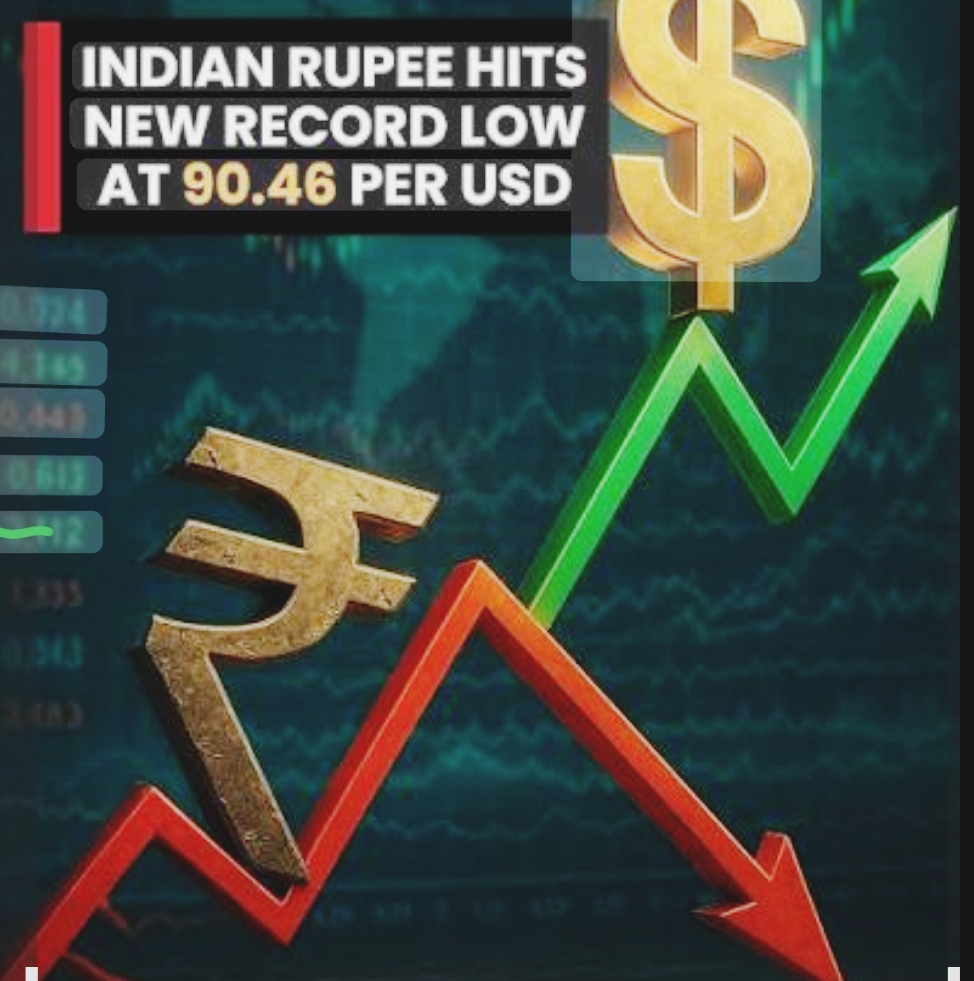
The Indian rupee’s recent slide—nearly 4.8% in weeks, breaching the psychologically bruising ₹91-to-a-dollar mark—has crowned it Asia’s worst-performing currency this year. What makes this unsettling is not collapse but contradiction. India’s macro indicators look reassuring on paper: GDP growth around 6–7%, comfortable forex reserves, and a current account deficit that is hardly alarming. Yet markets do not trade on balance sheets alone. Nearly $18 billion has exited Indian equities as foreign portfolio investors retreated, spooked by global risk aversion, stalled India–US trade talks, and renewed tariff anxieties under a resurgent Trump narrative. For the Indian middle class, this is not a remote macroeconomic drama. It is a slow leak in household certainty—felt first as unease, later as arithmetic.

Currency weakness rarely announces itself with shock therapy. It works by stealth. Prices do not spike overnight by double digits; they seep upward through imported inputs—crude oil, cooking oils, pulses, electronics components, machinery, pharmaceuticals—quietly lifting the cost base of daily life. A 10% depreciation typically transmits only partially into consumer prices, around 4–5%, but even this “moderate” pass-through can nudge the Consumer Price Index up by 0.3–0.5 percentage points. For households juggling EMIs, school fees, healthcare costs, and urban rents, this incremental inflation compounds month after month. Salaries do not keep pace. The result is not crisis but compression—real disposable income thinning without any single bill screaming alarm.
The pain sharpens where aspirations intersect with the dollar. Overseas education, foreign travel, imported gadgets, and international medical care—once symbols of upward mobility—suddenly demand recalibration. A $100,000 university course feels stable until the rupee slips from 85 to 91, quietly converting a ₹85 lakh plan into a ₹91 lakh reality before living expenses. Education loans denominated in rupees shift currency risk squarely onto families; those funding from savings confront an uncomfortable question: is this ambition still rational, or merely habitual? Travel follows the same delayed logic. Airfares and packages may be temporarily insulated by hedging and contracts, but the repricing arrives eventually. The shock is postponed, not cancelled.

Monetary policy adds a layer of confusion that often misleads the middle class. When the RBI cuts rates to support growth, the assumption is relief—lower EMIs, more breathing room. But currency depreciation scrambles this equation. If interest savings are offset by higher prices for imported goods and services, the net benefit evaporates. Worse, rate cuts redistribute stress unevenly. Borrowers gain; savers lose. Fixed-income households and retirees watch real returns erode while their cost of living inches higher. The rupee’s weakness thus creates a paradox of policy optics: support on paper, pressure in practice.
Investment behaviour, too, is being reshaped under this currency shadow. With foreign investors pulling back and markets turning volatile, middle-class investors navigate uncertainty with limited information and heightened emotion. Global assets beckon with diversification and potential returns, but currency risk cuts both ways. For most retail participants, diversified mutual funds remain the most rational hedge—professionally managed and less dependent on guessing the rupee’s next move. Yet the psychological impact of watching portfolios sway alongside a weakening currency fuels anxiety about 2026 and beyond. The fear is not merely loss, but drift—an erosion driven as much by sentiment as by fundamentals.
Looking ahead, the rupee is likely to remain volatile rather than catastrophically weak. India’s structural strengths—growth, reserves, domestic demand—argue against free fall. But global forces will continue to intrude: US interest rates, trade tensions, capital flows, and inflation expectations abroad. For the middle class, the lesson is sobering. A weaker rupee rewards exporters and dollar earners, but it taxes consumption-led aspiration. Financial planning now demands scenario thinking—hedging education costs, pacing foreign exposure, diversifying investments, and accepting that global ambition carries a visible currency price. The rupee may stabilise in time, but the middle class will remember the year it learned a hard truth: national growth does not automatically translate into personal financial comfort.
Visit arjasrikanth.in for more insights
 SOCIAL PERSPECTIVES