
By early 2025, declaring the death of global trade had become fashionable, almost performative. The United States launched one of the most expansive tariff regimes in modern history, sanctions became an everyday policy instrument, and retaliatory trade barriers spread across continents with alarming speed. Supply chains built patiently over decades appeared to snap under the weight of geopolitics.
Commentators spoke confidently of a post-globalisation world where nations would retreat inward, privileging domestic self-sufficiency over interdependence. Yet that obituary did not survive contact with reality. What unfolded instead was not collapse, but recalibration. Global trade bent under pressure, rerouted itself, and continued flowing—less visibly, more creatively, and with a resilience its critics underestimated.
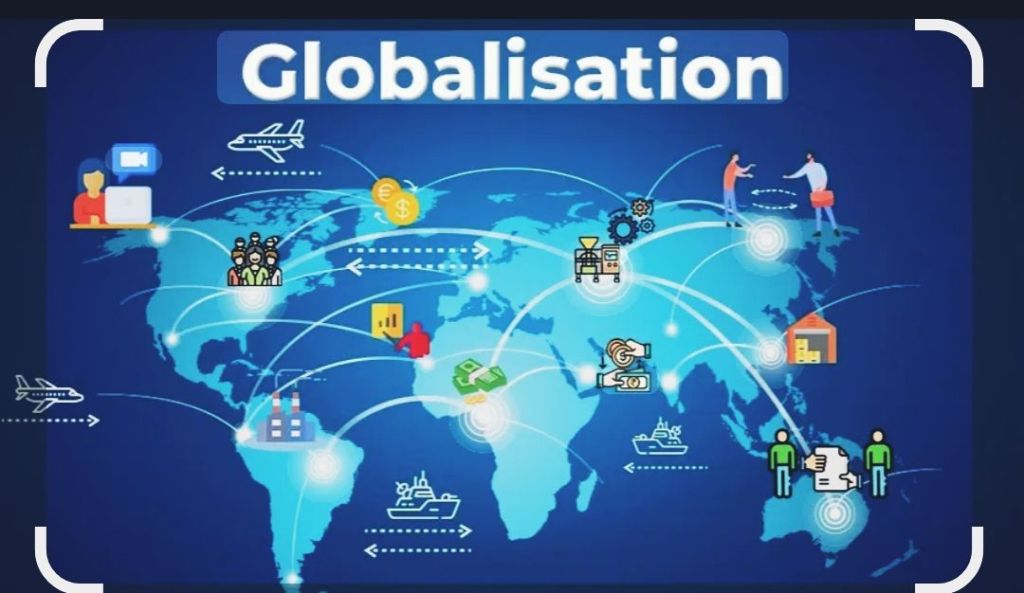
The past decade is best understood as fragmentation without disintegration. The US–China trade conflict that began in 2018 cracked the façade of seamless global commerce, a process accelerated by war in Europe and the weaponization of energy flows. Russia’s invasion of Ukraine in 2022 marked the sharpest rupture, tearing apart historic trade relationships almost overnight. While 2023 and 2024 brought temporary stabilisation, early 2025 saw fragmentation accelerate again, particularly between Washington and Beijing. Yet the numbers tell a subtler story. Global value chains, which carried 48% of world trade in 2020, still account for 46.3% today—near historic highs. Corridors closed, but the architecture of global production endured, revealing that globalisation is harder to dismantle than political rhetoric suggests.

What changed was not the existence of trade, but its geometry. As direct routes closed, intermediaries gained strategic importance. Countries positioned between rival blocs emerged as critical connectors, absorbing, redirecting, and adding value to flows blocked by politics. Mexico became the United States’ largest trading partner by 2024, acting as a gateway for Asian manufacturing. Vietnam deepened its role in electronics assembly. Kazakhstan, heavily sanctioned alongside Russia, increased imports from Russia by nearly 83% after Europe disengaged, filling gaps created by geopolitical realignment. These were not acts of simple transhipment. They involved new layers of processing, compliance, and integration into global value chains. Globalisation did not retreat; it learned to take detours.

If goods trade strained under tariffs and sanctions, services quietly became the system’s shock absorbers. Over the past five years, digital services—finance, IT, design, education, telemedicine—proved remarkably resilient. During COVID-19 and its aftermath, value creation continued even as ships stalled and ports clogged. Digital platforms lowered entry barriers for smaller firms, while TradeTech—AI-enabled customs, blockchain documentation, and smart contracts—reduced friction across borders. In value terms, data, intellectual property, and knowledge now rival, and often surpass, traditional manufacturing. The global economy is becoming lighter and faster, less dependent on physical movement but no less interconnected, challenging the assumption that globalisation is defined solely by containers and cargo.

Fragmentation also reshaped cooperation patterns. Since 2017, trade within geopolitical blocs has grown roughly 4% faster than trade across them, while US–China trade has expanded nearly 30% slower than each country’s trade with the rest of the world. Businesses responded by diversifying suppliers—62% attempted to do so by 2022—but many efforts were superficial, adding partners without reducing vulnerability. True diversification requires institutional readiness: efficient logistics, reliable energy, access to finance, and capable firms. Industrial policy further complicated outcomes. China’s heavy subsidisation of shipbuilding crowded out efficient competitors in Japan and Korea, paradoxically reducing global shipping costs by about 6%. Domestically, profits were modest; globally, exporters and consumers benefited. The same policy can appear distortionary or efficient depending on where one sits in the value chain.

Trade governance itself is evolving into something narrower and more fragmented. As the WTO weakens, comprehensive multilateral agreements have given way to targeted deals focused on critical minerals, digital trade, and strategic technologies. In just five years, critical-minerals agreements multiplied fifteenfold, while digital trade deals surged thirty-five times. These arrangements are often non-binding and uneven, but they work best where trust already exists. Countries embedded in regional agreements are eight times more likely to see such deals succeed, producing a global economy that resembles a quilt rather than a single fabric—dense with trusted clusters, thin at the edges.

India’s place in this rerouted world is quietly consequential. Now among the top ten countries in domestic value added embedded in exports, India accounts for 2.8% of the global total, driven largely by services. It performs strongly on financial resilience and business climate, yet struggles with firm capacity, infrastructure, energy reliability, and debt. Still, it is one of just sixteen countries consistently moving into more complex segments of global production. In an era where trade flows bend rather than break, India’s challenge is to convert service strength and geopolitical neutrality into connector status by fixing domestic bottlenecks. The lesson of 2025 is not that globalisation is ending, but that it is evolving—more digital, more regional, more selective. Those who adapt will shape it; those waiting for the old world to return will be left trading in nostalgia.
Visit arjasrikanth.in for more insights
 SOCIAL PERSPECTIVES