
Operation Silent Shield: India Defeated a Decades-Old Insurgency Without Celebration
For decades, India’s heartland endured a silent struggle. Dense forests and remote tribal regions, once vibrant with cultural identity and natural wealth, were engulfed by the shadow of Left-Wing Extremism (LWE). Villages remained cut off from governance, citizens lacked basic services, and development froze under the fear of coercion and violence. The insurgency at its peak spanned 126 districts — a Red Corridor that symbolized the State’s limited presence in its own territory. Today, that map has been redrawn. The number of significantly affected districts has dropped to just 11 from 115, marking over a 90% reduction. This extraordinary shift represents one of the most consequential internal security transformations in independent India — a success achieved not through loud proclamations, but through consistent, strategic, and determined statecraft.
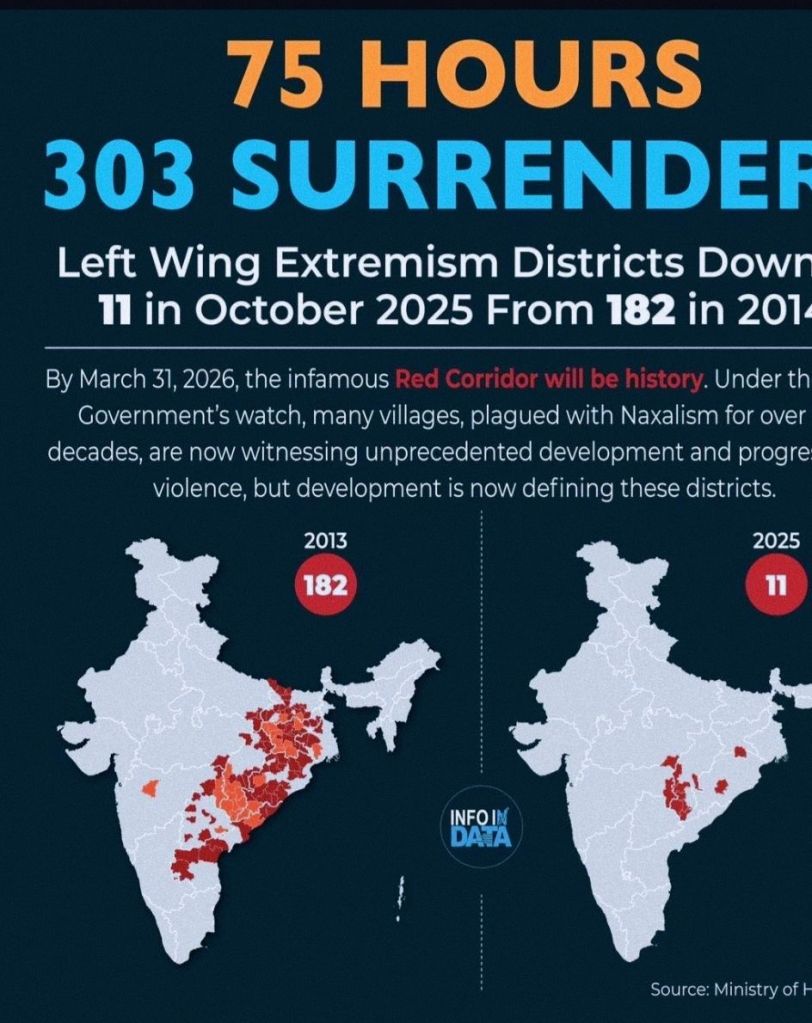
This turnaround was not driven by force alone. It emerged from a nuanced, long-term framework guided by the Ministry of Home Affairs (MHA), rooted in a simple truth: extremism flourishes in governance vacuums. Therefore, the strategy adopted a two-pronged model — decisive security dominance paired with deep developmental intervention. The State no longer reacted to insurgency; it proactively dismantled its foundations. Where ambushes once defined the terrain, governance has now taken root. The transformation is a reminder that national security is not merely the absence of conflict, but the presence of opportunity, rights, and trust.
The security overhauls reshaped India’s operational capabilities in some of the most unforgiving geographical conditions. Specialized counter-insurgency battalions trained in jungle warfare were deployed alongside local police forces that received modern technology and infrastructure upgrades. 586 fortified police stations were established as physical anchors of the State’s presence. Simultaneously, connectivity became a strategic weapon: roads, bridges, mobile towers, and logistics corridors enabled swift troop movement while denying militants mobility and sanctuary. These interventions forced extremists out of entrenched zones, dismantled command structures, and cut off recruitment channels. The symbols of fear have steadily given way to symbols of governance — a transition invisible from afar, but transformative on the ground.

Yet policymakers understood that ideological conflicts cannot be won solely on the battlefield. Parallel to security efforts, the government launched an unprecedented expansion of welfare into communities long deprived of State engagement. Healthcare reached remote tribes, school enrollment rose, skill development drove employability, and targeted livelihood missions offered pathways away from radicalization. Rehabilitation programs ensured that those who surrendered were reintegrated with dignity, not stigma. By replacing alienation with inclusion, the State chipped away at the emotional and economic appeal that insurgent groups once exploited. As developmental presence expanded, the insurgency’s narrative collapsed — “the State is absent” was no longer believable when opportunities began entering villages previously lost to history.

These gains have triggered a broader positive spiral. Regions once considered ungovernable are now opening up to infrastructure investments and industrial expansion. Roads now carry hospital supplies and school buses where armed squads once marched. Power lines and irrigation projects are boosting economic resilience and agricultural productivity. In many areas, economic revival has become the strongest security shield. What is unfolding is not merely pacification, but the creation of self-sustaining peace. Moreover, this experience contributes to a larger national security evolution — complementing stability in the Northeast and improving conditions in Jammu & Kashmir. At a global moment where violent extremism frequently mutates into new forms, India stands out for demonstrating that a democratic framework — strengthened law enforcement, community participation, transparent governance — can defeat entrenched insurgency without compromising constitutional principles.

However, success has not lulled the government into complacency. The remaining 11 districts represent the movement’s most hardened terrain — topographically challenging zones where extremist remnants, criminal syndicates, and survival networks still operate. Persistence and precision are vital, especially as new threats — narcotics trade, illegal mining, and cross-border networks — attempt to fill the void left by insurgents. Strengthened investigative frameworks, coordinated operations, and innovative socio-economic initiatives are being deployed to ensure stability becomes irreversible. The focus now is not only to suppress violence, but to prevent its resurgence by permanently dismantling its economic and psychological foundations.

This remarkable yet understated achievement reflects a governance philosophy grounded in perseverance and inclusivity. Where earlier regimes accepted prolonged insecurity as an inevitability, today’s approach has been to confront and resolve it — village by village, family by family. The true success lies not in the statistics, but in the lived experiences of communities who now walk freely, send their children to school, and plan for a future once unimaginable. India’s reclaimed peace is not a matter of celebration alone — it is a strategic asset powering the nation’s economic and geopolitical aspirations. As global observers admire the rise of a confident India, the most profound chapter is being written in the quiet forests of the former Red Corridor — where fear once ruled, hope now leads. Because the greatest victories of a nation often emerge not from military parades, but from the hearts of citizens who are finally free from fear.
Visit arjasrikanth.in for more insights
 SOCIAL PERSPECTIVES