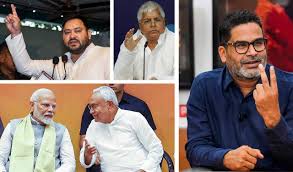
A 202-seat political supernova driven by the silent revolution of women voters and a welfare machine that rewrote India’s electoral physics.
The Bihar election did not simply produce a winner—it detonated a political moment so powerful that it has redrawn India’s electoral map, voter psychology, and the unwritten rules of political legitimacy. This was not an ordinary mandate. It was a seismic shift delivered with mathematical clarity: an NDA sweep of 202 out of 243 seats, signaling not just approval but a wholesale recalibration of public expectation. The state, often framed through cliches of backwardness and inertia, has instead emerged as the crucible of India’s next political grammar—one authored by the most formidable new force in Indian democracy: the empowered woman voter.

This election registered a historic 71.6% turnout, the highest since 1951, reflecting not only heightened political participation but a deep societal transformation. The surge in women voters was not a sudden awakening; it was the cumulative effect of two decades of targeted welfare—financial inclusion, SHG support, mobility schemes, maternal health interventions, and neighborhood-level infrastructure that directly improved daily life. These were not abstract government announcements; they were lived benefits. Over time, they cultivated a constituency that evaluates politics through experience, opportunity, and dignity rather than caste loyalties or charisma. When this constituency consolidated, the electoral consequences were tectonic.
The opposition, despite assembling a broad caste coalition and projecting a youthful leadership face, found itself outpaced on every front. Its reliance on constitutional anxiety, historical grievance, and identity mobilization stood in stark contrast to the incumbent’s results-driven governance pitch. Welfare architecture, delivery efficiency, and booth-level discipline operated for the NDA with the precision of a political machine. The opposition had passion; the NDA had organization. The outcome reflected that asymmetry.

Even the pre-election controversy over the removal of 47 lakh names from the rolls failed to dent voter confidence. The opposition alleged targeted disenfranchisement, while the Election Commission insisted this was routine cleansing of duplicates and deceased entries. Regardless of political narratives, turnout patterns revealed robust participation across demographic segments. Yet, after the results, sections of the opposition attempted to invalidate the mandate by alleging manipulation, clinging to moral outrage rather than confronting structural weaknesses—weak ground presence, fractured messaging, and an inability to articulate a forward-looking agenda.
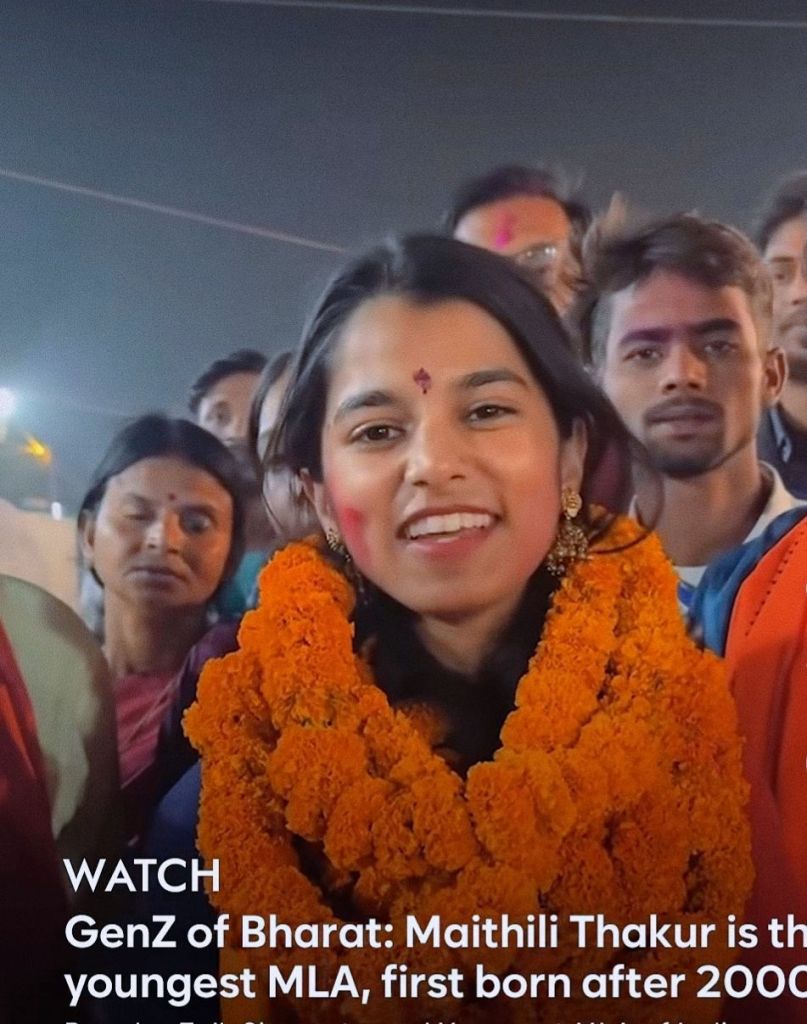
Perhaps the most defining transformation, however, lies in Bihar’s shifting leadership axis. Two political titans who shaped the state for more than thirty years receded simultaneously—one due to age and health, the other constrained by legal and political battles. Their retreat marks the end of an era when Bihar’s politics revolved around towering personalities, volatile alliances, and ideological improvisation. What emerges in their place is a more disciplined, institutional, and nationalized political architecture. Power is now anchored in organizational coherence, welfare efficiency, and a stable leadership structure aligned with the national ruling party. This is not merely generational change; it is a structural re-foundation of political legitimacy.
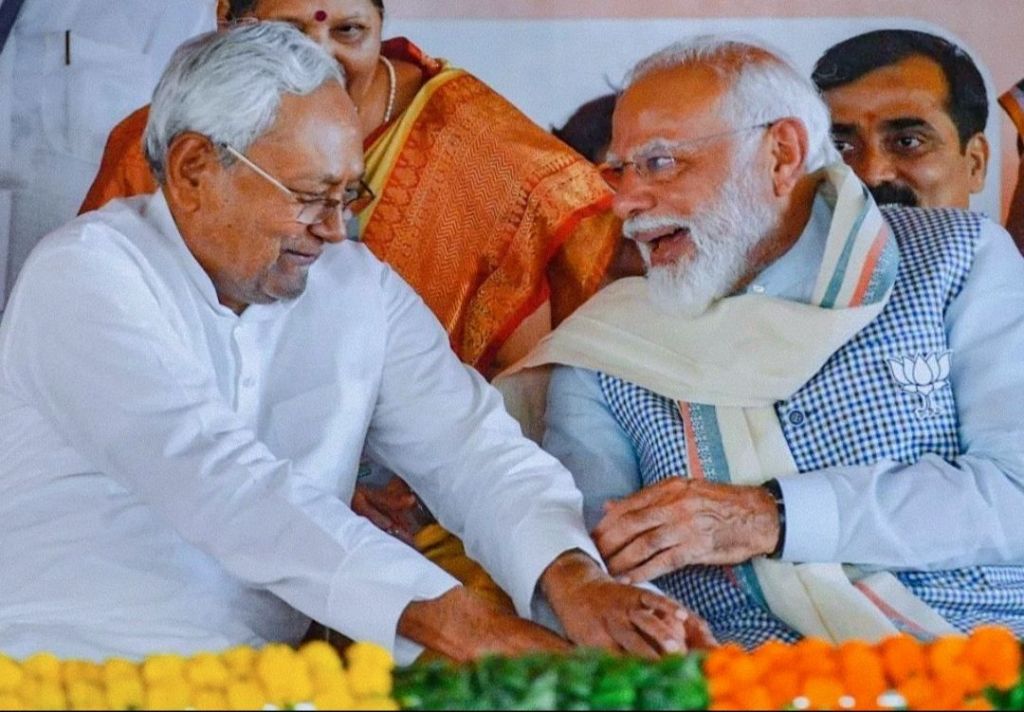
Nationally, Bihar’s verdict sends shockwaves far beyond the Ganga plains. It represents a significant setback to the broader opposition’s 2029 strategy, revealing a widening gap between opposition discourse and voter aspiration. Bihar’s demographic edge—median age 22—amplified this shift. Young voters rejected alarmist rhetoric, preferring measurable governance, economic mobility, and delivery credibility. Appeals rooted in constitutional fragility or caste nostalgia simply could not compete with the lived experience of welfare, roads, safety, and economic opportunity. This disconnect underscores the opposition’s steep uphill climb in states where it seeks to defend ground, including Tamil Nadu, Kerala, and West Bengal.

The Congress, in particular, faces a sobering reckoning. The Bihar outcome exposes its organizational fragility: a weakened cadre network, limited vote-transfer efficiency, internal rigidity, and an outdated ideological narrative ill-matched to contemporary aspirations. Its inability to engage backward classes, women, and youth with a compelling social compact risks accelerating its political marginalization. Without serious structural reform, decentralized leadership empowerment, and a national narrative built around opportunity and governance, its role as a credible anchor in alliances will continue to diminish.

Ultimately, what unfolded in Bihar is a national political moment disguised as a state election. It announces the arrival of an electorate that rewards delivery, distrusts rhetoric, and increasingly centers its political power within empowered communities—especially women. It shows that welfare is not charity; it is political capital. Delivery is not governance; it is legitimacy. And voters—assertive, aspirational, and acutely aware of their agency—now determine political destiny with unprecedented clarity.
In the decade ahead, Indian politics will belong to those who can build systems, not slogans; who can deliver outcomes, not excuses; and who recognize that the most disruptive force in Indian democracy is no longer identity or ideology, but the empowered citizen. Bihar has rewritten the script. The rest of India is already reading the next chapter.
Visit arjasrikanth.in for more insights
 SOCIAL PERSPECTIVES