
A single car bomb near one of India’s most protected landmarks didn’t just shatter glass — it exposed the cracks in the nation’s urban security grid, where complacency proved deadlier than chaos.
At precisely 6:52 p.m. on a bustling Monday evening, Delhi’s calm dissolved into chaos. A red hatchback, idling innocuously at a traffic signal near the Red Fort Metro Station — an artery pulsing with life, trade, and tourists — erupted into a thunderous explosion that tore through the heart of the capital. Flames devoured nearby vehicles, glass storefronts imploded, and within seconds, panic spilled across the streets like smoke itself. Eyewitnesses described the blast as surreal — the familiar hum of traffic replaced by screams, shattered glass, and an orange haze rising against the silhouette of one of India’s most enduring symbols of freedom.

The precision of timing and location was chilling. The attack struck at peak traffic hour, in a zone secured by multiple layers of surveillance — within sight of a UNESCO heritage monument and steps away from one of Delhi’s most crowded metro corridors. That a vehicle laden with high-grade explosives could penetrate so deep into this high-security zone reveals not a gap, but a collapse in vigilance. The event was not just an act of terror — it was an indictment of India’s urban security apparatus, exposing a failure that was technological, institutional, and deeply human.
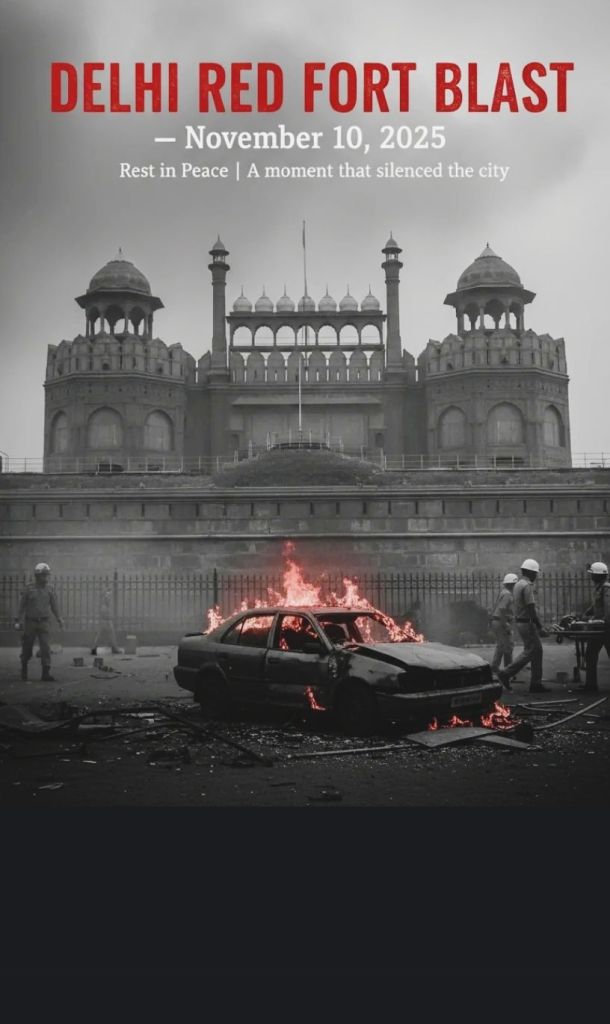
Within minutes, the city’s emergency response apparatus was activated. Sirens wailed across central Delhi as bomb disposal squads, forensic experts, and elite anti-terror units converged on the scene. A high alert was declared across the National Capital Region — airports, metro networks, and government complexes fortified under an umbrella of fear. Yet beneath the swift mobilization lay a more haunting question: how did this happen in the first place? Despite thousands of CCTV cameras and layered security controls, early investigations hinted that the explosive-laden vehicle might have been parked near the site for hours before detonation — a damning sign of systemic inertia and broken coordination. Surveillance feeds that should have raised red flags apparently blended into the routine noise of urban life.

Delhi’s vast security infrastructure — once heralded as a model for smart policing — revealed its fragmented underbelly. Jurisdictional overlaps between municipal police, heritage protection agencies, and intelligence units meant that no single entity held a complete picture. Real-time alerts were either missed or delayed. It’s a paradox that defines India’s urban security framework: immense hardware, minimal integration. Technology exists, but without synchronized data analytics, predictive intelligence, or unified command systems, it becomes mere surveillance theatre — watching everything, understanding little.

The Red Fort blast has reignited the debate on how India perceives terrorism in its evolving, urban form. Today’s threats are no longer shaped by militants crossing borders with rifles; they are engineered through encrypted apps, digital wallets, and ideological radicalization that hides in plain sight. Counterterrorism agencies across the subcontinent have recently uncovered caches of explosives weighing several tonnes, scattered across northern states — often operated by educated professionals embedded within mainstream society. These new-age networks are neither rural nor visible; they are urban, informed, and technologically fluent. Their battleground isn’t remote terrain — it’s the city itself.

This shift demands an equally sophisticated response — one that prioritizes prevention over reaction. India’s counterterror laws may be stringent, but legislation alone cannot outpace innovation in threat design. The system’s strength will depend on how effectively it integrates intelligence sharing, local policing, and digital surveillance into a single operational ecosystem. It also demands a cultural change — from bureaucratic complacency to continuous vigilance. Police stations in megacities like Delhi must evolve into data-driven control nodes, equipped not just with manpower but machine learning systems capable of recognizing patterns — vehicles parked abnormally long, license plates reused across locations, or communication signals clustering near sensitive sites.
The tragedy outside the Red Fort is more than a momentary lapse — it’s a symptom of systemic fatigue. Each explosion, each attack, triggers an all-too-familiar sequence: a lockdown, a committee, a report, and a gradual fading of urgency until the next disaster resets the cycle. This reactive rhythm has dulled the nation’s strategic edge. Urban security can no longer be episodic. It must be predictive, adaptive, and continuous — where threat detection evolves faster than the threat itself.

As the smoke cleared and the streets reopened, Delhi returned to its rhythm — but the illusion of safety had already cracked. The Red Fort, which once stood as a symbol of sovereignty, now stands as a reminder of fragility — of how modern terror no longer needs to cross borders to strike at the nation’s heart. It only needs one overlooked vehicle, one missed signal, one moment of administrative blindness.
The blast near the Red Fort will be remembered not only for its destruction but for its revelation. It tore open the myth of infallible security and exposed a truth too long ignored — that in the war against urban terror, the greatest enemy is not the attacker outside, but the complacency within.
Visit arjasrikanth.in for more insights
 SOCIAL PERSPECTIVES
One response to “💥Red Fort Under Fire: The Blast That Shook Delhi’s Nerves and Exposed India’s Fragile Urban Security Web💥”
Defence is complex game. It needs active, vigilant participation of all stakeholders. For a city which fails to comply with basic requirements of cleanliness, pollution control, littering or even road discipline, it is like trying to read Shakespeare without knowing the alphabet.
Citizens have to come forward and activley be a part of the system. Placid armchair propagandists can remain talking to no avail.
LikeLike