
“Smartphones, Smugglers, and the Death of Discipline: Bengaluru’s Most Secure Prison Turned Into a Digital Playground”
If prisons are meant to lock danger away from society, Bengaluru’s Parappana Agrahara Central Prison just proved that walls, wires, and watchtowers are no longer enough. What began as a few leaked video clips has now spiralled into a scandal that reads like a dark thriller — except this one is horrifyingly real. The footage, reportedly recorded between 2023 and 2025, exposes a shocking breakdown of order inside one of India’s most secure jails, where convicted rapists, smugglers, and even an ISIS operative appear to enjoy privileges that mock the very notion of punishment.
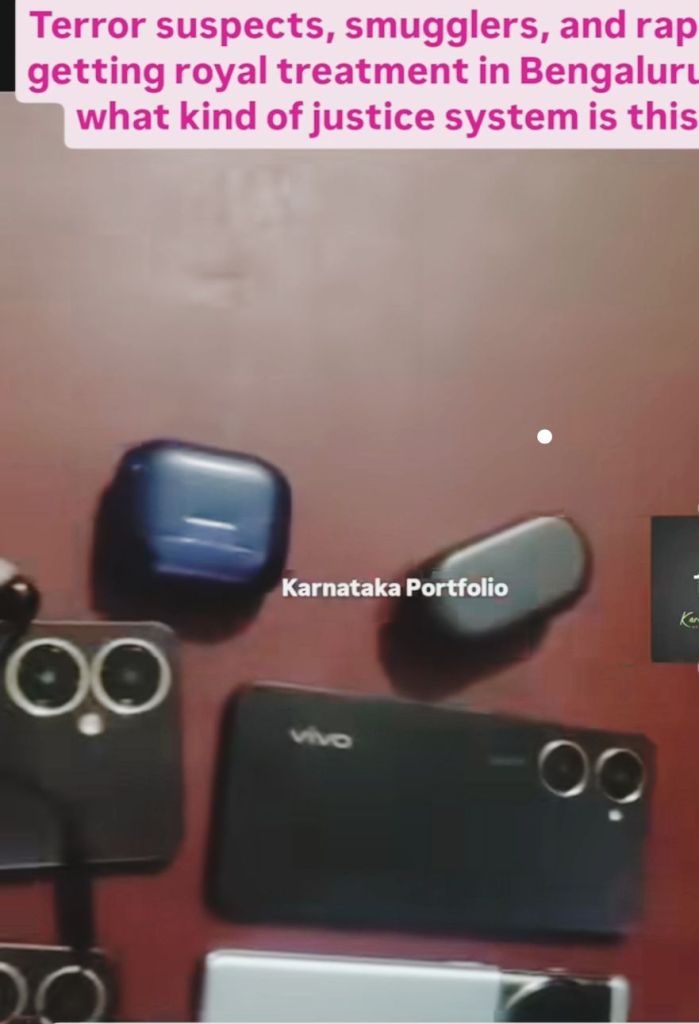
At the centre of this storm is a name India would rather forget — Umesh Reddy, a convicted serial rapist and murderer whose death sentence was commuted in 2022 to 30 years without remission. Yet, the leaked videos allegedly show Reddy lounging casually in his cell, juggling two Android smartphones and a keypad phone, scrolling through social media like any free citizen. In a facility where even a matchstick is supposed to be contraband, the sight of a convicted killer with multiple gadgets is not just indiscipline — it’s institutional decay.
And Reddy wasn’t alone.

Another inmate, Raju, accused in a high-profile gold smuggling case, was filmed not just using a phone but cooking his own meal inside prison — a scene more reminiscent of a kitchen vlog than a high-security lockup. Even more disturbing was footage of Johar Hamid Shakeel, an alleged ISIS operative, casually using a smartphone and accessing amenities far beyond his rights as a detainee. When terrorism suspects can stay digitally connected from inside a maximum-security prison, the issue ceases to be about lax supervision — it becomes a national security failure.

Authorities responded quickly — at least on paper. The Additional Director General of Prisons ordered verification of the footage, directing a Deputy Inspector General to conduct an inquiry, and an FIR is reportedly being filed at the Parappana Agrahara Police Station. But these moves, though procedural, merely skim the surface. The scandal doesn’t lie in the footage itself — it lies in what it reveals: a system compromised from within.
Three questions hang like a sword over this entire episode. First, how did so many phones enter a supposedly sealed facility? Occasional smuggling is one thing, but multiple smartphones circulating across multiple cells for years signals organized collusion, not coincidence. Second, who inside facilitated it? Phones don’t walk through gates on their own; they are bought, smuggled, charged, and protected — which implies complicity at several levels. And third, who leaked these videos — a brave whistleblower exposing rot or a rival inmate playing a dangerous game of digital blackmail?

This isn’t Parappana Agrahara’s first brush with scandal. The same prison was recently in the news when Kannada actor Darshan was accused of receiving preferential treatment. The recurrence of such episodes is no accident — it’s the symptom of a culture where power and privilege seep even into cells. For those who can pay or pull strings, the prison becomes less a place of punishment and more a private retreat with restrictions negotiable by price.
Adding to the irony is the issue of signal jammers. Parappana Agrahara is equipped with high-powered devices designed to block cellular communication. Residents in neighbouring areas have long complained that these jammers disrupt their mobile and internet connections. Yet, astonishingly, inmates inside seem to be livestreaming from their cells without interruption. Are these jammers outdated? Tampered with? Or deliberately switched off? Whatever the reason, it exposes a failure that is technical, moral, and administrative — a digital moat breached from within.

This scandal is more than a headline — it’s a mirror reflecting how India’s penal system is crumbling under its own contradictions. Technology meant to enforce control has been hijacked to enable crime. The custodians of law appear to have become its weakest link. When public trust in the justice system is already brittle, such incidents hammer it further, reinforcing a grim perception: that the rich, powerful, or connected remain privileged even behind bars.
India is no stranger to inquiries. But what Parappana Agrahara needs now isn’t another report destined for a dusty shelf — it needs accountability. Phones don’t sneak in; people let them in. Jammers don’t fail; they’re made to fail. Rules don’t erode overnight; they’re chipped away by apathy, greed, and silence. The scandal doesn’t just call for disciplinary action — it demands systemic cleansing, where technology, surveillance, and ethics are redefined to restore credibility.
In its current state, Parappana Agrahara is no longer a correctional facility — it’s a two-way corridor between crime and power, where WhatsApp bridges the walls and Wi-Fi mocks the locks. If India’s prisons are the final frontier of justice, this one has been breached not by violence but by signal bars and moral bankruptcy. Until the system finds the courage to police itself, every smartphone smuggled in becomes another symbol of a state surrendering to corruption.

In the end, Bengaluru’s high-security prison stands as a paradox — a fortress built to contain crime, now consumed by it. And in a digital age where control collapses with the tap of a touchscreen, Parappana Agrahara isn’t just a story about inmates breaking rules — it’s about a system breaking faith.
Visit arjasrikanth.in for more insights
 SOCIAL PERSPECTIVES