
“From Dial-Up Dinosaur to 5G Phoenix: BSNL Is Trying to Rise From Its Own Ruins”
Something quietly remarkable happened in India’s telecom landscape in August 2025. Bharat Sanchar Nigam Limited (BSNL), the public sector telecom giant most had written off as a relic of another age, added 1.4 million new mobile subscribers in a single month — overtaking Airtel in net additions for the first time in years. The event barely made headlines, but for those who’ve followed BSNL’s turbulent journey, it felt surreal — as if the dial-up dinosaur had suddenly grown wings.

For a company that once defined India’s connectivity dreams and later became a symbol of bureaucratic decay, this resurgence is nothing short of rebirth. The turnaround was triggered by a potent mix of government backing, deep restructuring, and renewed technological ambition — especially the upcoming nationwide 5G rollout, now fully tested and ready.
BSNL’s story has always mirrored India’s telecom journey. Once the nation’s backbone, connecting remote villages when private players stayed urban, it symbolized national integration. But cracks began to appear around 2010, when it reported its first-ever loss of ₹1,823 crore. By 2015, losses had ballooned to ₹36,000 crore. Bureaucratic indecision, policy paralysis, and missed opportunities pushed the company into freefall. When a massive spectrum fee in 2010 drained BSNL’s reserves from ₹29,300 crore to ₹1,700 crore, its decline accelerated. Overstaffing added to the pain — salaries alone consumed 54% of total revenue. Meanwhile, private players raced into 4G, while BSNL was still crawling through 3G.

Then came the Jio storm of 2016 — free calls, dirt-cheap data, and a digital blitz that rewrote the rules. Airtel scrambled, Vodafone and Idea merged to survive, and BSNL looked prehistoric. By 2019, burdened with ₹32,000 crore debt and a shrinking user base, BSNL was gasping.
But the government refused to pull the plug. It wasn’t just a company; it was a strategic lifeline. Without BSNL, India’s telecom space risked collapsing into a dangerous duopoly between Jio and Airtel. Between 2019 and 2025, the government injected life back into the company through three massive revival packages totalling ₹3.2 lakh crore — an amount larger than India’s defence budget.
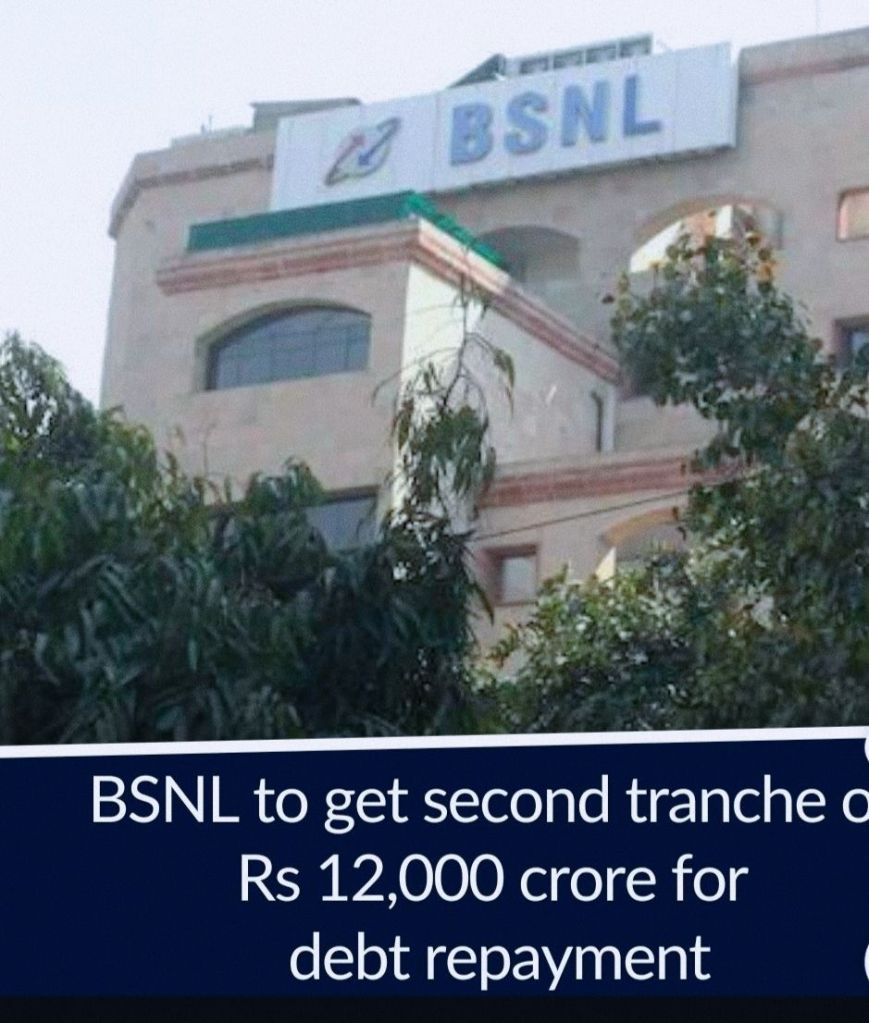
The first, in 2019, worth ₹69,000 crore, focused on survival. Through a Voluntary Retirement Scheme, BSNL halved its workforce — a painful but necessary amputation. The second, in 2022, poured ₹1.64 lakh crore into modernizing networks and funding 4G rollout, with a crucial shift — BSNL would now use an indigenous 4G and 5G stack developed by TCS and C-DOT, a bold step toward Atmanirbhar Bharat in telecom technology.
The third package, in 2023, worth ₹89,047 crore, delivered the much-awaited 5G spectrum, finally leveling the playing field with Jio and Airtel. A final ₹6,982 crore top-up in 2025 accelerated rural 4G expansion — the missing link in BSNL’s revival story.
The results are visible and tangible. Debt has been cut by a third. The company’s capital base has expanded fivefold. BSNL’s 4G towers now dot rural India, reclaiming territories once abandoned. Its subscriber base, which had been in freefall, has stabilized at about 9 crore. The August 2025 surge wasn’t a fluke — it was the rural heartland voting with its SIM cards.
When Jio and Airtel hiked tariffs, BSNL hit back with a ₹225 plan offering generous data, instantly resonating with small-town and rural users. With 5G trials complete, BSNL is gearing up to launch services in Delhi and Mumbai by December 2025. Its 4G infrastructure is already 5G-ready, requiring only a software update to go live nationwide — a technological masterstroke.
Financially, the tide is turning. BSNL posted back-to-back quarterly profits — ₹262 crore in Q3 FY25 and ₹280 crore in Q4 — its first in over a decade. Even if sceptics point to accounting adjustments, the psychological impact is immense. For the first time in years, BSNL isn’t a meme — it’s a movement.
Yet, challenges loom. Jio and Airtel together control over 70% of India’s telecom market. BSNL’s 7.9% market share and meagre 3.2% data penetration reveal a long climb ahead. Competing on glamour or marketing would be futile. Instead, BSNL’s strength lies in its affordability, dependability, and reach — the places where private networks still fade to a single bar.
BSNL’s mission isn’t to dominate; it’s to democratize. Its very existence ensures telecom equity — that no Indian, however remote, is left unconnected, and no private monopoly grows unchecked. The government recognizes that saving BSNL isn’t about nostalgia for a PSU — it’s about digital sovereignty and market balance.
However, financial injections can’t substitute operational excellence. BSNL must now prove that it can deliver quality service, digital agility, and customer satisfaction comparable to the best. It must shed the tag of being “cheap but slow” and rebrand as “reliable and proudly Indian.”
If BSNL sustains profits, launches 5G as planned, and consolidates its rural base, it could achieve what few state enterprises ever have — evolution instead of extinction. Its resurgence would not just mark a corporate turnaround but symbolize India’s determination to preserve both competition and connectivity.
For now, the most improbable comeback in India’s telecom history is quietly unfolding. The old behemoth that once carried the nation’s first phone call is now preparing to carry its 5G dreams. BSNL is no relic of the past — it’s proof that with vision, patience, and resilience, even the slowest connection can reboot into a revolution.
Visit arjasrikanth.in for more insights
 SOCIAL PERSPECTIVES