
From Mumbai’s buzzing phones to billion-rupee portfolio wars, India’s new millionaires aren’t just multiplying—they’re rewriting the rules of money, loyalty, and survival in a $2 trillion wealth scramble.
India’s millionaire map is being redrawn at breakneck speed. In just four years, the number of millionaire households has nearly doubled—from about four lakh in 2021 to almost nine lakh in 2025. Each of these households now holds a net worth of at least ₹8.5 crore, signaling not just a statistical milestone but a social shift. Wealth is no longer a tiny island guarded by a few dynasties—it’s an expanding archipelago of affluence reshaping the financial landscape.
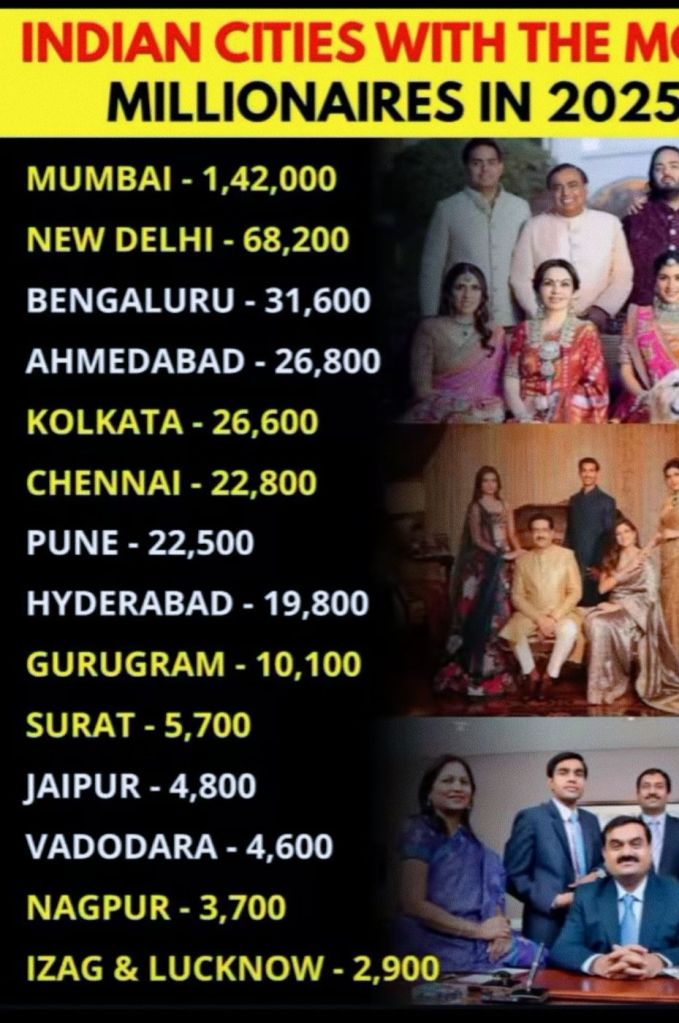
Nowhere is this more evident than in Mumbai, the country’s millionaire capital with nearly 1.5 lakh wealthy households. The frenzy is palpable. One family recently found themselves dodging a barrage of calls from relationship managers pitching the same deal: an IPO of a real estate investment trust. Some bankers were so desperate to close that one deal that they even waived their commissions outright. What looked like opportunity for clients felt like siege warfare, with phones buzzing nonstop.
This race reflects the new reality—money creation in India is not only real, it’s roaring. But as wealth swells, so does the competition to manage it. Every IPO, private equity fund, and alternative investment product triggers a frenzy. Relationship managers are expected to secure crores from multiple clients every year. With every firm chasing the same targets, the game is no longer about nurturing trust over decades; it’s about who can shout loudest, move fastest, and charge the least.

Clients, however, are catching on. India’s richest one percent already control over 60% of the nation’s wealth, and they are savvier than ever. Gone are the days when wealth was locked in gold or fixed deposits. Family offices—bespoke or multi-family collaborations—are now steering decisions, often opting for fixed-fee or advisory-led models that cut commission-heavy distributors out of the pie. Annual fees that once hovered around 3–4% have now collapsed to as low as 0.5–1%. A brutal price war has ensued, fuelled by new-age private equity and venture capital firms undercutting legacy wealth houses.
The fallout is clear. Families worth thousands of crores think nothing of shifting portfolios overnight if a rival promises better returns, exclusive access, or slashed charges. One family recently moved a ₹2,000 crore portfolio because another firm dangled a sweeter deal. Loyalty has become fragile; the only constant is the chase.

To survive, wealth managers are diversifying. Many now cross-sell services, tying wealth management to investment banking, brokerage, and corporate advisory. Others lean on technology—deploying AI to analyze client behavior, churn risk reports, and monitor portfolios in real time. This allows managers to juggle more clients without collapsing under the weight of expectations. Yet, the human factor remains the bottleneck.
India has fewer than 500 truly competent ultra-high-net-worth advisers. The scramble to hire them has unleashed an arms race of packages and perks. But poaching talent at any cost risks creating a bubble of unsustainable salaries, even as firms struggle with thinning margins. It’s a paradox: wealth is exploding, but skilled managers are vanishingly rare.

Meanwhile, client demands have grown sharper and more complex. Today’s millionaires don’t just want stock picks. They want entire wealth blueprints—succession planning, tax structuring, global diversification, governance for family firms, liquidity planning for entrepreneurs, and compliance navigation for offshore assets. Cookie-cutter advice is dead; every plan must be as bespoke as the clients commissioning them.
Layered over this is regulation. With new rules enforcing separation between advisory and distribution, the old double-dipping model is gone. Compliance costs are rising, especially for boutique firms trying to compete with giants that can spread costs across diversified businesses. Smaller outfits are bleeding to stay relevant, while bigger players tighten their grip on metros.
Still, the opportunity is colossal. Analysts expect India’s wealth management industry to double its assets under management within five years, crossing $2 trillion. The landscape will likely polarize—giant firms using scale and AI to dominate cities like Mumbai, Delhi, and Bengaluru, while boutique firms carve niches in emerging cities or specialist domains. The winners will be those who blend technology with trust, talent with transparency, and product with personalization.

For now, the image of that Mumbai family dodging incessant calls from relationship managers says it all. In India’s wealth rush, the boundary between service and siege has blurred. Millionaires may be multiplying at lightning speed, but so are the headaches of managing them. The gold rush is real, but so is the grind—and only those firms that can outlast the noise will still be standing when the dust settles.
Visit arjasrikanth.in for more insights
 SOCIAL PERSPECTIVES