
From frying dal to filling your plate, every drop of cooking oil connects India’s kitchens to geopolitics, inflation shocks, and the struggle for farmer survival—because edible oil isn’t just food, it’s strategy.”
Every morning in India, somewhere, a samosa sizzles, dal bubbles, or an omelet flips in a pan—and unbeknownst to you, you’re part of a multi-billion-dollar global drama. Forget OPEC and crude oil; the real story that touches every kitchen, wallet, and farm lies in edible oil. That humble bottle on your counter is more than a cooking ingredient—it is a symbol of dependence, inflation, farmer livelihoods, and national strategy.

India’s relationship with edible oil has been a slippery slope. In the 1960s, the average Indian consumed just 3.2 kilograms a year. Today, consumption has exploded to nearly 20 kilograms per person—more than 500% growth, far above the World Health Organization’s recommended 13 kilograms. Rising incomes, urbanization, and a taste for fried snacks, processed foods, and packaged indulgences have fueled demand. Palm oil, cheap and high-yielding, dominates at 37% of total consumption, followed by soybean at 21%, mustard at 14%, and sunflower at 12%. Every packet of chips, biscuit, Maggi, or chocolate contains its trace. Yet, despite domestic production of around 40–45% of demand, India imports the rest—and we import massive quantities.
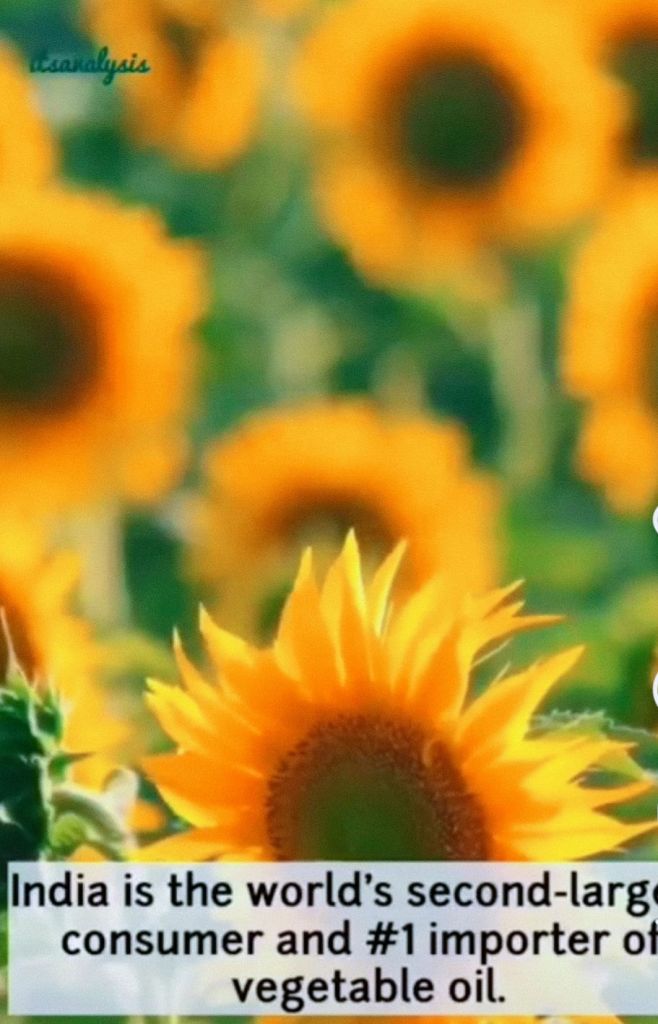
India is the world’s largest edible oil importer, bringing in 13–15 million tonnes annually, costing nearly ₹1.3 lakh crore. This is bigger than the GDP of some small countries and ranks just after crude oil and gold on India’s import bill. Sixty percent of cooking oil comes from abroad, leaving us vulnerable to geopolitics, climate shocks, and currency swings. Indonesia and Malaysia control 82% of global palm oil exports; Argentina, Brazil, Russia, and Ukraine dominate soybean and sunflower oil. A drought in South America? Prices soar. A war in Ukraine? Sunflower oil disappears. An export ban in Indonesia? Your cooking oil price doubles overnight. And since imports are dollar-denominated, every wobble in the rupee hits your kadhai directly.
Domestic economics aren’t helping. Oilseed production has reached record levels of over 41 million tonnes, but yields remain low—barely half the global average. Rainfed fields, marginal lands, and smallholders lacking irrigation, modern seeds, and technology plague the sector. Unlike rice and wheat, oilseeds lack robust MSP and procurement guarantees, making them less attractive to farmers. Companies face wafer-thin margins of 0.5–1% compared to FMCG giants with double-digit profits. Even India’s largest processor, Adani Wilmar, is pivoting toward FMCG, while Patanjali aims for a 50–50 split between oils and packaged goods by 2027.
Refining capacity is another bottleneck. India has over a thousand refineries, but utilization has dropped from 65% five years ago to 46% today. Low capacity usage means high fixed costs and financial stress, driving consolidation and squeezing smaller players.
Government policies oscillate between protecting farmers and controlling inflation. Import duties rise to shield domestic oilseed producers, then fall to temper food prices. In 2024, crude oil duties were hiked to 20%, only to be cut to 10% in May 2025. Duty differentials between crude and refined oil aim to encourage domestic refining but are short-term fixes. Imported inflation, driven by edible oils, skyrocketed from 1.3% in June 2024 to 31.1% by February 2025, highlighting the stakes.

To address this, the government launched the National Mission on Edible Oils–Oil Palm in 2021 with ₹11,000 crore, planting millions of saplings across 12,000 hectares. Mustard hybrids, PM-AASHA support schemes, and buffer stocks aim to make India self-reliant within seven years. But ambitions face tough realities: boosting yields, expanding irrigation, modernizing processing, and incentivizing farmers are easier said than done.
The stakes are clear. Edible oil is no longer just about frying pakoras. It affects the current account deficit, farmer livelihoods, inflation, and vulnerability to foreign shocks. Wars, droughts, or export bans dictate domestic prices. The choices we make—between farmer profitability and consumer relief—will shape India’s agricultural and economic future. A Yellow Revolution 2.0 may be needed to join the ranks of the Green and White revolutions, making India truly self-reliant in its oils.

So the next time you pour oil into the pan, tempering dal or frying samosas, remember: your kitchen is connected to boardrooms, trade policies, and international diplomacy. That simple bottle isn’t just oil—it’s a strategic commodity at the center of a global, economic, and political drama, with India’s fate hanging in the balance.
Visit arjasrikanth.in for more insights
 SOCIAL PERSPECTIVES