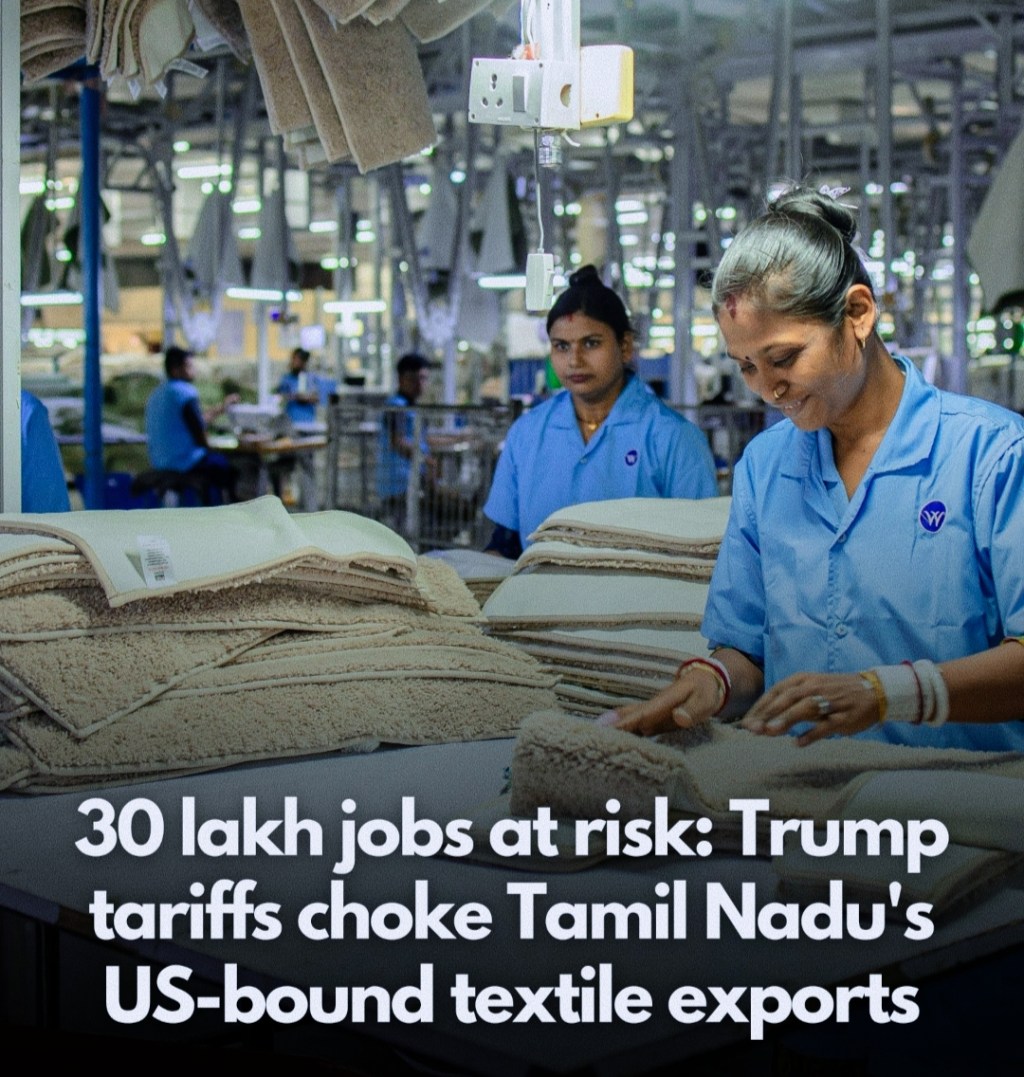
When U.S. politics turned into economic warfare, Gujarat’s diamond polishers and Tamil Nadu’s knitwear weavers became collateral damage—reminding India that global trade can unravel with the stroke of a pen.
When politics in Washington collides with the looms of Tiruppur and the polishing wheels of Surat, the fallout is more than just numbers on a balance sheet. It is a shockwave that shakes the livelihoods of millions across India’s two most vibrant export powerhouses—Gujarat and Tamil Nadu. The sudden 50 percent tariff imposed by the United States on Indian exports has not merely disrupted trade; it has exposed the fragility of a system that thrived on predictability.

What unfolded was no ordinary trade skirmish but a two-stage ambush. First came a 25 percent tariff on a wide range of goods, followed swiftly by another 25 percent aimed specifically at India, a punitive response to New Delhi’s continued crude oil and defence purchases from Russia. The message was blunt: energy independence comes at a heavy economic price.
The impact on Gujarat was immediate and devastating. Long hailed as India’s industrial heart, Gujarat thrives on textiles and diamonds—two sectors deeply dependent on American buyers. The textile sector alone, worth over $10 billion annually, suddenly found itself priced out of competitiveness. Exporters who had survived global recessions, pandemic shutdowns, and supply chain crises were now left gasping. Orders evaporated almost overnight. Liquidity dried up as payments froze on canceled consignments. Even if an agreement materializes tomorrow, industry veterans warn that recovery would take at least six months—an eternity for small and medium firms already walking a financial tightrope.

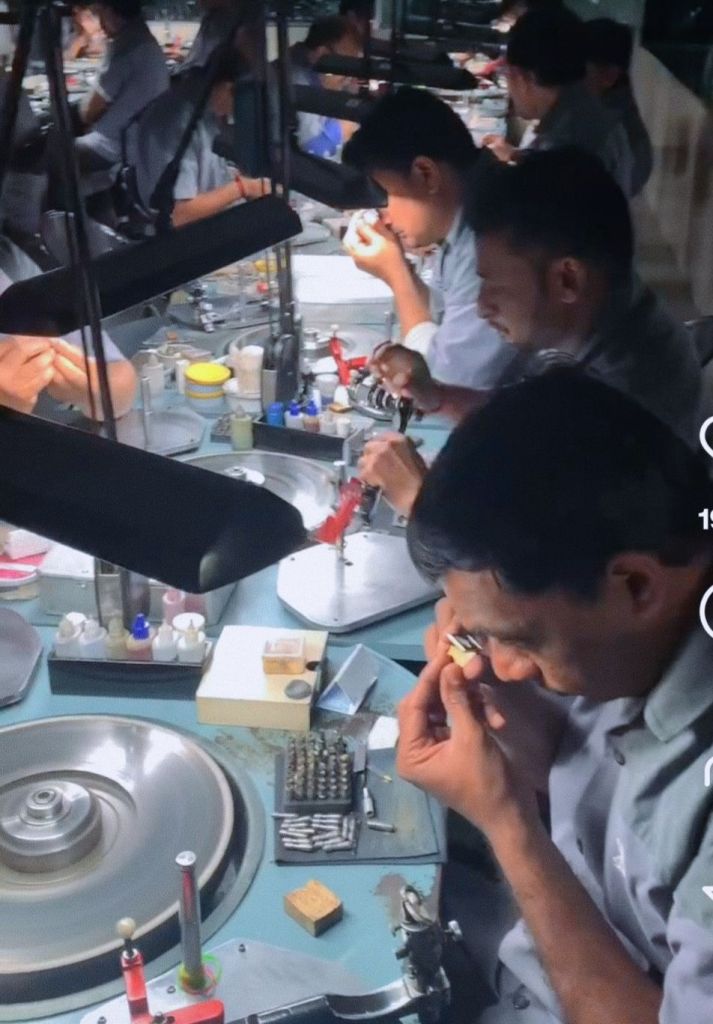
The diamond sector sparkles with irony and tragedy. Surat, which polishes nine out of every ten diamonds in the world, faced mass layoffs. Christmas orders—critical for sustaining half of annual U.S. shipments—were put on ice. Giants like Kiran Gems and Dharmanandan cut production by a third. Workers, once steady in their craft, now stand in queues for severance. Smaller towns—Bhavnagar, Amreli, Junagadh—watched employment vanish within weeks. With half of India’s polished diamonds headed for the U.S., the tariff translated into catastrophe. Some artisans turned to the growing lab-grown diamond industry, but anxieties run high that if tariffs extend there too, Gujarat will be cornered with no escape route.
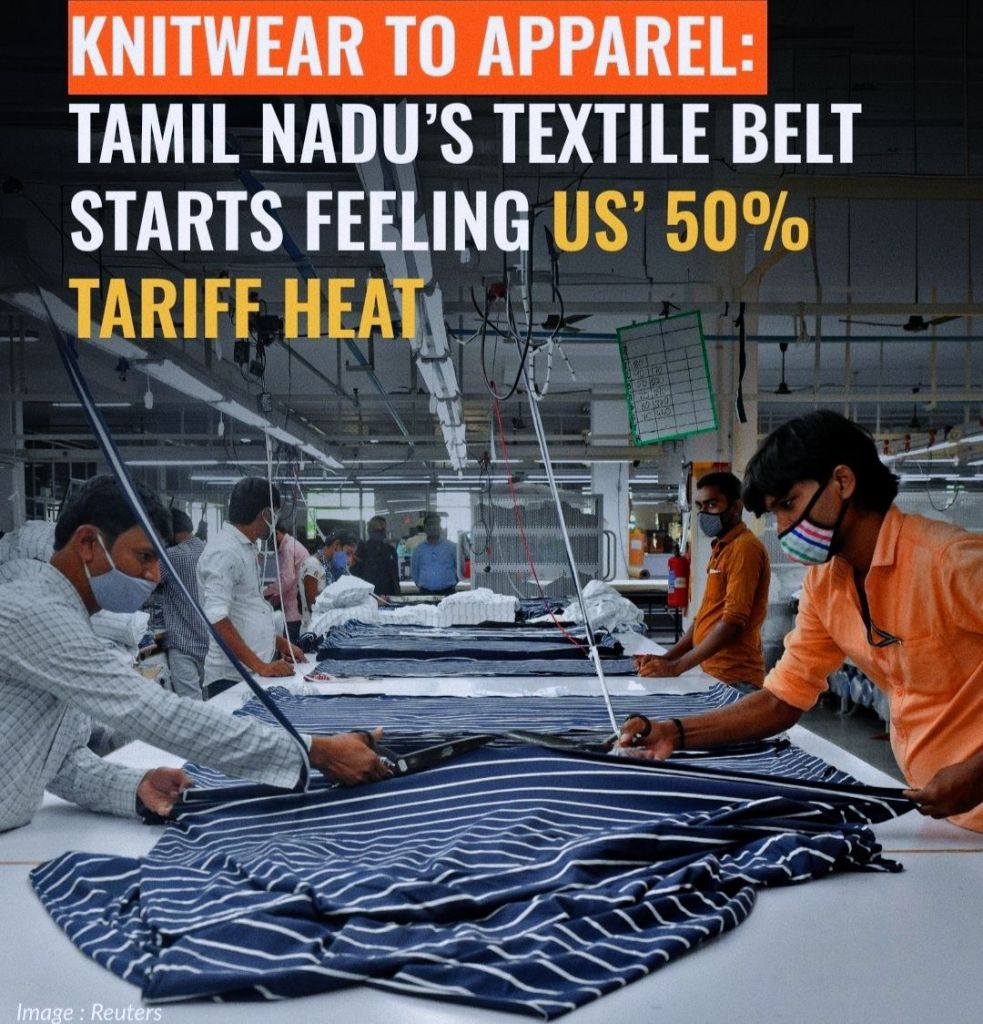
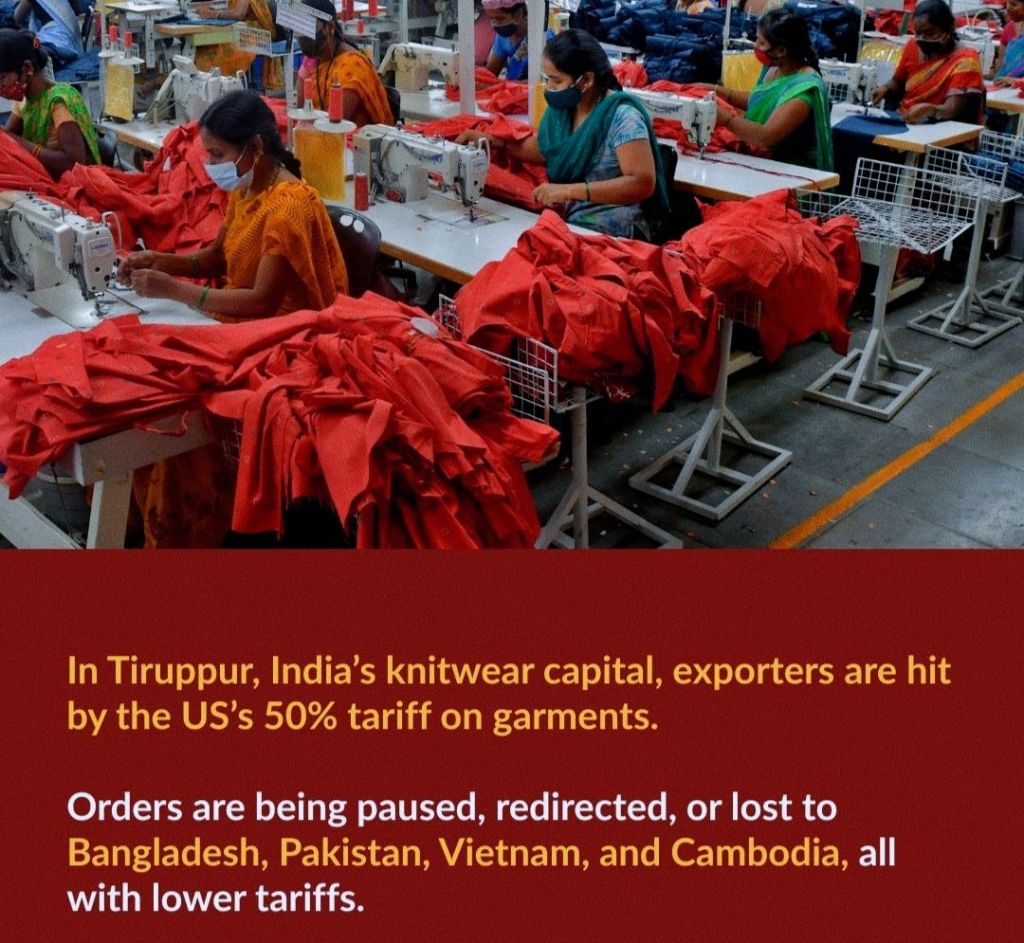
Tamil Nadu’s Tiruppur, the global knitwear hub, found itself ensnared in the same crisis. For an industry where U.S. retailers account for nearly 40 percent of orders, the blow was lethal. Buyers abruptly canceled contracts, citing untenable costs. Reports emerged of American retail chains directing factories to dispatch only what was ready before the tariff deadline, leaving unfinished consignments stranded. Thousands of small knitwear units shuttered operations. The collapse rippled through transporters, dyers, spinners, and allied trades, threatening nearly 300,000 livelihoods. With annual turnovers exceeding $5 billion, Tiruppur’s once-resilient economy now stares into the abyss. The pain is not only economic but social, as entire families tied for generations to garment work confront their first existential crisis.
Both Gujarat and Tamil Nadu show how tariffs ripple beyond headline statistics. These states are not just exporters but ecosystems, accounting together for nearly 68 percent of India’s total export basket and sustaining more than three million direct jobs. A sudden rupture in supply chains leaves factories shuttered and communities destitute. Picture a small Tiruppur family running 20 knitting machines, forced to shut because a Walmart order was canceled overnight. Or a Surat artisan who once cut stones for Tiffany’s, now idle. These are not abstract figures but lived human tragedies.
Yet paradoxically, trade data tells another story. Between April and July 2025, Indian exports to the U.S. rose by over 21 percent, reaching $33.53 billion, while U.S. exports to India grew by 12 percent. It is a strange paradox: trade momentum continues despite higher tariff walls. This suggests consumer demand and business linkages between the two economies are resilient, perhaps even developing immunity against political turbulence. But resilience has limits. With each escalation, the risk grows that momentum will snap, pushing exporters to reroute supply chains and U.S. buyers to shift permanently to rivals like Vietnam or Bangladesh.
The political context is inescapable. Washington’s tariff ambush is as much geopolitics as economics. By targeting India’s Russian oil imports and defence purchases, the U.S. seeks to tighten strategic pressure. New Delhi, however, remains firm: energy security and strategic autonomy are non-negotiable. The government now faces a tightrope walk—condemning tariffs, cushioning industries, and yet refusing to yield on foreign policy. Policy tools are on the table—export incentives, tariff reimbursements, market diversification—but none offer instant relief. Everyone acknowledges the reality: the U.S. market, which absorbs a quarter of India’s textiles and nearly a third of its gems and jewelry, cannot be replaced overnight.
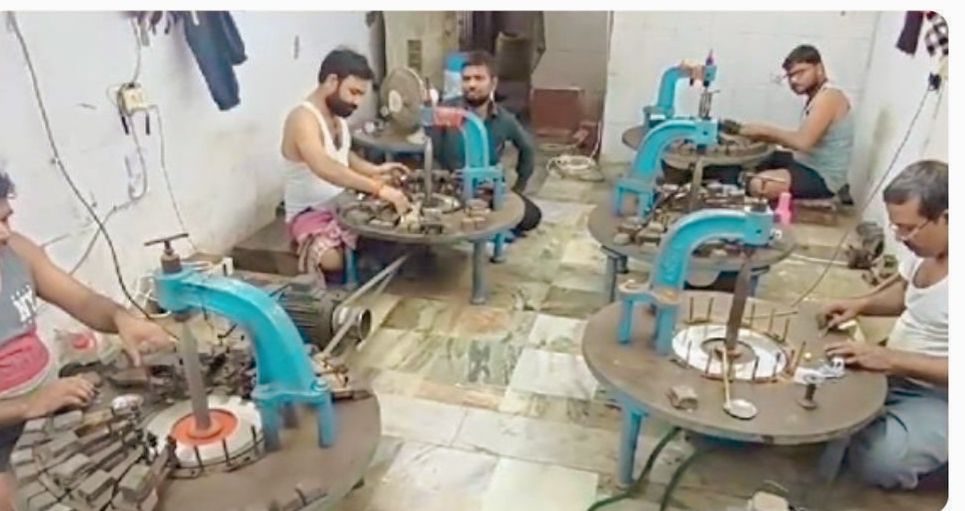
The consequences stretch beyond trade balances. Exports to the U.S. stand at $87 billion—about 2.5 percent of India’s GDP. A collapse in this corridor could shave off 0.2 to 0.4 percent of growth. But beyond percentages, the stakes are profoundly human. In Gujarat, diamond polishers slip into unemployment queues. In Tamil Nadu, knitwear entrepreneurs watch decades of toil unravel. Across both states, the ghost of economic fragility looms, reminding India that global supply chains remain hostage to the whims of faraway capitals.
In the end, the silk nooses of tariffs and the diamond dust of disrupted trade expose a bitter truth: politics and commerce are inseparable. Decisions in Washington ricochet into the looms of Tiruppur and the cutting benches of Surat. Unless swift relief arrives—through deft diplomacy abroad and bold interventions at home—the twin jewels of India’s export economy risk losing their brilliance. And with them, a vital part of India’s economic soul.
Visit arjasrikanth.in for more insights
 SOCIAL PERSPECTIVES