
Poker, rummy, fantasy sports—wiped out in seven minutes as India’s Parliament swung the hammer on an industry employing lakhs.
It took just seven minutes. Seven minutes for the Lok Sabha to introduce and pass the Promotion and Regulation of Online Gaming Bill, 2025. By 7:07 a.m., an industry worth billions, employing lakhs, and engaging nearly half a billion Indians had been pushed off the cliff. No consultation, no phased transition—just a guillotine. A day after the Union Cabinet gave its nod, political consensus translated into execution speed that would make even Silicon Valley blush. Overnight, India positioned itself among the world’s harshest regimes on digital gambling, outlawing online real-money gaming with one stroke of the parliamentary pen. With the Rajya Sabha’s approval, the bill is now law, awaiting only the formalities of implementation.

The sweep is breathtaking. Poker, rummy, fantasy sports—every platform where money changes hands is now illegal. The justification rests on a single chilling phrase: “suicidal harm.” Rising addiction, mounting debts, and tragic cases of self-harm were enough for lawmakers to flatten the sector. The penalties are equally ruthless. Players face up to three years in prison and fines of ₹1 crore. Advertisers risk two years behind bars and ₹50 lakh in penalties. This was not regulation; this was eradication.
The rhetoric of the state is neat and moralistic: “social gaming” versus “money gaming.” Ludo is safe, Candy Crush is safe, e-sports are safe. But once cash enters the picture, the government paints it as a public health emergency. Play for fun is leisure, play for money is danger. On paper, this is protection. In practice, it is the iron hand of the state colliding with one of India’s fastest-growing digital frontiers.

And what an industry it was. By 2022, over 450 million Indians were engaged in real-money gaming. Collectively, they lost an estimated ₹20,000 crore annually, but the sector generated ₹31,000 crore in revenue, attracted $2.5 billion in foreign investment, and supported nearly 400 start-ups. It directly employed 200,000 people and contributed another ₹20,000 crore to the exchequer. Far from being a fringe indulgence, this was a sunrise sector, a showcase of India’s digital growth story. To extinguish it in seven minutes was not just a crackdown on gambling—it was the demolition of a symbol of entrepreneurial ambition.
Industry insiders described the move as nothing less than a “death knell.” Their warning was blunt: prohibition does not erase demand, it only pushes it into the shadows. Players will not stop; they will migrate to offshore operators beyond India’s jurisdiction, where fraud, money laundering, and capital flight thrive unchecked. Ironically, domestic firms had pleaded for regulation, not immunity—seeking licensing frameworks, grievance redressal, and consumer safeguards. Draft proposals in 2023 had even hinted at a balanced middle path. Yet all nuance was drowned out in a legislative theatre that lasted less than the time it takes to brew a cup of tea.
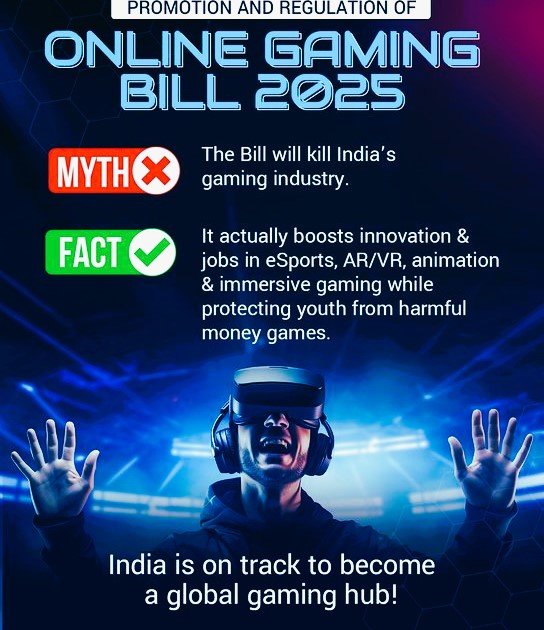
Why so sudden, so sharp? Addiction is the official explanation. But the undercurrents run deeper. Taxation had already shaken the foundations: the imposition of a 28% levy on the full face value of bets crippled most business models. A blanket ban was politically cleaner than messy recalibration. Jurisdictional authority was another flashpoint. Gaming straddled state borders and cyberspace, creating a grey zone of governance. A central ban asserted supremacy decisively. Populism too played its part: no politician risks votes by promising to save families from gambling ruin. Add to that security concerns over laundering and foreign money flows through gaming channels, and the calculus tilted firmly toward prohibition. In politics, simplicity often wins where complexity does not.
But the fallout is immediate and far-reaching. Investor confidence takes a hit every time India wields policy as a wrecking ball. Job losses are mounting as developers, designers, marketers, and compliance teams are rendered redundant. The start-up ecosystem, once hailed as the engine of India’s innovation, now confronts a state that can vaporize entire industries before breakfast. And most importantly, players will not disappear; they will simply migrate to riskier, unregulated corners of the internet. In the name of protecting citizens, the state risks exposing them to greater harm.

Implementation rules will follow soon, and financial regulators are already tightening scrutiny on money flows linked to gaming. Officials may promise consultations, but the fundamentals are settled. The hammer has only begun to fall.
Yet this moment transcends gaming. It is, at its core, a clash between two competing visions of India’s digital future. One vision imagines a nation that nurtures start-ups, attracts global capital, and embraces risk as the engine of innovation. The other envisions India as a moral custodian, ready to annihilate entire industries overnight in the name of social protection. Both visions carry weight, both carry logic. But by choosing prohibition over regulation, the state has revealed something deeper: a lack of trust in citizens, and a preference for control over choice.

Seven minutes was all it took. Seven minutes to redraw the contours of India’s digital economy, to turn a sunrise industry into a cautionary tale. The government calls it protection. The industry calls it execution. The truth, perhaps, is that in seven minutes, India managed both.
Visit arjasrikanth.in for more insights
 SOCIAL PERSPECTIVES
One response to ““Seven-Minute Guillotine: India Erased a Billion-Dollar Industry Before Breakfast””
good step
LikeLike