
“A Himalayan cloudburst exposes not just the fury of nature, but the deeper fault lines of human negligence, climate change, and unprepared governance.”
In the quiet pre-dawn hours of August 5, 2025, the tranquil village of Dharali in Uttarakhand was struck by an unimaginable catastrophe. A sudden and violent cloudburst transformed the serene Himalayan slopes into a churning torrent of water, mud, and debris. In minutes, homes, farmlands, and familiar landscapes were swept away with unyielding force. Over 210 millimeters of rain fell within just 24 hours, claiming at least five lives, while more than a hundred people remain missing. Survivors recall the moments before the disaster as hauntingly silent—an unsettling calm shattered by the sound of collapsing slopes, bursting riverbanks, and the earth itself succumbing to nature’s fury.
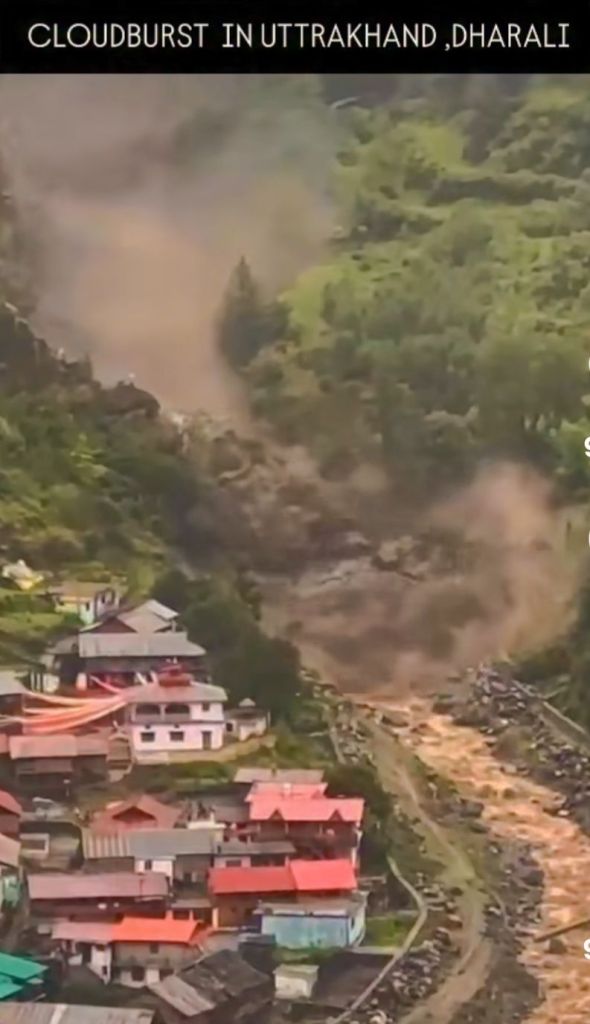
Chief Minister Pushkar Singh Dhami confirmed that a cloudburst was the scientific cause. Yet the scale of destruction reveals a deeper, more sobering truth: the impact of human negligence in amplifying natural hazards.
Cloudbursts—intense rainfall exceeding 100 millimetres per hour over a small area—are a known meteorological phenomenon in the Himalayas, where steep topography forces moisture-laden winds to rise rapidly, cooling and condensing into extreme rainfall. Climate change is intensifying such events. Rising global temperatures enable the atmosphere to retain more moisture, creating volatile conditions ripe for sudden downpours. The Dharali disaster echoes the Kedarnath floods of 2013, where over 6,000 lives were lost—a grim reminder of how global warming, coupled with local mismanagement, transforms natural hazards into large-scale humanitarian tragedies.
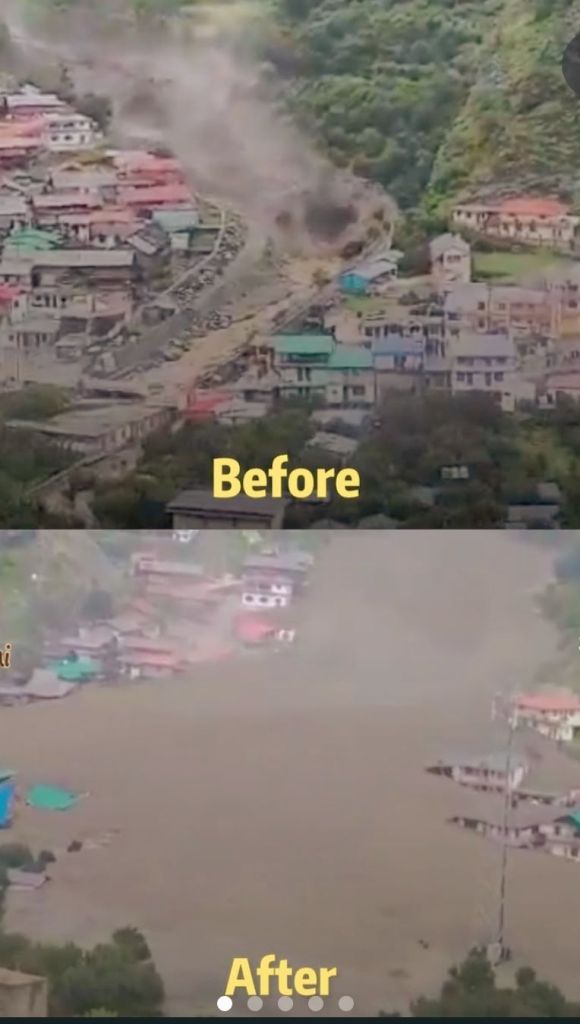
But to frame Dharali’s destruction purely as a climate story is to ignore decades of human action—or inaction—that have weakened natural safeguards. Unregulated and haphazard construction in flood-prone zones, unchecked deforestation, and indiscriminate road building in fragile hill terrains have destabilized slopes and obstructed natural water channels. Across India, from Wayanad to Chennai to Srinagar, the pattern repeats: vulnerable ecosystems altered for short-term gains, inviting nature to reclaim space with devastating consequences.
India’s institutional response to flood and landslide risks remains largely inadequate. By 2024, only 12% of the nation’s dams had Emergency Action Plans, despite long-standing recommendations. Floodplain zoning, proposed nearly five decades ago, has been implemented in just two states. Essential mitigation projects are delayed by bureaucratic hurdles, while vulnerable communities—the poorest and most exposed—are left to confront disasters with minimal preparation or support.

Global experiences offer compelling alternatives. Wuhan, China, has pioneered the “Sponge City” model, embedding wetlands, permeable pavements, and green spaces into urban design to absorb excess rainwater. In India, some states have demonstrated leadership: Andhra Pradesh has restored urban water bodies to reduce flooding, and Kerala’s Eco-DRR (Ecosystem-based Disaster Risk Reduction) program has mobilized local communities to rehabilitate degraded landscapes while improving livelihoods. These examples prove that resilience is achievable when planning, ecological stewardship, and community engagement converge.
India’s current policy posture, however, remains reactive—focused on relief and compensation rather than prevention. This approach perpetuates a costly cycle of rebuilding after each disaster instead of investing in long-term resilience. The path forward must combine structural measures—such as flood barriers, robust stormwater drainage, slope stabilization, and climate-resilient housing—with non-structural measures including early warning systems, strict land-use regulation, and transparent enforcement of zoning laws.

In ecologically sensitive regions like Uttarakhand, the policy default should shift toward restrictive development. Infrastructure projects should undergo rigorous environmental and geological assessments before approval, with a bias toward rejection unless there is an overwhelming public interest and demonstrable risk mitigation. Ecological buffers such as river floodplains, wetlands, and forest cover must be treated as vital infrastructure, not expendable land.
The Dharali cloudburst is both a tragedy and a warning. Climate projections indicate that extreme rainfall events in the Himalayan belt will intensify in frequency and severity. The region’s current infrastructure, governance capacity, and disaster readiness are ill-suited to withstand such shocks. Without systemic reforms, each monsoon season could bring fresh rounds of destruction, loss, and displacement.
Importantly, nature’s forces—rain, rivers, and wind—are not inherently the enemy. The real danger lies in our inability, or unwillingness, to adapt and prepare. Disasters such as Dharali are shaped by a combination of climatic triggers and human vulnerabilities. Our challenge is not merely to endure these events but to redesign our systems—physical, social, and institutional—to minimize harm.
This means embedding disaster risk reduction into every tier of governance, from village councils to national ministries. It requires climate literacy in infrastructure planning, better integration of local knowledge in hazard mapping, and sustained investment in nature-based solutions. It calls for holding both public agencies and private developers accountable for violations in ecologically sensitive zones. And it demands that political will align with scientific advice, resisting the temptation to compromise long-term safety for short-term gains.
As the waters of Dharali recede, they leave behind more than wreckage—they expose the fragility of our current trajectory. The lives lost are a painful reminder of what is at stake; the landscapes altered, a visual testament to the costs of inaction. Whether we treat this as another fleeting headline or as a decisive turning point will define the safety and sustainability of communities across the Himalayas and beyond.

If we fail to act now, the next cloudburst will not only erase homes and livelihoods but also wash away the last remnants of our excuses. In an era of accelerating climate change, preparation is not optional—it is a moral and strategic imperative.
Visit arjasrikanth.in for more insights
 SOCIAL PERSPECTIVES