
“Ctrl+Alt+ Research: Why India’s R&D Dreams Are Still Buffering While the World Hits Warp Speed”
In the age of Mars missions, moon landings, and AI-powered toothbrushes, it’s tragically ironic that a country which boasts of being the world’s IT brainbox barely invests in its own future. With less than 0.7% of its GDP earmarked for research and development, India isn’t just lagging behind—it’s rehearsing excuses while the rest of the world races ahead. When nations are training humanoids for space colonization and decoding the human genome with AI, India is still hitting refresh on the same bureaucratic Excel sheet of missed opportunities.
The statistics are not just sobering—they’re embarrassing. India’s Gross Expenditure on R&D (GERD) stands at a pitiable 0.64% of GDP. The global average? A robust 1.79%. China is cruising at 2.1%, and the U.S. leads the pack with 2.8%. This isn’t a gap—it’s a canyon. Worse still, while Indian policymakers love repeating the “Startup India” mantra, our private sector is in R&D coma. Industry’s contribution to total R&D is just 36.4%, while in China and the U.S., it’s a powerful 75% and 68% respectively.
So, what do we export? Certainly not patents or cutting-edge products. We export people—over 85,000 brilliant Indian-origin scientists now power labs in Boston, Berlin, and Beijing while Indian startups struggle to cross the prototype threshold. We’ve become the world’s training school for innovators—just not for ourselves.

Why this mess? It starts with chronic underfunding. Even in crucial sectors like agriculture, R&D investment is a shocking 0.43% of Agri-GDP. Add to that a regulatory system so byzantine it makes a 1990s Doordarshan schedule look tech-savvy. There are tax disincentives, legacy license raj mechanisms, and approval processes that move slower than glaciers. The innovation ecosystem is fragmented—universities operate in isolation, startups don’t know where to go, and large corporations prefer importing tech instead of building it in-house.
Even the little industrial R&D we do have is hilariously concentrated. Pharma and IT take the lion’s share at 24.3% and 8.7% respectively. Manufacturing? Electronics? Renewable energy? They’re still trying to download the R&D memo. And let’s not pretend we’re self-reliant—over 30% of India’s industrial imports still come from China, especially electronics and specialty chemicals. So much for Atmanirbhar Bharat; it’s more Atma-nirbhar with a side of import dependency.

Now, let’s talk about the talent paradox. India produces engineers in bulk, but when it comes to real researchers, we’re out of stock. There’s a shocking mismatch between what’s taught and what the industry needs. Our graduates can recite definitions but can’t build a drone that flies straight. Add to this the massive gender gap—only 14% of our R&D personnel are women, compared to 30% globally. This isn’t just a diversity issue—it’s a massive loss of potential.
So what’s the fix?
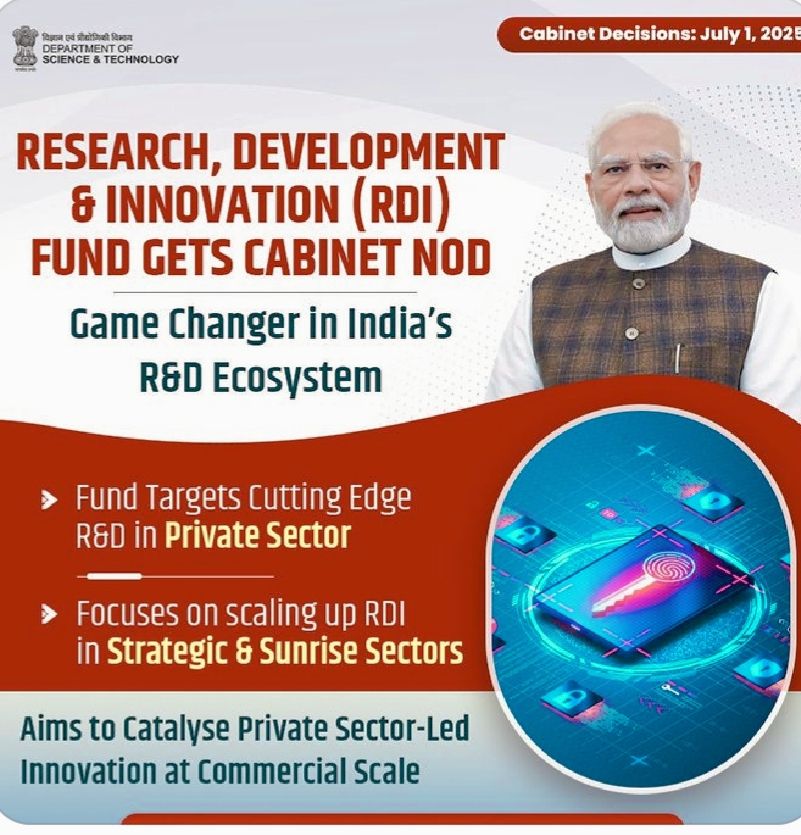
India must make a moon-shot commitment to double its GERD to 2% of GDP by 2030. It’s not just about money—it’s about national will. Institutions like the Anusandhan National Research Foundation (ANRF) must be given teeth—not just funding, but autonomy, speed, and a mandate to chase bold ideas. CSR and FDI funds should be incentivized to flow into R&D, not just as charity, but as lucrative business opportunities.

And let’s not reinvent the wheel. Germany’s Fraunhofer Institutes have cracked the code—government-funded, industry-aligned R&D machines that churn out products, not just papers. India’s Ucchatar Avishkar Yojana (UAY) has potential, but it needs steroids. Public-private partnerships must be more than PowerPoint promises. South Korea, Japan, and Israel have proven that even small countries can build big innovation stories with the right vision.
India must become obsessed—with AI, with quantum computing, with climate-resilient agriculture. These can’t just be panel discussion topics—they need to be national missions. We must fast-track patents, monetize public research, and reward inventors. Innovation should be the most secure career path in this country, not the riskiest.

And what of the talent drain? We need a reverse brain drain revolution. Offer globally competitive research grants. Build world-class labs. Launch the Vigyan Dhara Scheme with real funds and global mentors. Let’s bring our best minds home—not with sentiment, but with substance.
Let’s not forget equity. R&D isn’t just for men in metro cities. Rural women can innovate, too. A fixed percentage of every public R&D grant must go to women-led teams and rural innovators. The next water purification miracle or low-cost farming tool could come from a village in Odisha or a small town in Assam—not just IITs and IISc.
It’s time for a cultural reset. Enough with jugaad. Enough with slogans. Let’s stop worshipping the past and start building the future. Because the next industrial revolution won’t come with a warning—it’ll arrive as a patent someone else already owns.
The real question isn’t whether India can become an innovation superpower.
The real question is: will we wake up in time to lead, or keep refreshing a screen that’s already frozen?
Visit aarjasrijanth.in for more insights
 SOCIAL PERSPECTIVES