While Trump fumes and flings tariffs, India rewires global trade routes, powers digital revolutions, and turns economic reincarnation into its next superpower move. Welcome to the age of the ‘undead economies.’
Donald Trump’s recent jab calling India and Russia “dead economies” is less a geopolitical statement and more a frustrated outburst from a man watching the world rearrange itself beyond his control. It’s the voice of old power refusing to acknowledge a new era. Let’s be clear: these aren’t corpses Trump is talking about—they’re economies bursting with life, ambition, and, most dangerously for his narrative, momentum. Whether Trump likes it or not, India is not a “dead economy.” It’s a restless, roaring force, powered not just by oil and infrastructure, but by its billion-strong human will.

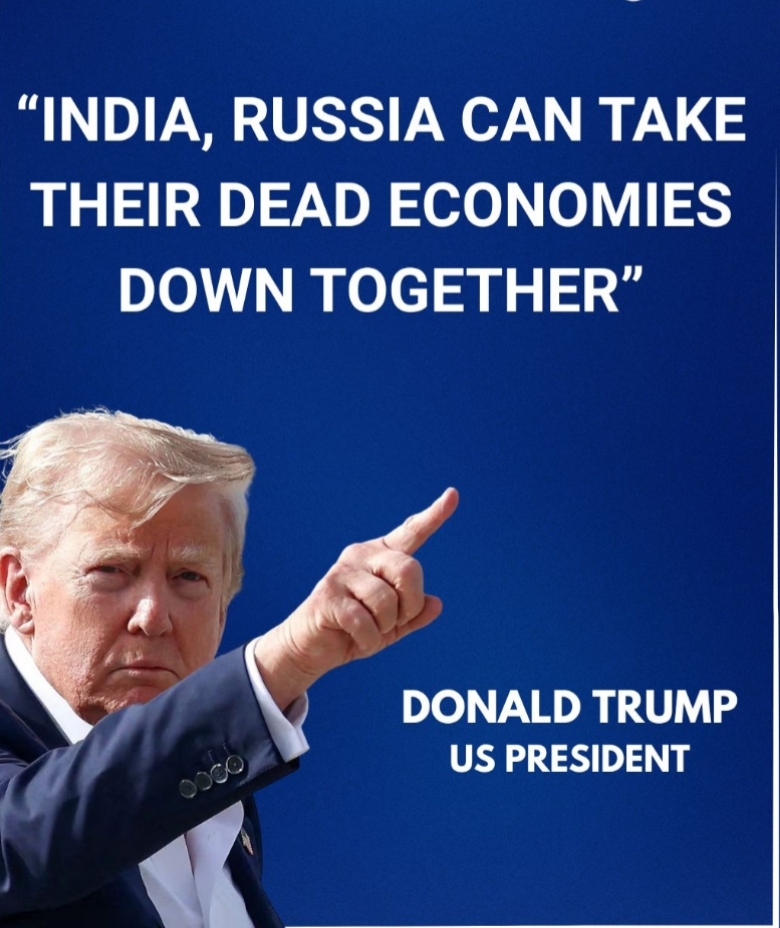
On July 31st, Trump declared on Truth Social: “I don’t care what India does with Russia. They can take their dead economies down together, for all I care.” This was paired with a 25% tariff on Indian goods and a threat of further penalties for its energy and defence trade with Russia. It sounded less like diplomacy and more like a schoolyard insult hurled by someone losing control of the playground. Behind the bluster, however, lies an undeniable truth: India is rising, and no amount of American petulance can rewrite that.
India, the so-called “dead economy,” is currently growing at 6.2%—one of the highest among major nations. Even with trade tensions, it remains the world’s most dynamic market for tech, energy, and skilled labour. Its $190 billion bilateral trade relationship with the U.S. is symbiotic. If Trump thinks a tariff tantrum will stop India, he’s badly misreading the script. Because India isn’t powered by American goodwill—it’s powered by its people. Its engineers, farmers, doctors, coders, and dreamers. This is a country that builds satellites on a shoestring budget, delivers medicines across the world, and trains the next generation of global tech leaders.
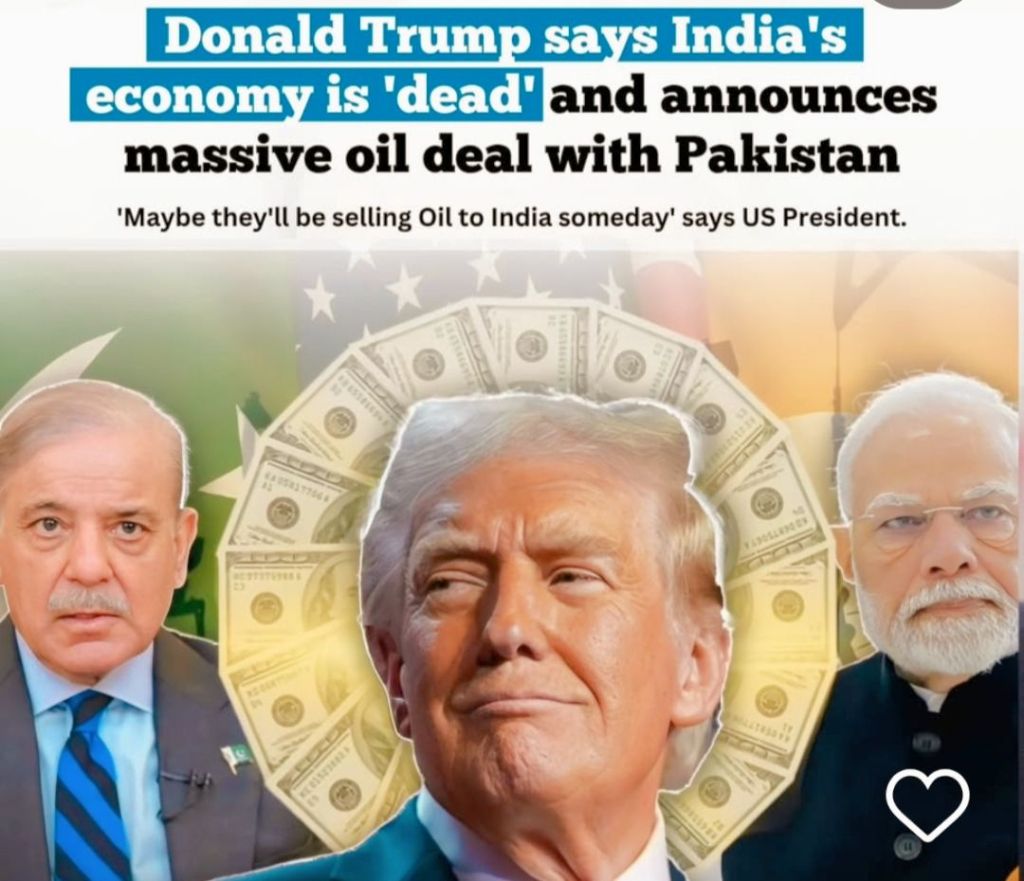
And what of Russia? Far from being buried by sanctions, it has rerouted trade flows, tapped into a “shadow fleet” to move oil, and deepened its economic ties with Asia. Trade between India and Russia alone hit $75 billion in 2024. Fertilizers, crude, coal, and even diamonds move through a parallel world of barter and local currency exchanges. Medvedev’s cryptic “Dead Hand” reference may have caught headlines, but the real threat to American dominance is not nuclear—it’s transactional. Countries are learning how to trade without dollars, without Western approval, and without fear.
Trump’s rant wasn’t about facts; it was about frustration. Because while he builds walls, India builds networks. While he imposes tariffs, India signs FTAs. And while he talks up “America First,” India quietly aligns with Europe, ASEAN, the Gulf, and Africa. It’s not just trade—it’s a tectonic shift in how the world does business. India is negotiating with the UK on a comprehensive trade deal. It’s exporting solar panels, pharmaceuticals, and electric vehicles. Apple is manufacturing iPhones in Tamil Nadu. India is investing in green hydrogen and 5G. “Dead economy”? No, Mr. Trump—this is economic reincarnation on a planetary scale.

Let’s look at where this “dead economy” is headed. India is betting big on the future—digitally, demographically, and diplomatically. The Production-Linked Incentive (PLI) schemes are driving manufacturing booms in sectors from electronics to defence. The National Green Hydrogen Mission is aiming for energy independence by 2030. The JAM trinity—Jan Dhan, Aadhaar, Mobile—has revolutionized financial inclusion. Its start-up ecosystem is now third only to the U.S. and China. This isn’t a country dying—it’s one that’s outgrowing its skin.
Yes, India buys oil from Russia—because it’s cheaper, reliable, and strategic. Trump’s America, meanwhile, continues to import Russian LNG through Europe. The difference is, India’s unapologetic about its national interest. It isn’t posturing behind slogans—it’s acting. In fact, India’s shift from Russian arms dependence shows its maturity: from 68% Russian defence imports in 2017 to a diversified portfolio today. Pragmatism, not paralysis.
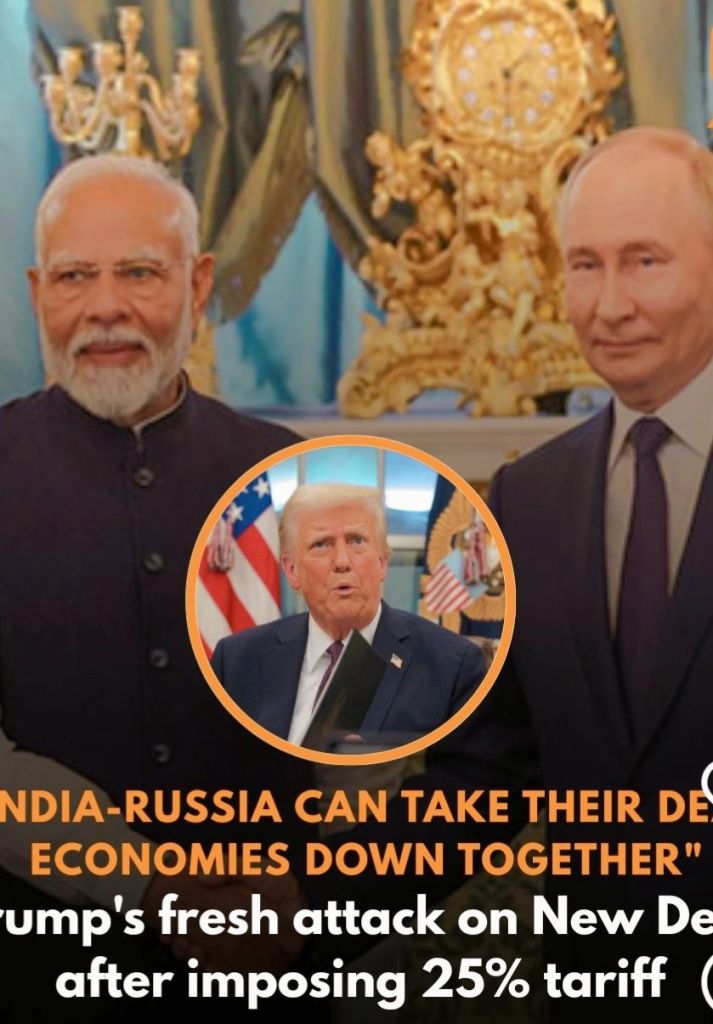
And if Trump thinks he can isolate India by slapping tariffs and throwing insults, he’s mistaken. This isn’t 1991. India has backup plans. It’s building corridors to the Middle East through the India-Middle East-Europe Economic Corridor (IMEEC). It’s deepening BRICS partnerships. It’s discussing rupee-ruble trade. It’s talking with Japan, Australia, France, and the UAE. It’s everywhere—and nowhere near dead.
Trump’s label doesn’t hurt India. It only exposes his dwindling influence. What he calls “dead” is in fact the world slipping out of unipolar control. He’s lashing out because countries like India and Russia are no longer willing to play the junior partner. They’re too busy signing their own checks, building their own weapons, creating their own platforms. They’ve figured out that dignity isn’t an American export—it’s a birth right.

In the end, Trump’s tantrum may win him claps from his voter base, but it won’t stop the Indian juggernaut. This is a country where 800 million people get free food security, where 1.4 billion citizens are digitally connected, where 20-year-olds launch start-ups and 70-year-olds vote in record numbers. It’s fully alive.
So when Trump sneers “dead economy,” he isn’t describing India. He’s describing a worldview that can’t handle change. He’s describing the death of unilateralism, not of a nation. Because in this new world order, it’s not the loudest voice that leads—it’s the strongest will. And India, powered by its people and its purpose, isn’t dying. It’s just got started.
Visit arjasrikanth.in for more insights
 SOCIAL PERSPECTIVES