
India’s safest tech haven turned shock therapist overnight—sending a message louder than any ping: adapt or get automated. As AI rewrites the rules, will Indian IT evolve or get ctrl-z’d by its own legacy?
In an act of corporate drama that stunned even the most cynical corners of India Inc., Tata Consultancy Services (TCS), the stalwart symbol of Indian IT’s reliability, shocked the system by laying off 12,000 employees in a move that wasn’t a memo—it was a megaton. This wasn’t cost-cutting. It was cultural demolition. TCS, long the embodiment of “safe jobs” and “slow but steady”, just launched its version of shock therapy—and it chose to do it loud, cold, and clear.

The message was unmistakable: AI has arrived, and it doesn’t do HR hugs.
Let’s not sugarcoat it. This wasn’t some bland “realignment exercise” or a quarterly belt-tightening ritual. This was a declaration of war on the very foundations of the Indian IT model. For decades, the model thrived on a glorious mix of human pyramids, offshore delivery centres, and the magical ability to turn humanities graduates into Java warriors in 90 days. But suddenly, that model looks like dial-up in a 5G world. The tech world turned a corner, and TCS tripped on its own legacy.
The official statements were a masterclass in corporate gloss: “strategic workforce optimization,” “AI-led delivery transformation,” “skills realignment.” Translated from HR-ese: the veterans didn’t learn fast enough, the future doesn’t wait, and machines are faster, cheaper, and never ask for promotions. And let’s be clear: this isn’t the usual freshers-get-culled story. No, this time, it’s the mid-level managers, the battle-hardened developers, the project leads — the people who once ran the show and now find themselves shown the door.

Why now? Why this scale? Because the tech storm brewing globally has finally made landfall in India. Western clients are jittery, budgets are shrinking, and digital transformation deals are going from billion-dollar dreams to thousand-dollar consultations. Every CEO in the West has two obsessions: reducing headcount and injecting AI. ChatGPT isn’t just writing code—it’s rewriting strategy. GitHub Copilot isn’t just an assistant—it’s a silent assassin of the junior coder. Suddenly, having thousands of engineers looks more like a liability than a strength.
And yet, there’s something tragically short-sighted in this purge. Efficiency may please shareholders today, but where’s the vision for tomorrow? TCS is slicing through its institutional muscle. You can replace code, but not curiosity. You can automate functions, not culture. There’s no bot for mentorship, no algorithm for client empathy. When companies fire people, they don’t just lose labor—they lose stories, loyalty, intuition. You don’t inspire innovation by installing fear.

Meanwhile, the smarter giants are playing a longer game. Accenture is investing in retraining armies of professionals. IBM is nudging engineers into frontier tech like quantum and blockchain. Infosys has turned reskilling into a core product. Amazon, ruthless as it is, is pumping billions into upskilling its workforce. Because here’s the golden rule: transformation without transition is just chaos in disguise. You can’t go from zero to AI by skipping the human bridge.
TCS could have rewritten its playbook. It could’ve offered sabbaticals, launched internal AI academies, built “skills accelerators” for mid-career employees. It could have gamified learning, incentivized change, and used its sheer scale to turn every coder into a prompt engineer or AI-integrated specialist. Instead, it chose to let go. Loudly. Publicly. With the precision of a spreadsheet and the warmth of a robot.
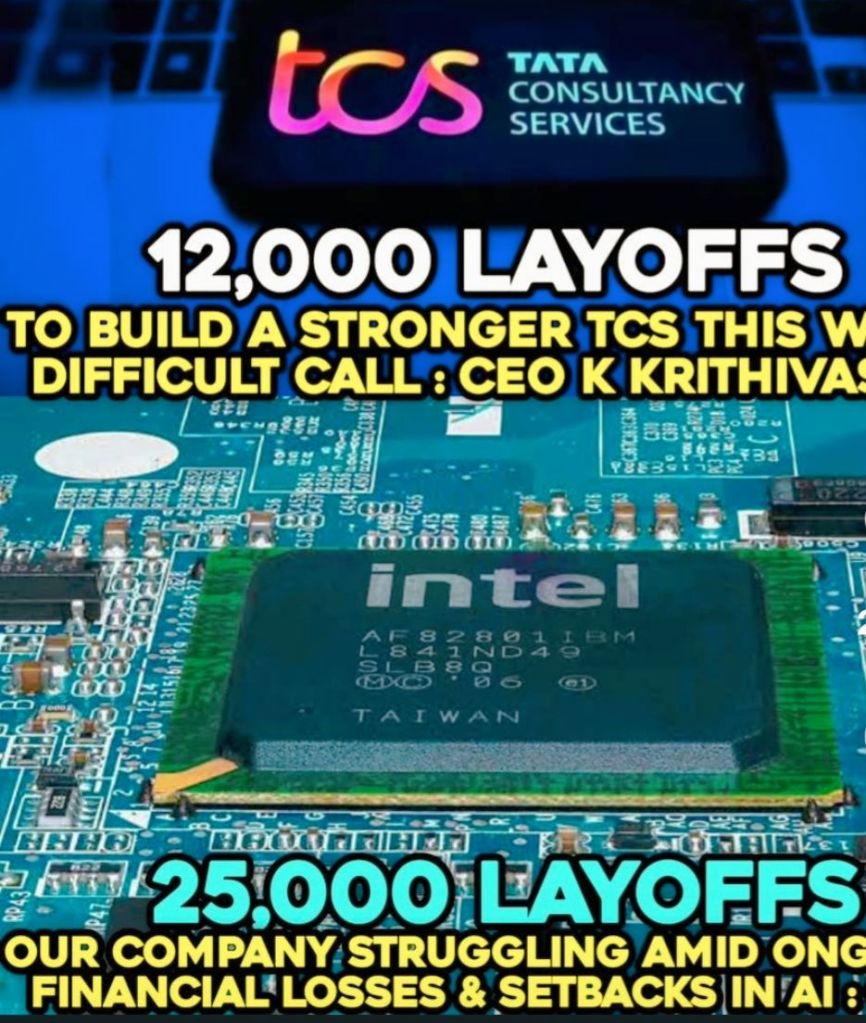
And now, a ripple has turned into a wave. Infosys, Wipro, Tech Mahindra — all are watching, calculating, wondering how deep the knife can go. Employees across India’s tech campuses are rattled. Aspirants at engineering colleges are suddenly questioning a future that once looked like a golden highway. Because if TCS, the most conservative, most predictable employer in the country, can swing the axe this hard, then truly, no one is safe.
Here’s the kicker: AI didn’t kill Indian IT. Complacency did. For years, the industry ignored the signals. Instead of reimagining the pyramid, it painted it. Instead of rewriting the codebase, it added patches. But technology doesn’t wait for tradition. Now, the coders of yesterday must become the architects of tomorrow. The companies that win this new war won’t be the ones that shrink—they’ll be the ones that shift. Shift from bodies to brains. From volume to value. From headcount to mindshare.

TCS has sounded the siren. The pyramid is crumbling. The bench is burning. The age of plug-and-play humans is over. This is not a business cycle. This is a species shift. From man-made to machine-taught. From coders to curators. From execution to evolution.
So here’s the blunt truth: the future won’t be staffed. It will be sparked. By those who adapt, not those who wait. By those who code with AI, not against it. And if India’s IT titans want to lead the future, they must first stop fearing it.
Because the future has already been deployed. It’s just waiting for login credentials.
Visit arjasrikanth.in for more insights
 SOCIAL PERSPECTIVES
One response to ““TCS Code Red: Ctrl+ Alt+ Fired 12000 Humans and Hired Algorithms ”
given an eye opening warning
LikeLike