Once side-lined for choosing marriage, today’s women bureaucrats lead fiscal policy, crush crime syndicates, and crack national exams—reshaping the Indian state from within, one bold decision at a time.
Once upon a bureaucracy, a woman could be forced to give up her post for choosing marriage. Today, she could be drafting the country’s budget or quelling unrest in a Maoist-affected district. The transformation is not a happy accident—it is a quiet revolution, built on data, grit, and women who no longer request inclusion but reshape the institutions they enter.
Take Anuradha Thakur, a 1994-batch IAS officer, who now sits at the helm of India’s Department of Economic Affairs, a position once graced by Dr. Manmohan Singh. Her rise is not an anomaly. From health to corporate affairs to personnel and training, the corridors of power are seeing an influx of women IAS officers in significant, strategic roles. Out of 90 Union Secretaries, 16 are women—an 18% representation that, while not equal, signals a massive leap from a time when even becoming a district magistrate seemed out of bounds for women.
This shift hasn’t come overnight. Back in 2010, women formed only 22% of new IAS entrants. By 2023, that number jumped to 30%, with a peak of 34% in 2020. Today, nearly 1,500 of India’s approximately 5,500 IAS officers are women. These aren’t just statistics—they’re seismic shifts. When women enter the system, they don’t just add to it—they alter its priorities, culture, and even its power dynamics.
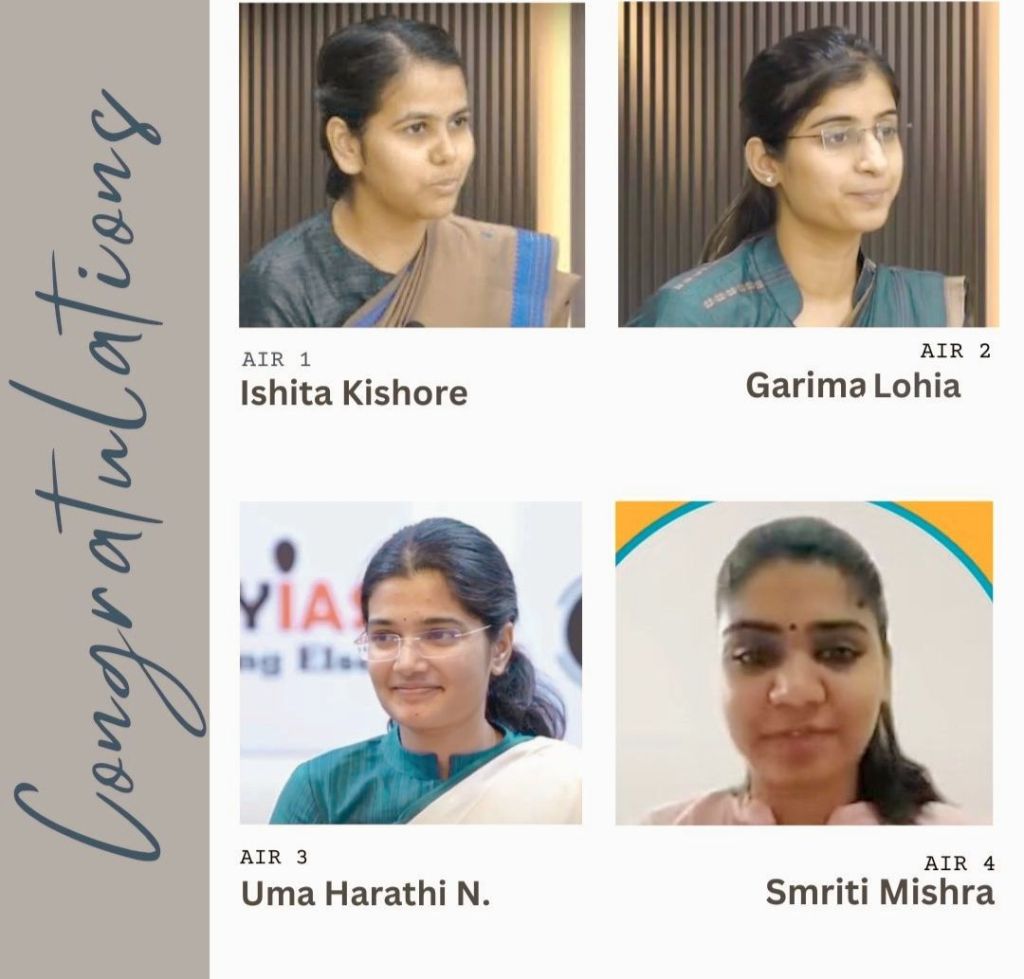
The real plot twist? Women have topped the UPSC exams back-to-back. In 2020, it was Shruti Sharma, Ankita Agarwal, and Gamini Singla. In 2023, it was Ishita Kishore, Garima Lohia, and Uma Harathi N. These aren’t mere achievements—they are signals. The future is not inching toward parity; it’s accelerating toward transformation.

And these women aren’t warming seats in token roles. Durga Shakti Nagpal in Uttar Pradesh cracked down on the sand mafia. Smita Sabharwal in Telangana pioneered tech-driven governance. Harjot Kaur Bamhrah has reimagined healthcare in Punjab. From enforcing law to drafting budgets, they are everywhere—visible, impactful, and unflinching.
But make no mistake—the revolution wears bruises. Only two of India’s 36 states and Union Territories have women Chief Secretaries. Ministries like Defence and Home remain male bastions. Women are often nudged toward “soft” portfolios—education, social welfare—rarely given the hard-edged offices of finance or security. Biases, both overt and hidden, persist.
And then comes the “invisible club”—the smoke-filled rooms and late-night calls, the WhatsApp networks and old boys’ camaraderie. These informal spaces still elude women, not because they lack competence but because they were never invited. A senior officer candidly remarked how male colleagues bond over a drink with politicians—an avenue rarely open to their female peers.
In conflict zones, the divide is even starker. Of the 47 Left-Wing Extremism-affected districts (until 2021), only 7 had women Collectors. As of 2022, only 142 of India’s 716 districts had women at the helm. That’s a dismal 19%, despite women consistently securing nearly one-third of the top administrative posts through the UPSC.
The geography of gender bias is also uneven. Tamil Nadu and Kerala have been more progressive, allowing women into the field early. States like Punjab and Haryana, however, took decades to shed their patriarchal filters. Clearly, the problem isn’t just gender—it’s a heady mix of gender, geography, and generational attitudes.
Yet the inertia is breaking. Lena Nair, from the 1982 batch, recalls a time when only 10% of her peers were women—yet 14 of them became secretaries. “Once you proved your credentials, the post came to you,” she says. Today, women don’t just prove—they dominate.
But we can’t pause here. If we are serious about sustaining this shift, structural reforms are overdue. Delhi’s “spouse posting” model needs replication across cadres. Anti-harassment frameworks must be strengthened, mentorship programs institutionalized, and conversations about horizontal reservation for women in civil services mainstreamed. This is not about favours; it’s about fairness.
On the societal front, we still battle biases that go beyond gender. Muralidharan, former Chief Secretary of Kerala, took to social media to call out the colourism and misogyny she endured. “As if being dark and a woman was something to be ashamed of,” she wrote. But perhaps it is from these very power posts that such prejudices can finally be confronted—and crushed.
Globally, India is not yet leading. Rwanda boasts 61% women in civil and parliamentary roles. Sweden has crossed 50%. The U.S. federal service is almost 46% female. India stands at 27% in the IAS. But here’s the good news: we’re on the right trajectory. The arc of history may be long, but it is clearly bending toward balance.
This is not just about employment or representation. It’s about narrative. Once upon a time, a woman bureaucrat’s role was to keep quiet and comply. Today, she commands, she reforms, and most importantly, she refuses to wait for change. She becomes it.
The steel frame of India’s bureaucracy has met its iron ladies. And they’re not here to decorate the system. They’re here to redesign it—bolt by bolt.
Visit arjasrikanth.in for more insights
 SOCIAL PERSPECTIVES
2 responses to “ “Iron Ladies and the Quiet Coup: India’s Women IAS Are Rewriting the Rules””
women is Half of the sky, so they should feel equally inAll spheres of life walk
LikeLike
The tide is turning. Slowly but surely. May the Force be with them.
LikeLike