
India’s bold leap into electricity futures rewires power from transformers to trading terminals—where no kilowatts flow, but capital does.
A quiet revolution is buzzing through India’s energy landscape—one not defined by new solar parks, ultra-mega power plants, or transmission lines stretching across the subcontinent. Instead, it’s being driven by spreadsheets, price indices, and trading terminals. For the first time in Indian history, electricity is being unbundled from its physical constraints and reimagined as a purely financial instrument. Welcome to the dawn of electricity futures—where no electrons move, and yet millions may change hands.
Traditionally, electricity in India has been a physical commodity: generated, transmitted, and consumed in real time. The entire system hinged on physical delivery, governed by long-term Power Purchase Agreements (PPAs), day-ahead auctions, and real-time balancing mechanisms. You could not “trade” electricity without actual generation and consumption. But beginning July 2025, that paradigm is set to change. The National Stock Exchange (NSE) and the Multi Commodity Exchange (MCX), regulated by the Securities and Exchange Board of India (SEBI), will launch electricity futures—cash-settled contracts that allow trading based purely on anticipated prices, not physical supply.
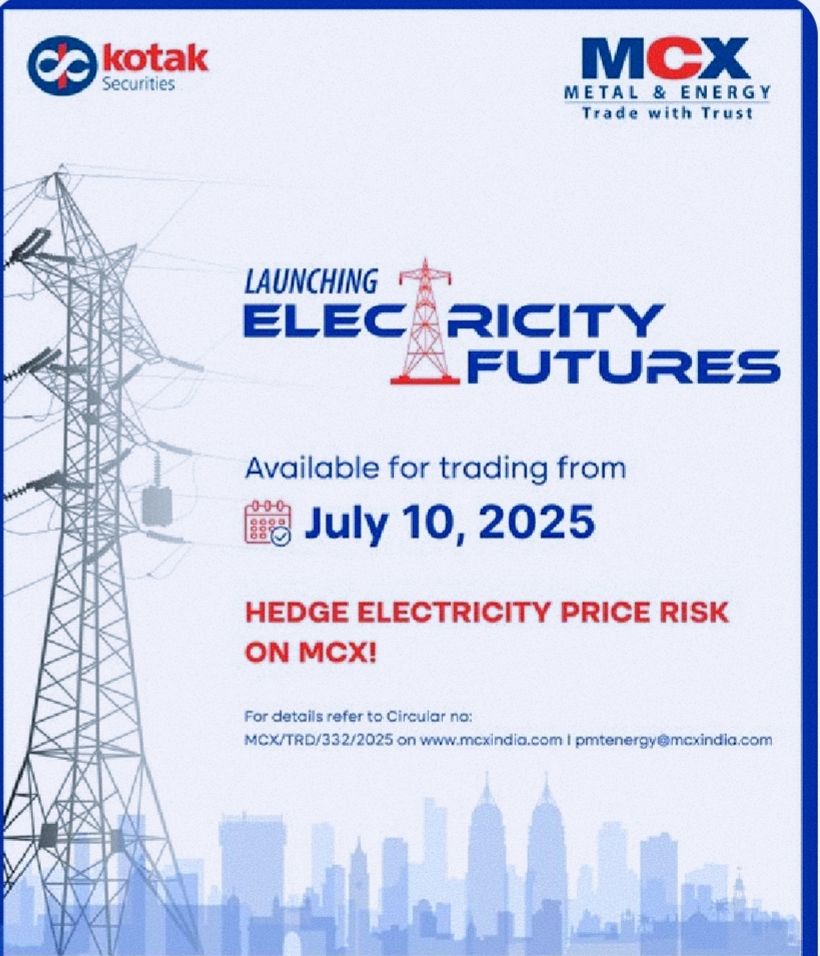
If this sounds like a financial leap, it is. Similar to gold or crude oil futures, electricity futures allow investors to speculate on or hedge against price fluctuations without handling the underlying commodity. There will be no transmission wires, no substations, and no electricity delivery involved. These contracts will be settled in cash, based on a pre-determined price index, enabling participants to profit—or lose—based on market movements alone.
India’s energy market has, until now, been anchored in physical delivery platforms like the Indian Energy Exchange (IEX), which is regulated by the Central Electricity Regulatory Commission (CERC). Long-term PPAs between generators and state-owned distribution companies (DISCOMs) provide the bulk of the country’s electricity supply. When demand spikes—due to weather fluctuations or supply shortages—spot markets fill the gap through real-time and day-ahead auctions. In each case, the transaction involves the actual delivery of electricity.
Electricity futures challenge this structure. These contracts don’t require physical delivery, and therefore fall under SEBI’s regulatory oversight, not CERC’s. The jurisdictional battle between these two regulators culminated in a Supreme Court verdict that drew a clear line: CERC governs physical delivery; SEBI regulates financial contracts. That ruling has now enabled NSE and MCX to venture into the electricity space—minus the wires.
For renewable energy producers, electricity futures offer a much-needed hedge. Many smaller solar and wind producers operate without long-term contracts, exposing them to volatile spot prices. Futures allow them to lock in prices, improving financial stability and bankability. Large power consumers—such as industrial units—can also hedge their costs, avoiding spikes during periods of high demand. Meanwhile, financial institutions, hedge funds, and traders can inject liquidity and deepen the market.

As the market matures, price discovery will improve, volatility will be better managed, and the electricity ecosystem could become more efficient and resilient. In theory, it’s a win for producers, consumers, and the broader financial system.
Historically, Indian utilities have been risk-averse. DISCOMs already struggle with delayed payments and tariff rigidity; they are unlikely to embrace complex derivatives without significant capacity building. Add to that the political sensitivities around electricity pricing—frequent subsidies, election-time giveaways, and bureaucratic inertia—and participation from key stakeholders could remain limited.

If the market is dominated by speculators rather than genuine participants, volatility could spike. Futures markets thrive on sentiment and expectations, not real-time demand and supply. But electricity isn’t like other commodities. It can’t be stored. It can’t be delayed. Demand and supply must match instantly to keep the grid stable. A surge in speculative activity could distort price signals, leading to unexpected stress on real-time markets.
The cautionary tale of the Texas power crisis in 2021 is a stark reminder. During an unprecedented winter storm, power supply collapsed while demand surged, driving prices up by 180 times. Futures markets failed to cushion the blow, and several power providers who had sold contracts at fixed rates went bankrupt trying to buy electricity at exorbitant prices to meet obligations. India’s regulated tariffs and stricter oversight may reduce this risk, but the structural fragility remains.

The success of electricity futures in India will depend on several factors: depth of participation, regulatory safeguards, transparency in price indices, and alignment with the physical power market. They must complement—not compete with—existing instruments like the Real-Time Market (RTM), Green Day-Ahead Market (G-DAM), and the upcoming Market Coupling initiative. Coordination between financial and energy regulators will be crucial to ensure systemic stability.
Despite the complexities, electricity futures represent a bold step forward. They offer a new layer of financial innovation in an industry often bogged down by legacy systems, regulatory bottlenecks, and political risk. For a country aiming to become a global manufacturing hub and ramp up renewable integration, price risk management is not a luxury—it’s a necessity.
In the end, India hasn’t just introduced a new financial product. It has signalled a fundamental rethinking of how electricity is valued, traded, and hedged. Electricity is no longer just a utility service—it’s becoming a strategic financial asset.
The wires may stay underground, but the potential is sky-high.
Visit arjarikanth.in for more insights
 SOCIAL PERSPECTIVES