
Axiom Mission 4 and Shubhanshu Shukla are Rewriting India’s Space Odyssey through Private Enterprise, Global Alliances, and Scientific Vision
In a moment that reverberates through the annals of history, India has triumphantly returned to human spaceflight after a staggering 41 years, with the launch of Axiom Mission 4 (Ax-4). At the helm of this ground-breaking voyage is Group Captain Shubhanshu Shukla, the first astronaut from the Indian Space Research Organisation (ISRO) to embark on a journey to the International Space Station (ISS) since Rakesh Sharma’s iconic mission in 1984. The significance of this event transcends mere technological achievement; it is a powerful symbol of national pride and aspiration for a billion people looking skyward.

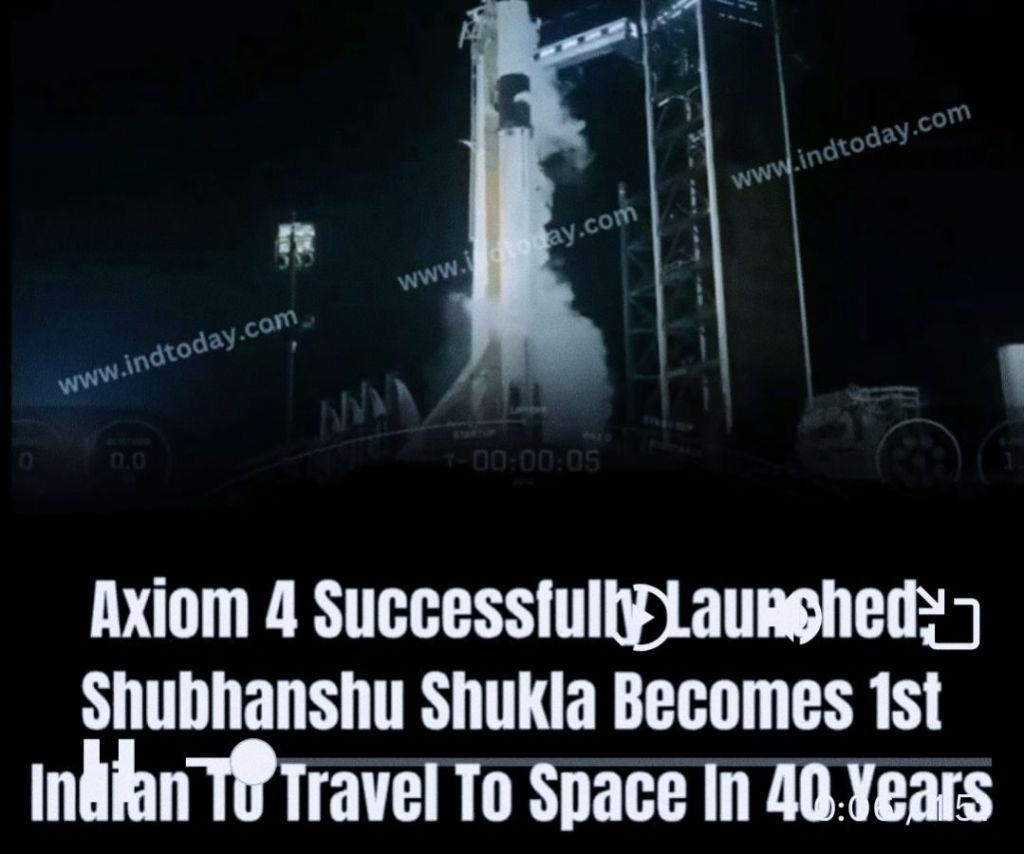
The Ax-4 mission, launched aboard SpaceX’s Falcon-9 rocket from Kennedy Space Centre in Florida, marks a historic convergence of commercial space initiatives and international cooperation. As Shukla and his fellow astronauts began their orbital journey, the excitement was palpable, with watch parties held across the globe—including one at Shukla’s alma mater, City Montessori School in Lucknow, where his parents witnessed this momentous occasion. The rocket lifted off at 12:01 PM IST, 25June,25 and just ten minutes later, the crew found themselves orbiting the Earth, a feat that not only reignites India’s space ambitions but also rekindles the dreams of generations inspired by the cosmos.

This mission is not merely about achieving a launch; it signifies a radical transformation in how India engages with space exploration. Unlike past endeavours that were predominantly state-led, Ax-4 embodies a new era of public-private partnerships, showcasing the collaborative spirit between NASA, Axiom Space, and India’s burgeoning private aerospace sector. This shift is a testament to India’s evolving strategy in space exploration, positioning itself as a key player in the global space economy and highlighting the importance of fostering a vibrant commercial space industry.
Shukla’s historic flight represents a generational leap forward, bridging the four-decade gap since India’s last human space mission. The implications of this return extend far beyond the launch pad; Ax-4 serves as a precursor to ISRO’s ambitious Gaganyaan mission, which aims to send Indian astronauts into space aboard a domestically developed spacecraft. The operational experience gained by Shukla and his crew will directly inform the development of India’s own crewed mission architecture, ensuring that the lessons learned in this commercial endeavour will contribute to the nation’s future aspirations.

Moreover, the scientific opportunities offered by the Ax-4 mission are immense. Aboard the ISS, Shukla and his fellow astronauts will conduct a range of experiments in microgravity that could unlock new frontiers in biotechnology, material science, and climate research. The unique conditions of space allow for the exploration of phenomena that are otherwise unobservable under Earth’s gravitational constraints, paving the way for ground-breaking advancements in pharmaceuticals, regenerative medicine, and sustainability science.
The Ax-4 mission also carries significant diplomatic weight, further solidifying India’s role on the international space stage. By participating in missions of this calibre, India aligns itself with global norms of space governance, particularly through frameworks like the Artemis Accords. This participation enhances India’s stature as a responsible and capable spacefaring nation, contributing not only to scientific progress but also to the geopolitical stability of the space domain.

Economically, Ax-4 opens the doors to private capital inflows into high-technology segments while minimizing the risks associated with investment in human spaceflight systems. The validation of operational protocols through this mission catalyses India’s efforts to build a sustainable and commercially viable space economy. The prospects for space-based manufacturing gain legitimacy through practical demonstrations on orbital platforms, particularly in sectors such as pharmaceuticals and advanced materials.
Perhaps the most profound impact of Shukla’s journey lies in its ability to inspire a new generation. The image of an Indian astronaut participating in international space research resonates deeply with students and young professionals across the country, fostering an environment ripe for growth in STEM education and innovation. As space exploration becomes an aspirational frontier, missions like Ax-4 play a catalytic role in nurturing the dreams and ambitions of countless young minds, ensuring that the benefits of such achievements extend well beyond the boundaries of scientific research.
In conclusion, Axiom Mission 4 is not just a technological endeavour; it is a cultural and strategic statement of intent. It signifies India’s resurgence as a formidable player in the realm of human space exploration, merging private ingenuity with scientific excellence and international collaboration. As Shubhanshu Shukla embarks on his orbital voyage, he carries not only the instruments of exploration but also the hopes and dreams of a billion people, reaffirming India’s place among the stars. In the narrative of India’s space program, Ax-4 marks the dawn of a new chapter—one that is rich with ambition, resilience, and a commitment to forging a path forward in the cosmos.
Visit arjasrikanth.in for more insights
 SOCIAL PERSPECTIVES
One response to ““Shubhanshu Shukla Soars: India’s Astronaut Breaks 41-Year Space Drought, Igniting Dreams Among Billions””
Wonderful post
LikeLike