
The rise and rush of India’s road-building behemoth hides a financial high-wire act, where borrowed billions, monetized miles, and fiscal illusions converge to build a glittering empire with vanishing foundations.
In the intricate world of public infrastructure financing, few stories are as contradictory—and as quietly alarming—as that of the National Highways Authority of India (NHAI). Tasked with building and managing 1.46 lakh kilometers of national highways, NHAI has become both a symbol of India’s rapid development and the source of a growing financial strain that remains largely out of public view. Driven by a focus on speed, scale, and visual success, NHAI has fundamentally changed how infrastructure is financed in India—often walking a fine line between innovation and risk.

In the early 2000s, NHAI emerged as a shining example of public-private partnerships through the Build-Operate-Transfer (BOT) model. Under this system, private companies built the highways at their own cost, operated them to recover investments through tolls, and then handed them back to the government. It was efficient, kept public finances off the hook, and appeared sustainable—until real-world challenges brought it down. Problems such as delays in land acquisition, incorrect traffic forecasts, and declining investor interest led to the collapse of the BOT model by 2014. Within a few years, it disappeared from NHAI’s project strategy, leaving the agency in urgent need of an alternative.
The transition was swift and dramatic. NHAI turned to government-funded models—Engineering-Procurement-Construction (EPC) and the Hybrid Annuity Model (HAM). These required less investment from private companies and more direct government expenditure. In EPC, the government pays the full cost of construction upfront, while under HAM, it pays 40% during the construction phase and the rest in installments over time. These approaches enabled an unprecedented pace of highway construction, reaching a record 34 kilometers per day by 2025. But this growth came at a cost. Between 2015 and 2024, NHAI’s debt surged from ₹24,000 crore to a staggering ₹3.35 lakh crore. This number is more than a statistic—it is a warning.
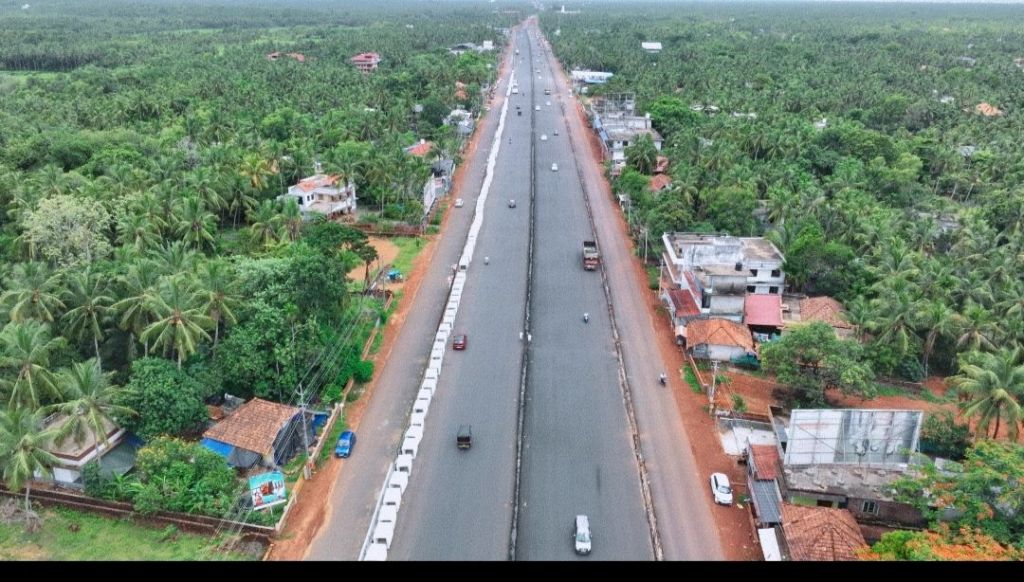
What makes this situation even more concerning is that NHAI’s debt does not show up in the government’s official fiscal deficit. As an autonomous body, NHAI is outside the formal budget, even though its financial burden is closely tied to public funds. In 2019, the Comptroller and Auditor General (CAG) cautioned that if NHAI and other similar entities were included in the fiscal calculations, India’s deficit figures would be far higher than officially reported. Yet, in an environment where maintaining appearances often outweighs fiscal transparency, these warnings have gone largely unheeded.
In 2022, the Finance Ministry finally intervened, instructing NHAI to slow down its borrowing and focus instead on budgetary support and asset monetization. While this might sound like a sound financial reform, it comes with difficult trade-offs. Asset monetization involves handing over operational highways—especially those that generate steady toll income—to private players in return for upfront payments. This means giving away future revenue in order to fund present needs. Essentially, it’s a short-term solution that may compromise long-term stability.

The Toll-Operate-Transfer (ToT) model was introduced to implement this monetization strategy. Through this, NHAI auctions high-traffic highways to private bidders for a fixed period. On paper, it helps the government raise funds without adding to its official debt. In practice, it is a delicate balancing act. The agency aims to monetize 1,472 kilometers of highways by 2026, expecting to raise ₹40,000 crore. However, not all roads are profitable. While six-lane expressways with high toll revenue are attractive to private bidders, many rural roads and corridors embroiled in legal disputes are not.
This creates a deeper concern. NHAI is selling off its best assets first—the highways with the most reliable earnings. Once these are gone, the agency may be left with less valuable roads that few investors want. This is not a sustainable path. It raises fundamental questions about the future: What happens when there are no profitable assets left to monetize? Will NHAI be reduced to a financially hollow institution, dependent entirely on government funding, without the ability to sustain itself?
Alongside ToT, NHAI has experimented with several other financing models. It has launched Infrastructure Investment Trusts (InvITs) to attract global pension funds, turned future toll income into immediate capital through securitization, issued tax-free bonds, and borrowed from international financial institutions like the World Bank and the Japan Bank for International Cooperation (JBIC). These are all creative tools and show commendable innovation. However, financial systems built on such complex structures are also vulnerable to stress. Like an intricate design on glass, the whole framework can crack under pressure.

To its credit, NHAI has used some of these funds to reduce its debt burden—repaying ₹56,000 crore in loans in a single year. But relying on selling existing assets to fund new ones is not a long-term financial strategy. It resembles liquidation more than investment. Without a consistent, sustainable source of income, NHAI risks undermining its own future capacity.
The larger question now is about India’s approach to funding its infrastructure ambitions. Should a dedicated portion of fuel tax or GST be set aside for highways? Should NHAI be restructured as a leaner, more accountable agency with select public-private partnerships? Or is it time to acknowledge that infrastructure, while necessary for growth, must be grounded in fiscal discipline?

NHAI’s journey is not just about roads or construction—it is a reflection of how India finances its development. It is about whether we are building on stable economic ground or making decisions based on short-term appearances. As vehicles race down the new expressways and highways of India, the real test lies not in the speed of construction, but in the strength of the financial foundations beneath them. Until a more responsible and sustainable funding model is adopted, India’s highway revolution will continue to shine on the surface—while hiding growing vulnerabilities just below.
Visit arjasrikanth.in for more insights
 SOCIAL PERSPECTIVES