
India’s Diplomatic Power Play: The Bold Crusade Against Global Terrorism!!!
In a historic and unprecedented diplomatic manoeuvre, India has launched a bold campaign to fortify global counter-terrorism efforts by deploying seven high-level delegations comprising 59 Members of Parliament to 32 nations worldwide. This high-octane diplomatic offensive underscores India’s uncompromising stance against terrorism, especially state-sponsored terror originating from Pakistan, and reaffirms its commitment to forging robust international alliances, fostering intelligence cooperation, and applying coordinated global pressure.
This sweeping initiative demonstrates India’s heightened geopolitical maturity and strategic foresight in confronting the transnational threat of terrorism. It sends a resolute message: India is not merely responding to terror—it’s leading the global conversation, setting the terms for a united, zero-tolerance stance against those who propagate, finance, or harbour terror networks. By targeting outfits like Lashkar-e-Taiba and Jaish-e-Mohammed and pushing for punitive measures such as FATF grey-listing, India is determined to expose and isolate terrorism’s enablers.
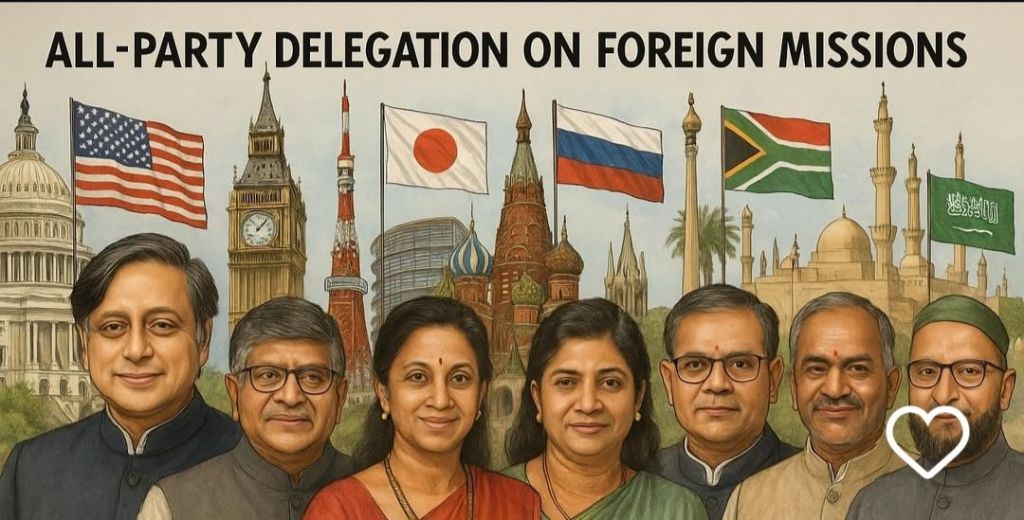
The delegations are engaging key nations across Europe, the Middle East, Asia-Pacific, Africa, and the Americas, signalling India’s multifaceted approach to international diplomacy. In their discussions, delegates are focusing on forging intelligence-sharing mechanisms, fast-tracking extradition treaties, advancing cyber counter-radicalization efforts, and championing UNSC reforms that empower global security governance. There is a renewed push for the extradition of fugitives such as Dawood Ibrahim and Hafiz Saeed, whose continued evasion of justice remains a stain on global law enforcement cooperation.
India’s proactive outreach reflects an evolved national security doctrine—one that values pre-emptive action, international solidarity, and sustained diplomatic pressure over episodic condemnation. The outreach carries strategic depth, aiming not only to prevent catastrophic incidents like the 26/11 Mumbai attacks or Pulwama but also to institutionalize real-time intelligence and cross-border coordination as a permanent safeguard. These counter-terror alliances are expected to unlock broader defense cooperation, bolster trade relations, and enhance India’s stature as a security partner of choice.
Yet, challenges persist. Despite India’s past diplomatic victories, such as the grey-listing of Pakistan by FATF between 2018 and 2022, geopolitical constraints remain—chief among them China’s obstructive veto in the UNSC and the economic pragmatism of Gulf nations like the UAE and Saudi Arabia, who maintain ties with Pakistan. Navigating these complex relationships while advancing the counter-terror agenda will require India to blend firmness with finesse.

Looking ahead, India’s vision is expansive: securing a permanent UNSC seat to architect global counter-terror frameworks, deepening the Quad’s mandate in Indo-Pacific security, and leveraging platforms like the G20 to legislate stronger global anti-terror protocols. This initiative is not a symbolic gesture; it is a strategic repositioning that may permanently alter how the world responds to terrorism.
India’s parliamentary diplomacy is a landmark assertion of its global agency—a pivot from reaction to leadership in the fight against terror. As the 59 MPs fan out across continents, they carry not just dossiers and talking points, but the weight of a nation determined to rewrite the global rules of security. The world is not just watching; it is being asked to choose sides. And in this evolving equation, India is making it clear—neutrality is no longer an option.
Visit arjasrikanth.in for more insights
 SOCIAL PERSPECTIVES