
Amaravati Ascends: The Phoenix Capital of the Post-Carbon Age
Amaravati’s tale is one of dazzling ambition, wrenching setbacks, and a stunning resurrection. Once envisioned as India’s first net-zero carbon capital, this 217-square-kilometre greenfield city, nestled between Vijayawada and Guntur, was meant to redefine the landscape of sustainable urban development. It captured the world’s imagination with its promise of futuristic living powered entirely by clean energy. But the dream soon turned to dust as political headwinds halted its momentum. What followed was a half-decade of stagnation, uncertainty, and unfulfilled promises. Now, with a dramatic political shift in Andhra Pradesh, Amaravati is roaring back to life—armed with sharper vision, global support, and the lessons of a tumultuous past.

At its inception, Amaravati symbolized the apex of sustainable city planning. Spearheaded by N. Chandrababu Naidu, the project promised a ₹65,000 crore capital run entirely on renewable energy, featuring 2,700 MW of solar, wind, and hydro power, mandatory solar rooftops on one-third of all buildings, district cooling systems designed for Andhra’s punishing summers, and an electric-only public transportation system. The city’s blueprint bore the fingerprints of global luminaries—Foster + Partners, Singaporean urban planners, and multilateral backers like the World Bank and AIIB. It was the kind of high-tech, low-carbon marvel that developing nations aspired to emulate.
But the change of government in 2019 brought with it a jarring reversal. The YSRCP administration shelved Amaravati’s plans in favour of a decentralized three-capital model, diverting resources and halting momentum. Farmers who had contributed 34,000 acres through a landmark land-pooling model erupted in protest, their sense of betrayal echoing across the state. International funders, alarmed by the policy U-turn and governance ambiguity, withdrew nearly $500 million in financing. Amaravati soon became a ghost city—filled with skeletal structures, deserted cranes, and fading dreams.
The 2024 elections changed everything. With political clarity restored, Amaravati is experiencing one of the most remarkable infrastructure comebacks in Indian history. This isn’t just a restart—it’s a complete reboot. The revived plan expands the original vision while addressing its shortcomings with sharper focus and technological upgrades.

Energy infrastructure is at the heart of this resurgence. The city now aims for 3,500 MW of renewable capacity, bolstered by floating solar panels on the Krishna River and agrivoltaic arrays co-existing with agriculture. Siemens is leading the development of an AI-powered smart grid—India’s first “energy internet” designed to optimize consumption, generation, and distribution in real time.
Urban planning has also undergone a climate-smart transformation. New designs incorporate 51% green cover, micro-forests using Miyawaki techniques, and cool corridors inspired by traditional stepwells. Service tunnels run underground to reduce surface heat and allow for seamless maintenance. Heat-resilient urbanism is no longer an add-on—it is the design principle.
Farmers, once alienated, are now at the centre of the development model. Through an innovative equity-sharing scheme, original landowners are being given stakes in commercial ventures on their lands. This economic participation is changing the narrative—from protest to partnership. The first batch of 10,000 solar-powered farmhouses is already under construction, merging agriculture with green living.

Amaravati’s revival is not just local—it has triggered a geopolitical ripple effect. The UAE’s Tabreed is investing $200 million into district cooling infrastructure. South Korean companies are constructing what may become the world’s largest geothermal air-conditioning network. Japan has extended ₹15,000 crore in soft loans via JICA, with the strategic condition that Japanese firms supply 30% of renewable components. This is no longer just a state capital—it is becoming a diplomatic and economic crucible for sustainable innovation.
The World Bank has returned, pledging $800 million with blockchain-monitored financial tracking to ensure transparency. In a major healthcare development, Mayo Clinic has signed an MoU to anchor a 2,000-bed smart hospital in the city’s Health District. Nine “theme cities”—including Knowledge City, Justice City, and Media City—are attracting global developers, turning Amaravati into a potential hub for climate-aligned urban specializations.
However, the path forward is riddled with challenges. A Supreme Court verdict on the three-capital policy remains pending. Legal ambiguity continues to cast a long shadow over Amaravati’s final status, potentially requiring a constitutional amendment to cement its role as the sole capital. Funding is another hurdle. Phase-1 alone demands ₹37,702 crore, and the government is banking heavily on land monetization—auctioning prime commercial parcels at ₹50,000 per squre yard , higher than Mumbai’s Bandra-Kurla Complex.

Execution pressure is immense. The construction of a fully functional government complex, equivalent to two new Dubai’s, must be achieved in under five years. Infra Companies are racing against time to deliver key infrastructure before the next elections. Climate volatility also threatens timelines and outcomes—erratic monsoons could disrupt both solar energy output and Krishna River’s hydropower supply.
Yet, amid these uncertainties, Amaravati has re-emerged as a symbol of resilience. If successful, it will not only set a benchmark for post-carbon urbanism in tropical regions but also showcase how democratic course correction is possible, even for mega projects derailed by politics. It offers a compelling model of stakeholder-driven planning, technological ambition, and inclusive growth—one that is already drawing attention from nations across Africa and Southeast Asia.
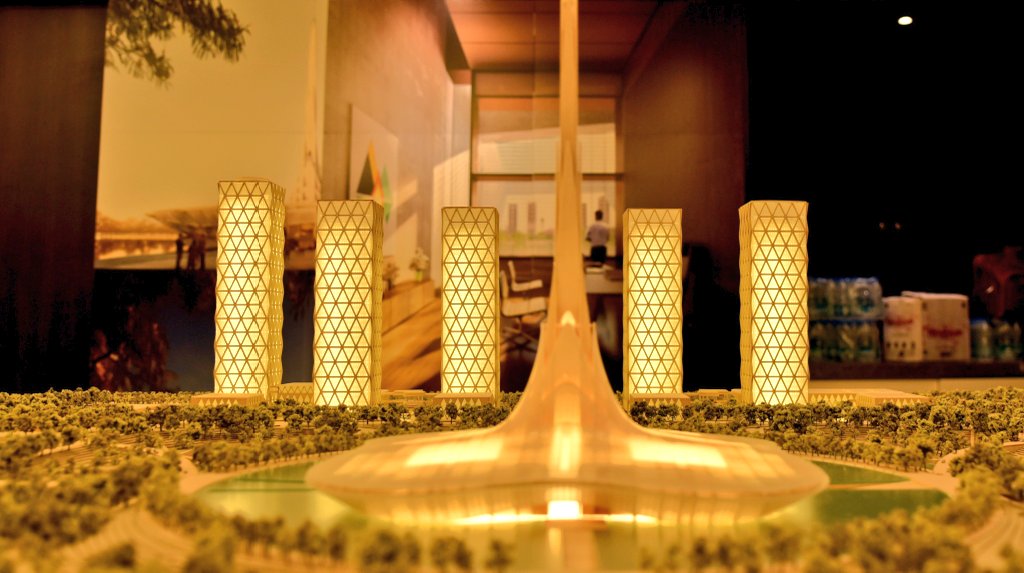
As construction cranes reappear on the skyline and international flights are slated to land at Amaravati International Airport by 2027, a new narrative is taking shape. This is no longer just a capital city in the making—it is a high-stakes experiment in sustainable civilization building. Amaravati may yet prove that from the ashes of political turmoil can rise the blueprint for humanity’s urban future.
Visit arjasrikanth.in for more insights
 SOCIAL PERSPECTIVES