
“Green Hydrogen Revolution: India’s H2O Cowboys Outsmarting Trump, China & Fossil Fuels!”
The world is pouring billions into a fuel that burns like fire but emits only water. What once sounded like science fiction is now becoming the cornerstone of a quiet revolution—green hydrogen, the dark horse in the global clean energy race. While some regions chase advances in artificial intelligence and others dominate solar panel production, a remarkable transformation is underway within India’s growing industrial landscape. Compact, modular machines are being engineered to split water into its elemental parts, offering a tangible path to decarbonize everything from steel plants to cargo ships. And in this revolution, India is no longer a passive observer—it is rapidly emerging as a central player.
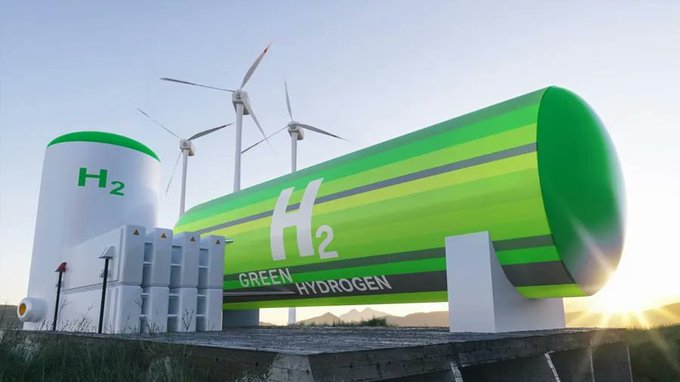
Green hydrogen mirrors the energy output of fossil fuels, minus the carbon burden. It emits only water vapor and can energize sectors where batteries fall short—heavy industry, long-haul transport, and high-temperature manufacturing. It also offers energy storage capabilities far superior to current lithium-based systems. Yet, the irony remains that nearly all global hydrogen is still derived from fossil fuels, making it dirtier than coal. Green hydrogen—produced through electrolysis powered by renewables—is five times costlier, but that hasn’t deterred a global investment push exceeding $100 billion. The belief is clear: this fuel can be the linchpin for decarbonizing hard-to-abate sectors that account for nearly a third of global emissions.
India’s edge lies in its confluence of natural and economic assets. Plentiful sunlight and wind enable low-cost renewable electricity. A vast and skilled workforce, coupled with mature manufacturing ecosystems, provides the industrial muscle to build complex systems at scale. A combination of policy incentives and market potential is driving rapid advances in green hydrogen production technologies—particularly compact electrolysis units that can be deployed flexibly across geographies and scales.

These next-generation machines stand apart from legacy systems. They are designed for quick integration with solar and wind farms, can ramp up or shut down instantly, and require significantly less electricity. Their plug-and-play modularity allows deployment across a range of use cases—from pilot-scale projects to full-scale industrial retrofits—without bespoke engineering. Domestic supply chains, originally built for the automotive and electronics sectors, are now being repurposed to mass-produce hydrogen systems with the precision and speed of consumer tech manufacturing.
The economic rationale is growing stronger by the day. Green hydrogen currently costs about $5 per kilogram but must drop to $1 for true fossil fuel parity. With innovations reducing the need for rare and expensive metals, and direct integration with renewable farms eliminating grid dependence, this price point is inching closer. Export markets offer an added bonus—regions with stringent carbon pricing regimes are willing to pay a premium for clean fuels, and India is well-positioned to fill that demand.

The vision is not just to meet domestic needs but to lead globally. By becoming a hub for affordable green hydrogen production, India could invert the long-standing pattern of energy dependence, transforming itself from an importer of fossil fuels into an exporter of clean molecules. Hydrogen made in India could soon power industrial operations in Europe, fuel vehicles in East Asia, and help balance grids across continents.
Of course, challenges persist. Competing technologies elsewhere remain cheaper, and key materials needed for electrolysis systems are in global short supply. Infrastructure for storage, transport, and export—including pipelines, refueling stations, and hydrogen-ready ports—needs to be built out quickly. But recent history provides a roadmap. India’s leap in solar energy adoption—from high-cost imports to low-cost domestic production—shows how quickly the landscape can shift with the right mix of scale, innovation, and policy will.

The narrative is shifting—from “Make in India” to “Split in India.” Water, once symbolic of purity, is now also a symbol of power. In this unfolding chapter of the energy saga, shipping containers may soon carry not just electronics or textiles, but clean fuel crafted from the sun and split by the atom. This revolution won’t flash across headlines—it will hum in quiet factories, pulse through buried pipelines, and sail across oceans. Not televised, but electrolyzed.
India’s hydrogen hustle has begun. And this time, it isn’t just catching up—it’s leading.
 SOCIAL PERSPECTIVES