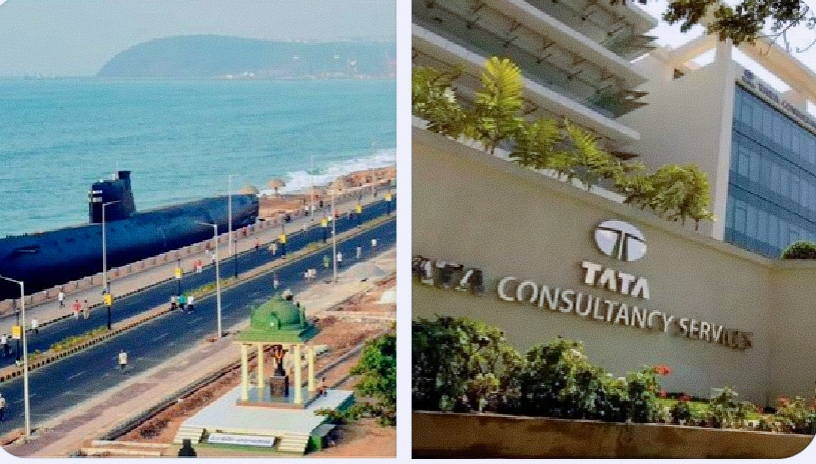
Vizag’s Tech Tsunami: TCS’s Zero-Cost Land Deal Sparks a 12,000-Job Revolution and Transforms Andhra’s Coast into India’s Next Silicon Shore!!
Sometimes, history is rewritten not with a roar, but with a whisper—like the quiet yet seismic decision to offer 21.16 acres of prime Rushikonda land for just 99 paisa to Tata Consultancy Services (TCS). This wasn’t just a transaction. It was a declaration. A moonshot. A digital dharma being carved into the coastal cliffs of Visakhapatnam, signalling a tectonic shift in how India dreams, builds, and believes in its own future. Welcome to Vizag—the new Silicon Shore of India—where a symbolic act has unleashed a real, roaring revolution.
By granting land at near-zero cost, the Andhra Pradesh government under the visionary leadership of Chief Minister N. Chandrababu Naidu has not forfeited land, but catalyzed a transformation. The message is simple but profound: investment in ideas and innovation trumps short-term revenue. And Vizag, long known as the City of Destiny, is now scripting its next chapter as the crucible of India’s digital renaissance.
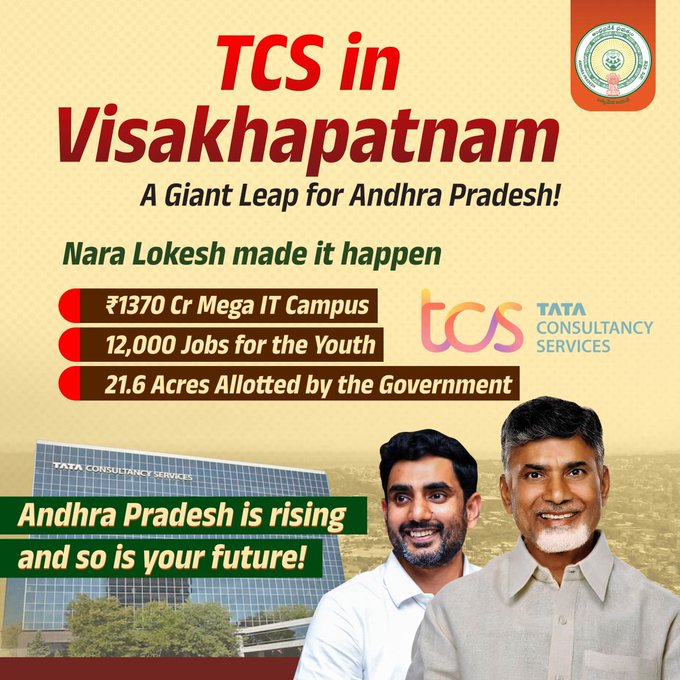
At the heart of this revolution is TCS—a global giant with a $170 billion market cap and more than 150,000 AI-skilled professionals. Their ₹1,370 crore commitment is not a mere real estate transaction; it is a vote of confidence, a signal to the world that Vizag is open for innovation. From a temporary site that will go live in just 90 days to a sprawling permanent campus to house 10,000–12,000 professionals, the pace of progress is nothing short of electric. This is not about slow trickles of development; it’s about a tidal wave of change.
Imagine this: a 500-acre Data City, pulsing with startups, cloud servers, fintech innovators, AI labs, and digital nomads—all rising from what was once a sleepy coastal town. Add to that the arrival of Google Cloud scouts eyeing the region, and you begin to realize—this isn’t ambition; this is destiny manifest.
Vizag offers more than tech-friendly terrain. It is a geostrategic jackpot. Its proximity to undersea cable landing stations ensures blistering-fast international connectivity. Unlike quake-prone regions, Vizag boasts geological stability and infrastructure that has already weathered storms, literally. Throw in uninterrupted power (with renewable integration on the horizon), breath-taking beaches, and a lifestyle far removed from the chaos of overpopulated metros—and you have a city that doesn’t just work, but works beautifully.

The government’s decision to offer land at negligible cost may raise eyebrows among skeptics, but those with vision see it for what it truly is: an investment with exponential dividends. The return is not just 12,000 direct jobs, but a cascading effect across the economy—cafes buzzing with coders, co-working spaces sprouting like saplings, real estate booming, retail evolving, and hospitality flourishing. With ₹9,000 crore projected in infrastructure infusion alone, the multiplier effect is undeniable.
And then there’s the human capital. For too long, young minds from Andhra Pradesh migrated to other cities, driven by the absence of opportunity at home. That era ends now. With institutions like Andhra University and GITAM aligning their curricula to match industry needs, the brain drain is poised to become a brain gain. Vizag isn’t just retaining talent—it’s becoming a magnet for it.

Chief Minister Naidu’s foresight in nurturing this digital ecosystem cannot be overstated. His bet on Vizag is bold, strategic, and backed by an agile administration. From swift regulatory clearances to seamless infrastructure planning, this is governance as it should be—decisive, forward-thinking, and unshackled from the inertia of bureaucracy. IT Minister Nara Lokesh’s assertion that this is Andhra’s “moonshot” isn’t hyperbole. It’s a mission statement—and it’s being executed with surgical precision.
Of course, challenges exist. Scaling infrastructure, ensuring environmental sustainability, and retaining high-skilled talent in a rapidly evolving global market are no small tasks. But Andhra Pradesh is tackling these head-on, with proactive planning and a commitment to inclusive growth. Policies are being tailored to ensure marginalized communities also benefit, not just from jobs but from access, training, and a stake in the digital future.

The parallels with Sanand, Gujarat—where Tata Motors triggered an industrial revolution—are too obvious to ignore. Vizag is walking the same path, but with one foot in tradition and the other firmly planted in tomorrow. The sea breeze now carries with it the hum of servers, the pulse of startups, and the dreams of a new generation writing code under coconut trees. This is not a fluke. This is by design.
So, when you hear someone scoff at the idea of giving away prime land for less than the price of a cutting chai, remind them: revolutions don’t start with profits—they start with purpose. And in Vizag, that purpose is now roaring louder than the waves it overlooks.
From the shores of the Bay of Bengal to the boardrooms of Silicon Valley, a new story is being written—one paisa at a time.
Visit arjasrikanth.in for more insights
 SOCIAL PERSPECTIVES