
**An exposé of India’s dual legal order—where high-speed privilege collides with slow-motion justice, and procedure becomes a selective fiction manipulated by the elite.**
In a country where the average citizen spends years navigating bureaucratic red tape for basic services such as land mutation or a business license, a privileged few operate in a parallel realm—where procedures bend, rules dissolve, and decisions are executed with startling speed. Two emblematic cases—the controversial restructuring of a defunct newspaper’s assets and a brazenly executed land acquisition—expose how India’s power elite masterfully manipulate the system. These are not just examples of regulatory circumvention; they are illustrations of how procedure itself is often rendered irrelevant when power intervenes.

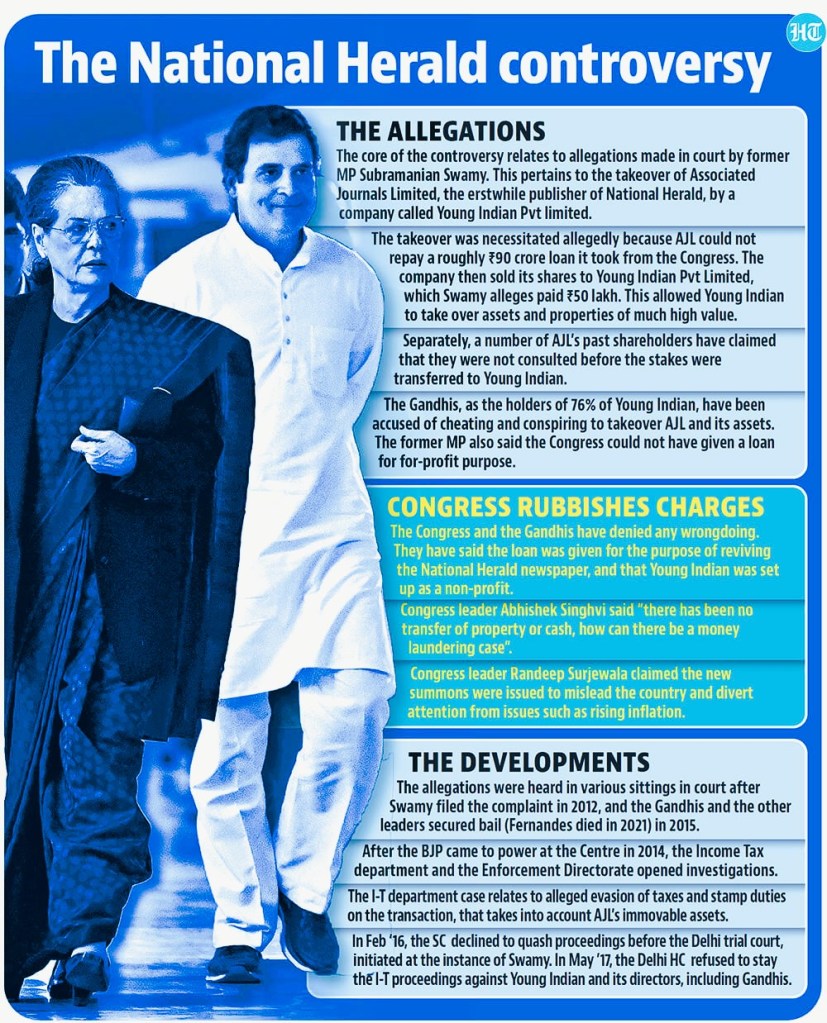
The National Herald case exemplifies this phenomenon with surgical precision. A struggling newspaper, burdened by debt, received an interest-free loan of ₹90 crore from a political party. Subsequently, its valuable real estate assets—located in prime urban zones across India—were transferred to a newly formed private entity for a mere ₹50 lakh. The transaction, on the surface, resembles a financial rescue; in reality, it was a sophisticated transfer of public-interest assets into the private domain of a political family. Compounding the issue is the entity’s registration as a “non-profit”—an organization that appeared to do little more than acquire and hold real estate worth thousands of crores.
Regulatory bodies such as the Income Tax Department and the Enforcement Directorate flagged the case for tax evasion, money laundering, and violations of corporate law. However, unlike ordinary taxpayers who face swift penalties for minor infractions, this case has lingered for years in legal limbo, punctuated by stays and procedural delays. The legal irregularities are glaring: party funds allegedly diverted for personal enrichment; assets grossly undervalued in contravention of market norms; and a non-profit used as a front for private control of public assets. Despite raids, court hearings, and sustained media attention, the process moves at a glacial pace—a telling indicator of the legal immunity afforded to the powerful.
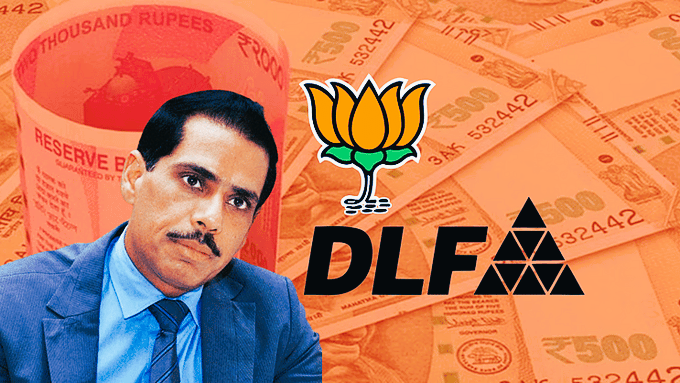
Parallel to this is the DLF land acquisition case, which underscores how political influence can convert agricultural land into gold virtually overnight. Tracts of land, protected under ceiling and zoning laws, were acquired at throwaway prices. Using a combination of benami transactions, opaque financial instruments, and expedited clearances, these lands were transferred to a major real estate developer at enormous profit margins. The approvals—ranging from zoning changes to environmental clearances—were issued with unusual alacrity, bypassing standard scrutiny and public consultation. The Haryana government’s role in facilitating this rapid transformation of land use and ownership has drawn serious questions.
The violations in this case are both systemic and procedural. Agricultural land was reclassified as commercial property with no credible oversight. Regulatory approvals were granted at speeds incompatible with due diligence. Financial trails, traced through shell companies and circular transactions, pointed toward the personal enrichment of politically connected individuals. Yet, like the National Herald case, serious investigative action only commenced after a shift in political power. By then, the trail had gone cold, assets had multiplied, and accountability had all but evaporated.
These cases reveal a sophisticated playbook: employ complex legal structures to obscure beneficial ownership; exploit gaps in regulatory frameworks, from land laws to corporate governance norms; expedite procedures through political patronage while ensuring that scrutiny is minimal or delayed; and when challenged, stretch proceedings over years until legal fatigue sets in and public attention wanes.
What emerges is not just a narrative of corruption but a portrait of dual realities. One in which ordinary citizens are bound by the rigidity of the law, and another where the influential navigate its loopholes with impunity. Slum dwellers are evicted under the guise of “illegal occupation,” while billion-dollar assets are transferred without due process. Farmers are imprisoned over disputed titles, even as elite interests rewrite land regulations to their convenience.
Ultimately, these are not merely cases of malfeasance—they are reflections of how institutional mechanisms can be repurposed to serve entrenched power. In this architecture of selective enforcement, the law does not fail uniformly; it fails surgically. For the common citizen, procedure is a burden. For the privileged, it is a tool—malleable, elastic, and entirely optional. Until the system holds all to equal standards of scrutiny and accountability, the only thing accelerating in this democracy will be the scale and sophistication of its scandals.
Visit arjasrikanth.in for more insights
 SOCIAL PERSPECTIVES