
The Maritime Midas Touch: Gautam Adani is Crafting New Trade Currents in the Indian Ocean
A billion-dollar beast rises in Sri Lanka—and with it, a new era of Indo-Pacific power play where India roars, China watches, and Colombo cashes in. In the grand theatre of maritime geopolitics, a new act has just begun, and the spotlight is now on Colombo. The Adani Group, with its trademark boldness and strategic flair, has unveiled the Colombo West International Terminal (CWIT)—a staggering $800 million deep-water facility that may well rewrite the rules of Indian Ocean trade, tilt economic fortunes for Sri Lanka, and send unmistakable ripples across the decks of Beijing’s port empire.

At 1,400 meters long and 20 meters deep, CWIT isn’t just a port terminal; it’s a logistical leviathan. With an annual capacity of 3.2 million TEUs, it can berth the behemoths of the shipping world and move containers with such grace and speed that even Singapore might start looking over its shoulder. But the real genius of this project lies beyond its concrete and cranes. This is a masterstroke of economic diplomacy, one that ties Colombo’s future closely to India’s rise as a maritime powerhouse.
Backed by a 35-year public-private partnership between Adani Ports and SEZ—holding a commanding 51% stake—Sri Lanka’s John Keells Holdings, and the Sri Lanka Ports Authority, CWIT is Colombo’s first fully automated terminal. It promises lightning-fast vessel turnaround times and a technological edge that positions it among the most advanced facilities in Asia. Its initial $553 million backing from the U.S. International Development Finance Corporation adds validation; however, Adani’s decision to self-finance the project through internal accruals signals both financial muscle and unwavering commitment.
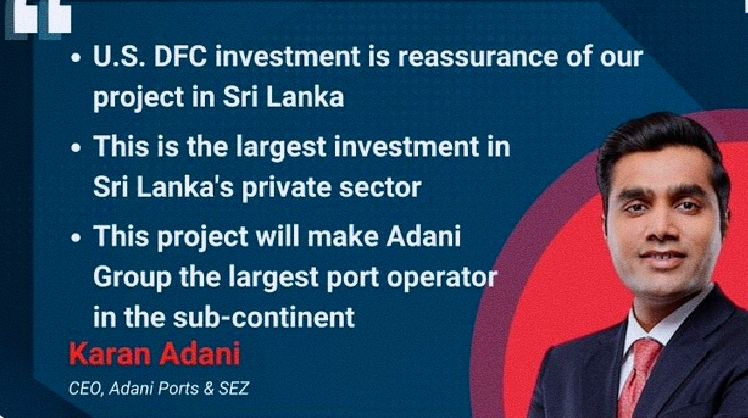
The economic implications for Sri Lanka are as massive as the terminal itself. Still reeling from a devastating financial crisis, the island nation now finds in CWIT a lifeline and a launchpad. Thousands of direct and indirect jobs are anticipated from the project, covering operations, logistics, ancillary services, and trade facilitation. This isn’t about merely handling containers; it’s about reviving livelihoods, boosting GDP, and reasserting Sri Lanka’s role as a global maritime crossroads.
The Port of Colombo already handles over 70% of its transshipment cargo linked to India. With Adani now at the helm of CWIT, that pipeline will only get smoother and more integrated. The Mundra-Colombo route will become a high-efficiency artery, binding Indian trade even closer to its southern neighbour while ensuring that Colombo remains a vital link between East and West.
But this terminal is more than just economics; it embodies strategy, symbolism, and rivalry. For over a decade, China’s Colombo International Container Terminal (CICT), operated by China Merchants Port, held sway over the port. CWIT changes the game. It’s India’s countermove in the Indian Ocean’s great port chessboard—a balancing act against China’s “String of Pearls” and a clear signal that New Delhi is no longer content to play second fiddle in its maritime backyard.

Adani’s expansion abroad is equally telling. From Haifa in Israel to Dar es Salaam in Tanzania, and now Colombo, the Group is carving out an international footprint that’s both commercial and geopolitical. With plans to scale overseas cargo handling capacity to 150 million tonnes per annum in five years, Adani Ports is no longer just India’s largest private port operator—it’s a global force steering India’s maritime ambitions with corporate precision.
Gautam Adani frames the CWIT inauguration not merely as a business venture but as a testament to Indo-Sri Lankan camaraderie, trust, and a shared vision for regional prosperity. Krishan Balendra of John Keells stressed its significance as one of the most important private-sector investments in Sri Lanka’s history.
In an era where ports serve as gateways and power bases, Colombo’s latest terminal stands tall—not merely in concrete but in consequence. It underscores a new model where private enterprise, national interest, and regional collaboration converge to create lasting impact. The Colombo West International Terminal is not just infrastructure; it’s a future-maker, transforming Sri Lanka into a serious player in the global maritime economy, ready to compete with the likes of Singapore, Dubai, and beyond.

For Adani, this endeavour is more than another project; it demonstrates that even in the face of global scrutiny and challenges, the Group remains relentless in vision, execution, and influence. The tides have turned in the Indian Ocean. A new axis of maritime power is emerging, and at its heart stands a glittering new gateway in Colombo—Adani-built, Sri Lanka-bound, and world-ready. As competition heats up between the Vizhinjam International Transhipment Terminal in India and CWIT, the stakes for maritime supremacy have never been higher, making this an exciting chapter in the ongoing saga of global trade dynamics.
Visit arjasrikanth.in for more insights
 SOCIAL PERSPECTIVES