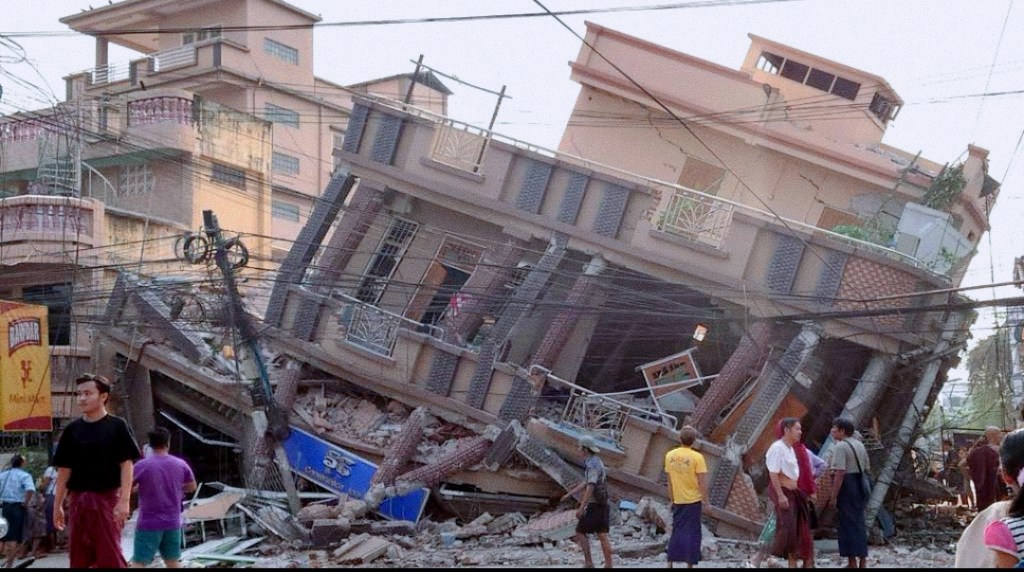
Myanmar’s Devastating Quake and the Seismic Time Bomb Beneath South Asia!!
Myanmar and its neighboring countries were violently reminded of nature’s fury when a 7.7-magnitude earthquake struck, sending shockwaves as far as Thailand. The tremors triggered widespread panic, toppling buildings and leaving destruction in their wake. Dozens of workers were buried under the rubble of a collapsed skyscraper in Bangkok, while Mandalay, Myanmar’s second-largest city, reeled from the aftershocks. The disaster has once again raised pressing concerns about the seismic vulnerability of South Asia and the urgent need for measures to mitigate future catastrophes.

Originating near Sagaing at a shallow depth of 10 km, the earthquake radiated powerful seismic waves across the region. Within minutes, a 6.4-magnitude aftershock followed, exacerbating the chaos. Thailand declared a disaster emergency as skyscrapers swayed, and critical infrastructure suffered significant damage. Eyewitnesses described scenes of sheer terror, with office workers scrambling to evacuate, traffic grinding to a halt, and water cascading from rooftop pools. In Bangkok, a 30-story government office under construction collapsed, leaving at least one dead and dozens trapped beneath the debris.
Beneath the Earth’s crust, tectonic forces have been shaping South Asia’s geological landscape for millions of years. The Indian subcontinent continues to move northward at approximately 5 cm per year, forcing the Indian Plate to collide with the Eurasian Plate. This relentless motion results in the continued rise of the Himalayas and the formation of an extensive network of fault lines, making the region one of the most seismically active in the world. Myanmar, in particular, sits at a volatile tectonic junction where multiple geological interactions converge. The immense forces at play include the Sunda Megathrust in Indonesia, the subduction of the Philippine Plate beneath the South China Sea, and the complex deformation of the Indo-Burmese arc. Over decades or centuries, stress builds up within these fault systems, eventually being released in the form of devastating earthquakes. Despite advancements in geophysics and seismology, predicting the exact timing of these tremors remains an insurmountable challenge.

Certain regions across South Asia are especially prone to catastrophic earthquakes, classified into seismic zones based on intensity and frequency. Zone V, which includes the Himalayan belt, Northeast India, parts of Myanmar, Nepal, and Bhutan, bears the brunt of the tectonic collision, making it the most vulnerable to frequent and powerful earthquakes. Zone IV, covering regions such as Bihar, Uttar Pradesh, and Delhi, remains highly susceptible to major quakes due to its proximity to active fault lines. Zones III and II, spanning much of peninsular India, experience occasional tremors but lack the intense seismic activity observed in the northern belt. The recent Myanmar quake underscores the region’s ongoing vulnerability. The question is no longer whether another earthquake will strike, but when, and whether the affected nations will be adequately prepared.
While earthquakes are natural phenomena beyond human control, their impact can be mitigated through strategic planning and proactive measures. Japan, a country situated atop multiple fault lines, has set a global benchmark for earthquake preparedness. Its advanced engineering practices, early warning systems, and public awareness initiatives have significantly reduced casualties despite frequent high-magnitude quakes. South Asia must adopt a similar approach by prioritizing earthquake-resistant infrastructure. Governments should enforce stringent building codes, ensuring structures are designed to withstand seismic shocks. Engineering solutions such as reinforced concrete, flexible foundations, and energy-absorbing dampers can prevent catastrophic collapses. However, in many parts of the region, unregulated construction and outdated buildings continue to pose a substantial risk.

Investing in seismic monitoring networks is another crucial step. Early warning systems can provide precious seconds of lead time, allowing people to take cover and enabling critical utilities to shut down before tremors intensify. Countries such as Mexico and Japan have demonstrated the life-saving potential of such systems, setting an example for South Asia to follow. Public education and emergency preparedness also play an essential role. Regular earthquake drills, school safety programs, and widespread dissemination of information can teach citizens how to respond effectively during a quake. The simple yet effective “Drop, Cover, and Hold” technique has proven to save countless lives when practiced consistently.
Urban planning must incorporate seismic risk assessments to ensure long-term resilience. Construction on active fault lines and in liquefaction-prone areas should be strictly regulated. Cities need open evacuation spaces, well-maintained roads for emergency response, and hospitals equipped to handle mass casualties following an earthquake. Another critical aspect is the retrofitting of old buildings. Many historical and residential structures in South Asia were constructed before the advent of modern earthquake-resistant designs. Strengthening these buildings with modern reinforcements can prevent collapse and preserve lives.

Robust and well-coordinated disaster response mechanisms are essential for minimizing casualties and damage in the aftermath of an earthquake. Governments must invest in well-trained emergency response teams, equip hospitals for crisis situations, and establish rapid relief mechanisms. Swift action in rescue operations, medical aid, and infrastructure repair can make the difference between life and death. International cooperation and knowledge exchange are also vital, as best practices from earthquake-prone nations like Japan, Chile, and the United States can offer valuable insights into effective disaster management strategies.
The South Asian region will continue to experience earthquakes due to its unique geological setting, but the extent of destruction and loss of life will depend on the level of preparedness. The Myanmar earthquake serves as a dire warning—a call to action for governments, engineers, urban planners, and citizens alike. The time for complacency has long passed. As tectonic plates continue their slow yet unrelenting movement, the next big earthquake is not a matter of if, but when. The real question remains: will we be ready?
Visit arjasrikanth.in for more insights
 SOCIAL PERSPECTIVES
One response to “**Tectonic Terror: When the Earth Strikes Back**”
A powerful and urgent call for proactive resilience in one of the world’s most earthquake-prone regions. The Myanmar quake is a stark reminder that preparedness—not panic—must define our response to nature’s fury. Investing in infrastructure, early warning systems, and public awareness is the need of the hour.
LikeLike