

Vietnam’s bold reforms and agile governance propelled it into global export dominance while India grapples with structural roadblocks in the race for manufacturing supremacy.
In the evolving global market, export orientation is a key driver of economic strength. Vietnam has emerged as a major export hub, especially under the China+1 strategy, which promotes diversifying supply chains beyond China. Vietnam has successfully capitalized on this shift, establishing a strong trade balance with the U.S. through favourable business conditions and cost advantages. In contrast, India, despite its vast resources and large population, has struggled to match Vietnam’s export growth. The China+1 strategy encourages businesses to expand into countries like India, Vietnam, Thailand, Bangladesh, and Malaysia, reducing reliance on China while mitigating risks from trade tensions and geopolitical challenges. Vietnam’s agile adaptation to this strategy has solidified its position as a global manufacturing leader, while India continues to address structural challenges to fully leverage this opportunity. This comparison underscores the significance of policy frameworks and business environments in shaping export competitiveness.
Vietnam, with a population of approximately 100 million and a land area smaller than the Indian states of Rajasthan and Madhya Pradesh, has surprisingly managed to establish itself as a formidable player in the global export market. In recent years, Vietnam has shifted from a primarily agrarian economy to an export-oriented one, with exports accounting for an astonishing 93.8% of its GDP. This shift has not only bolstered its economy but also allowed it to maintain a substantial trade surplus, especially with the U.S., where it exported over $120 billion worth of goods last year, significantly outpacing India’s exports to the same market.

The China+1 strategy has played a pivotal role in this transformation. As companies seek alternatives to Chinese manufacturing, many have turned to Vietnam, attracted by its favourable labour costs, improving infrastructure, and a government keen on fostering a business-friendly environment. The Vietnamese government has undertaken significant reforms, including the recent decision to cut up to 20% of its civil service workforce, a bold move aimed at increasing efficiency and reducing bureaucratic red tape. This decisive action stands in stark contrast to India’s cumbersome governance structure, which includes over 53 ministries and numerous departments, often resulting in inefficiencies that hinder export growth.
The comparative statistics tell a compelling story. While Vietnam’s exports reached approximately $430 billion, India’s exports accounted for only about 21.89% of its GDP, reflecting a persistent trade deficit. The Indian economy, with its vast potential in textiles and garments, is still heavily reliant on imports, which stood at around 23.96% of its GDP. In contrast, Vietnam has not only surpassed India as a textile and garment exporter but also positioned itself as the second-largest exporter in the world, overtaking Bangladesh in recent years.
The contrast in governance styles and economic strategies between the two countries cannot be overstated. Vietnam’s leadership has demonstrated a willingness to make tough decisions and implement sweeping reforms, often in a rapid and decisive manner. For instance, the Vietnamese Parliament recently voted with a 97% majority to streamline government operations, abolishing several ministries and merging others to create a leaner administrative structure with 14 Ministries . This contrasts sharply with India’s approach, where political considerations often take precedence over economic reforms, resulting in a slower pace of change.
Furthermore, Vietnam’s ability to attract foreign investment has been bolstered by its strategic location and favourable trade agreements. The Comprehensive and Progressive Agreement for Trans-Pacific Partnership (CPTPP) and various bilateral trade agreements have enhanced Vietnam’s market access, allowing it to capitalize on its manufacturing capabilities. Meanwhile, India has struggled to create a similarly conducive environment for foreign investment, often deterred by regulatory hurdles and a lack of infrastructure.
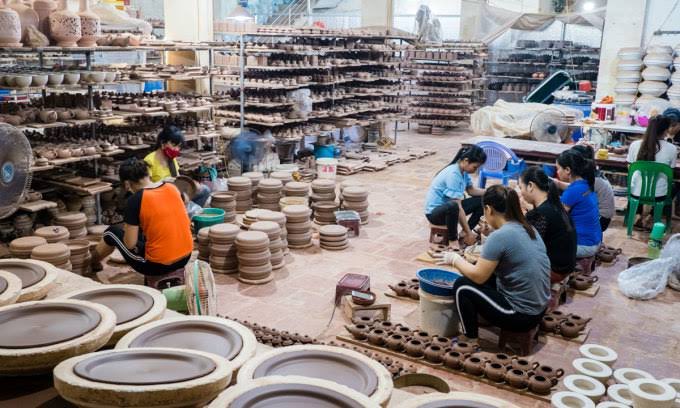
In terms of specific sectors, Vietnam has carved out a niche in electronics and textiles. It has become a key manufacturing hub for global brands looking to diversify their supply chains. The country’s largest export category includes broadcasting equipment, which encompasses a wide range of electronics. This manufacturing prowess is not just limited to electronics; Vietnam has also become a major player in the textile and garment industry, exporting products that are often more cost-effective than those produced in India.
While India possesses a rich tradition in textiles, its export performance in this sector has lagged behind due to a combination of factors, including high production costs, regulatory barriers, and a lack of focus on value-added manufacturing. Indian manufacturers often struggle to compete with the efficiency and pricing of Vietnamese goods, which are produced at scale and with lower labour costs.

The future trajectory of both nations will depend significantly on their ability to adapt to global market trends and enhance their export capabilities. Vietnam’s proactive approach to governance and reform, coupled with its strategic positioning within the China+1 framework, has set it on a path of sustained economic growth and export success. On the other hand, India must urgently revamp its economic policies, streamline its bureaucratic structures, and foster a more conducive environment for manufacturing and exports to avoid falling further behind in this competitive landscape.
In conclusion, while Vietnam has emerged as a formidable export powerhouse, leveraging its strengths and adapting to global demands, India faces significant challenges that require timely and effective reforms. The contrast in export orientation and economic strategies between these two nations serves as a vital lesson for policymakers in India, emphasizing the need for decisive action to enhance its position in the global market. As the world becomes increasingly interconnected, the ability to compete effectively in exports will be crucial for both nations’ economic futures.
Visit arjasrikanth.in for more insights
 SOCIAL PERSPECTIVES