From Reservation to Revolution – The Judgment That Unleashed a Meritocracy Storm Across India
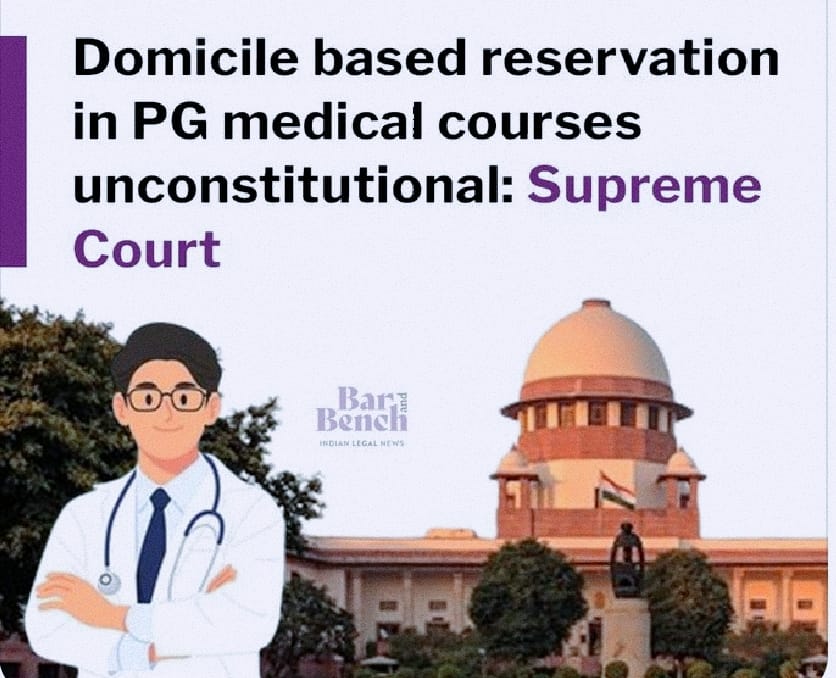
In a landmark decision, the Supreme Court of India has struck down domicile-based reservations for postgraduate (PG) medical courses, sending shockwaves across the medical fraternity and sparking widespread debate. A three-judge bench comprising Justices Hrishikesh Roy, Sudhanshu Dhulia, and S.V.N. Bhatti ruled that such reservations are constitutionally impermissible and violate Article 14 of the Indian Constitution, which guarantees the right to equality. This judgment, while reaffirming the importance of meritocracy, has raised significant questions regarding its long-term impact on medical professionals, healthcare accessibility, and the autonomy of state governments in determining educational policies.
The court’s decision was clear and resolute. It emphasized that “We are all domiciles in the territory of India. There is nothing like a provincial or state domicile. There is only one domicile.” This powerful declaration effectively negates the preferential treatment previously given to students based on their state of residence, marking a shift towards a more merit-based system. The judgment now mandates that admissions to PG medical courses be based solely on merit as determined by the National Eligibility cum Entrance Test (NEET). This ruling aligns with the Supreme Court’s earlier pronouncements, including the 1984 Dr. Pradeep Jain case, where it was established that residency-based reservations in PG medical courses undermine the constitutional principle of equality.
The immediate consequence of this decision is the removal of state-imposed barriers that limited students from pursuing higher medical education outside their home states. Previously, domicile-based quotas ensured that medical aspirants from states with fewer educational institutions had a better chance of securing a seat in PG courses within their region. The abolition of these quotas now paves the way for students to compete on a national scale, offering them a broader range of opportunities. This nationalization of medical education is likely to result in a more diverse and competitive pool of specialists, which could significantly enhance the overall quality of medical professionals across the country. Additionally, the judgment aligns with the constitutional right of every citizen to live, trade, and practice a profession anywhere in India, providing equal access to medical education irrespective of geographic location.
However, the ruling has also sparked concerns, particularly among students from states that have fewer medical institutions. Critics argue that this judgment disproportionately affects such students, as the absence of domicile-based reservations means they will now have to compete with candidates from other parts of the country, many of whom may have had access to better resources and preparation. This shift could reduce the chances for students from these regions to pursue specializations within their home states. Moreover, states that have heavily invested in medical education, with the expectation that these institutions would produce healthcare professionals who would stay and work within the state, may now experience an outflux of trained doctors. This could exacerbate regional disparities in healthcare, leaving underdeveloped and rural areas struggling to retain qualified medical professionals.

One of the most pressing concerns raised by the judgment is its potential impact on state healthcare systems. Many state governments introduced domicile-based quotas as a means of ensuring that doctors trained in local institutions would remain in the state to serve its communities. By striking down these quotas, the Supreme Court has removed the incentive for PG medical graduates to stay within their home states. This could lead to a concentration of specialists in urban and metropolitan areas, where the demand for advanced medical care is highest, while rural and underserved regions continue to face shortages of trained doctors. The already-existing healthcare divide between urban and rural areas could deepen, further disadvantaging marginalized communities that lack access to quality healthcare services.
In response to this development, state governments may need to explore alternative strategies to retain medical professionals. For example, they could introduce mandatory service bonds or offer financial incentives to encourage PG medical graduates to stay and work within their state. These measures could serve as a means of balancing the merit-based admissions process with the need to address regional healthcare challenges. Furthermore, the central government may face increased pressure to develop policies that strike a balance between promoting meritocracy in medical education and addressing the healthcare needs of underserved areas.
Despite these concerns, the ruling unequivocally reinforces the principle of equal opportunity, ensuring that all medical aspirants are assessed based on their academic merit rather than their place of residence. This shift represents a significant step towards a truly nationalized medical education system, where the best minds can access the best training, regardless of geographical boundaries. It promotes fairness by eliminating the artificial barriers created by state-based reservations, encouraging students to compete in a more equitable environment.
For students who have already been admitted under domicile-based reservations, the Supreme Court has provided clarity, stating that the judgment will not affect their admissions. However, for future medical aspirants, this decision represents a fundamental change in how PG medical courses will be allocated. It is a paradigm shift that is likely to reshape the landscape of medical education in India, with far-reaching implications for the healthcare sector.
While it remains to be seen whether this judgment will lead to a more efficient and fair medical education system or if it will exacerbate existing regional disparities, one thing is certain: the days of domicile-based reservations in PG medical courses are now over. This landmark decision is bound to reshape the future of medical education in India, and its full impact will unfold in the years to come. Whether the ruling proves to be a step forward in creating a more equitable healthcare system or whether it intensifies existing challenges will depend on how the central and state governments adapt to this new reality.
Visit arjasrikanth.in for more insights
 SOCIAL PERSPECTIVES