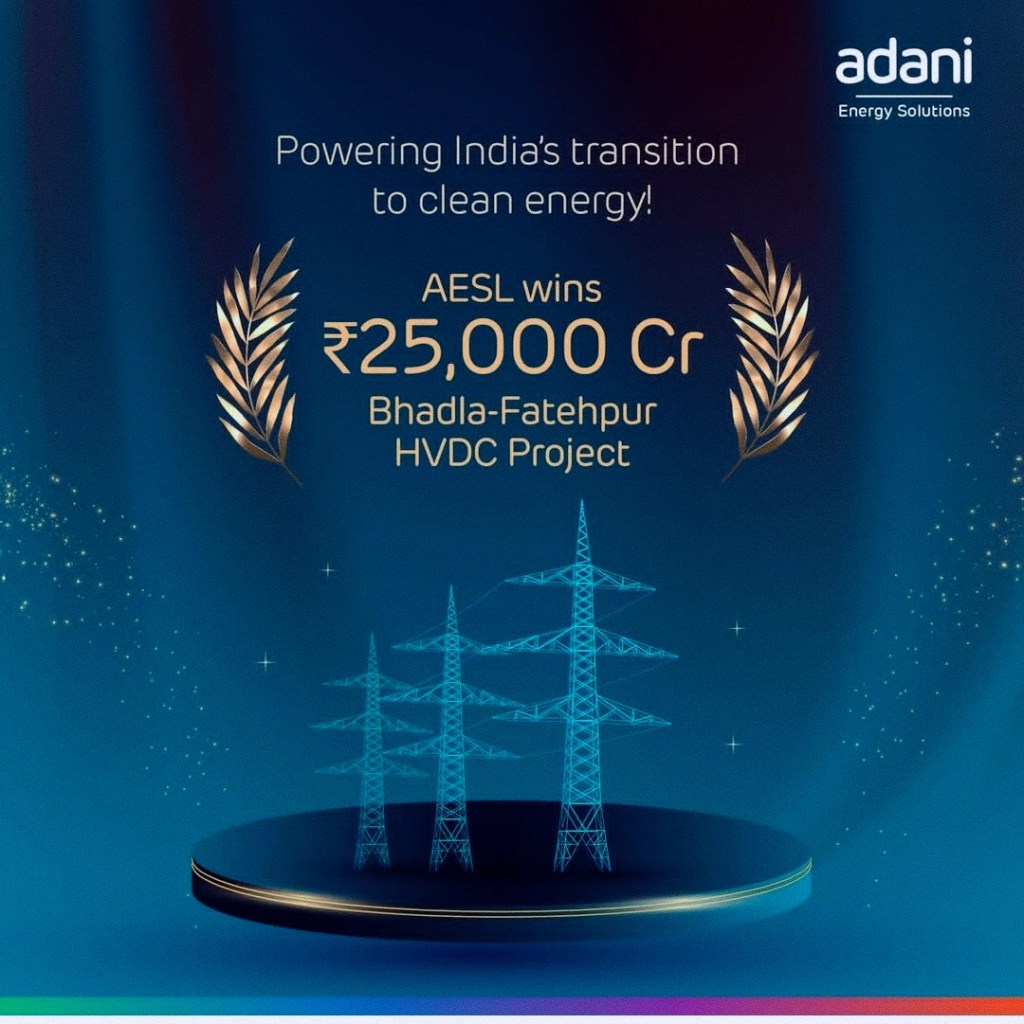

From Sun-Baked Deserts to Sky-High Cities: Adani’s Electric Revolution is Igniting a Sustainable Energy Explosion Across India.
At a time when the world is grappling with an energy crisis, Adani Energy Solutions Limited (AESL) has not just kept up with the rapid pace of change but has firmly positioned itself as a key player in driving India’s transition to sustainable energy. AESL’s recent success in securing the monumental ₹25,000 crore Bhadla-Fatehpur High Voltage Direct Current (HVDC) project marks a ground-breaking moment for India’s energy infrastructure. This triumph is not just about winning a contract; it symbolizes AESL’s strategic foresight in addressing both energy generation and activation, demonstrating the essential duality of producing and efficiently transmitting power.
The sheer scale of AESL’s achievement cannot be overstated. This project, aimed at evacuating 6 GW of renewable energy from the vast solar fields of Rajasthan to meet the growing demand in North India, promises to transform the energy landscape. By tapping into Rajasthan’s vast renewable energy zone (REZ), AESL is ensuring that the energy produced in the remote deserts reaches the urban centres and industrial hubs where it is most needed. The system will cover 2,400 circuit kilometres, creating a network capable of handling 84,186 megavolt-amperes (MVA) of power. This ambitious venture reflects AESL’s commitment to enhancing India’s capacity to meet its increasing energy demands and underscores its crucial role in the country’s energy future.

But why is the act of “activating” power so crucial? In a world shifting towards renewable energy, the ability to transmit this clean energy effectively is just as important as producing it. AESL’s Bhadla-Fatehpur project addresses this critical gap, ensuring that the energy generated in remote areas is efficiently distributed across vast distances. The project goes beyond theory by making renewable energy actionable and accessible. This is especially important in a country like India, where power shortages remain a concern, and the grid’s reliability often hangs in the balance.
AESL’s triumph in securing the project is a testament to its engineering expertise and innovative approach. The competitive bidding process under the Tariff Based Competitive Bidding (TBCB) mechanism was intense, but AESL emerged victorious, thanks to its transparent and competitive bidding strategy. The formal transfer of the project to AESL on January 20, 2025, represents not only an enormous opportunity but also a significant responsibility to help accelerate India’s decarbonization efforts. AESL’s CEO, Kandarp Patel, emphasized the company’s commitment to leveraging cutting-edge technologies and sustainable practices to minimize the project’s environmental impact. By efficiently evacuating renewable energy from one of the harshest regions of the country, AESL is making a tangible contribution to India’s green energy revolution.

Moreover, the Bhadla-Fatehpur project promises to enhance grid reliability, a critical concern for India’s power infrastructure. By ensuring the smooth transfer of renewable energy across such long distances, AESL is reducing the risk of power outages in urban areas. The direct link between production zones and demand centres will provide a more stable and reliable power supply to millions of consumers. This project, in addition to boosting India’s energy security, will serve as a crucial element in reducing the nation’s dependence on fossil fuels, bringing India closer to its renewable energy goals.
AESL’s contribution to India’s energy infrastructure is not just about technology—it’s also about human and financial capital. The company’s extensive order book, now valued at approximately ₹54,761 crore, highlights its ongoing investments in the country’s energy future. It’s clear that AESL is not only focused on short-term gains but is committed to long-term sustainable growth, with a focus on innovation and infrastructure development. As the company works to commission this project over the next 4.5 years under the Build, Own, Operate, and Transfer (BOOT) structure, it will continue to play a pivotal role in enhancing India’s energy grid, ensuring that each kilowatt-hour of renewable energy is put to optimal use.
In the broader context of India’s energy transformation, AESL is positioning itself as a crucial player in the nation’s quest for energy sustainability. With this monumental project, AESL is not just contributing to the country’s immediate energy needs; it is laying the groundwork for a cleaner, more reliable, and more efficient energy future. Through its dedication to renewable energy, AESL is playing a central role in helping India meet its ambitious targets for reducing carbon emissions, while simultaneously creating a dependable infrastructure capable of supporting the nation’s growing energy needs.
At its core, AESL’s Bhadla-Fatehpur project serves as a powerful reminder that the activation of power is as essential as its generation. The transmission of renewable energy across vast distances requires not only advanced technology but also visionary leadership and strategic planning. AESL’s successful execution of this project will ensure that the energy generated in Rajasthan’s solar fields powers homes, industries, and businesses across the length and breadth of North India. It will pave the way for a greener, more sustainable energy future—one where the activation of power becomes a cornerstone of India’s energy strategy.

AESL stands at the forefront of this energy revolution, leading the charge toward a cleaner, more sustainable India. Through innovation, commitment, and an unwavering focus on infrastructure, AESL is making energy activation a key pillar of India’s renewable energy strategy. As the company works to bring this vision to life, the implications of this project will ripple across the country, transforming the way India generates, activates, and consumes energy, and ensuring a brighter, greener future for generations to come.
visit arjasrikanth.in for more insights
 SOCIAL PERSPECTIVES