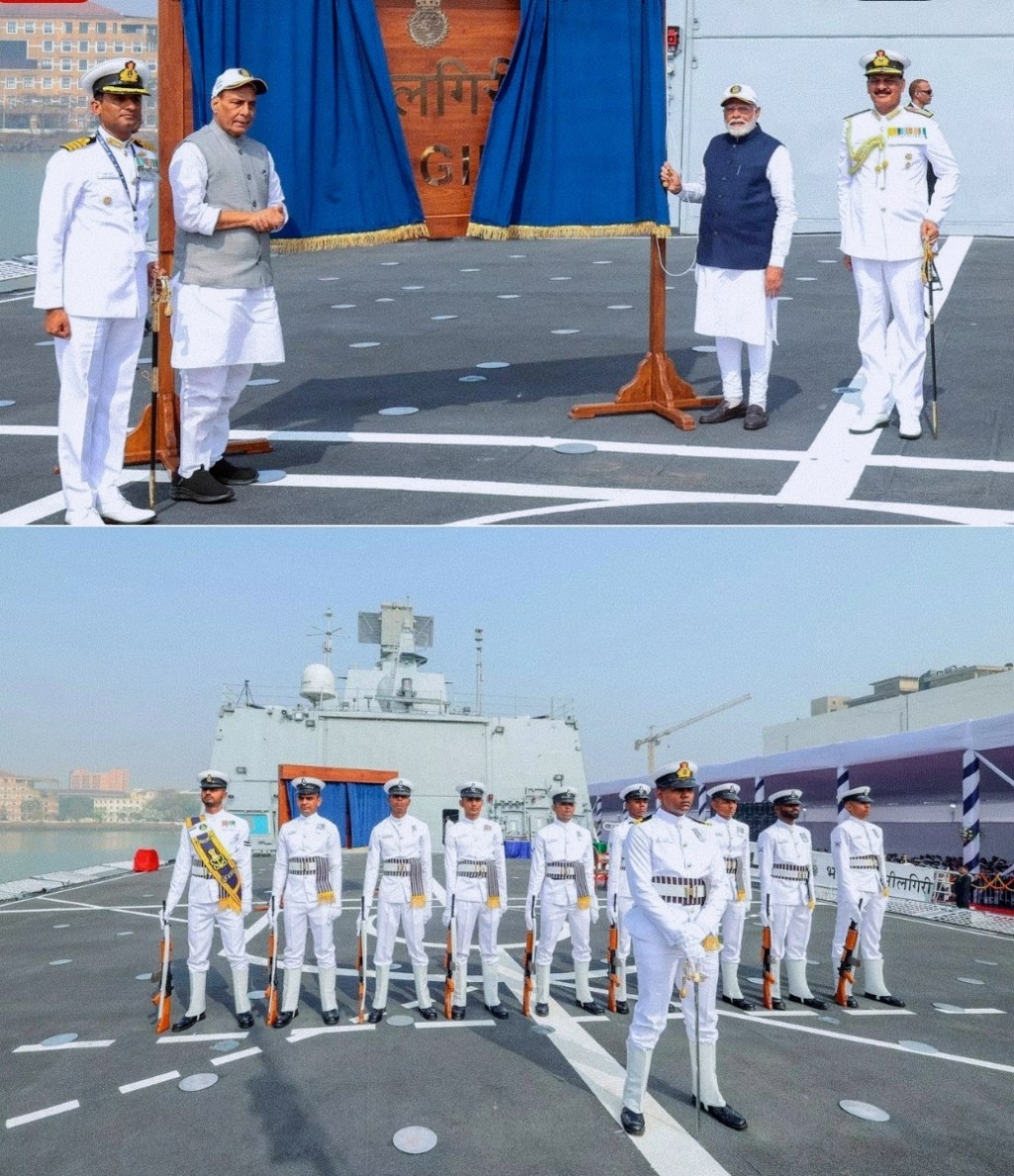

From Stellar Spacecraft Docking to Naval Masterpieces, How India is Charting a Bold New Course on the Global Stage
In the ever-evolving political landscape of India, where complexities often overshadow progress, the nation’s growth trajectory has found an unwavering champion. Yet, beneath the towering shadow of leadership, the spotlight now falls on India’s strides in space exploration and naval modernization, painting a portrait of a country poised to shape the global stage. The past decade has been transformative, with advancements in science and technology placing India in the league of global frontrunners.
India recently achieved an extraordinary milestone in space exploration, SpaDeX Mission, joining the elite club of nations—the United States, Russia, and China—capable of performing successful space docking experiments. This complex manoeuvre involved two satellites, designated Spacecraft A and Spacecraft B, gradually narrowing their distance from 15 meters to a precise 3 meters before latching onto each other. Such precision not only showcases ISRO’s technological brilliance but also lays the foundation for critical future missions. The ability to transfer power between the satellites, already tested in the initial phases of the experiment, underscores the operational readiness of India’s space capabilities.

This docking technology is pivotal for satellite servicing, the development of space stations, and long-term interplanetary missions. It also propels India closer to its ambitious goals of establishing the Bharathi space station and sending astronauts to the Moon by 2040. While initial attempts faced challenges, including delays and technical hiccups, the resilience and determination of ISRO engineers ensured success. These efforts epitomize the nation’s spirit of perseverance and innovation, a trait that has consistently defined its rise in the global arena.
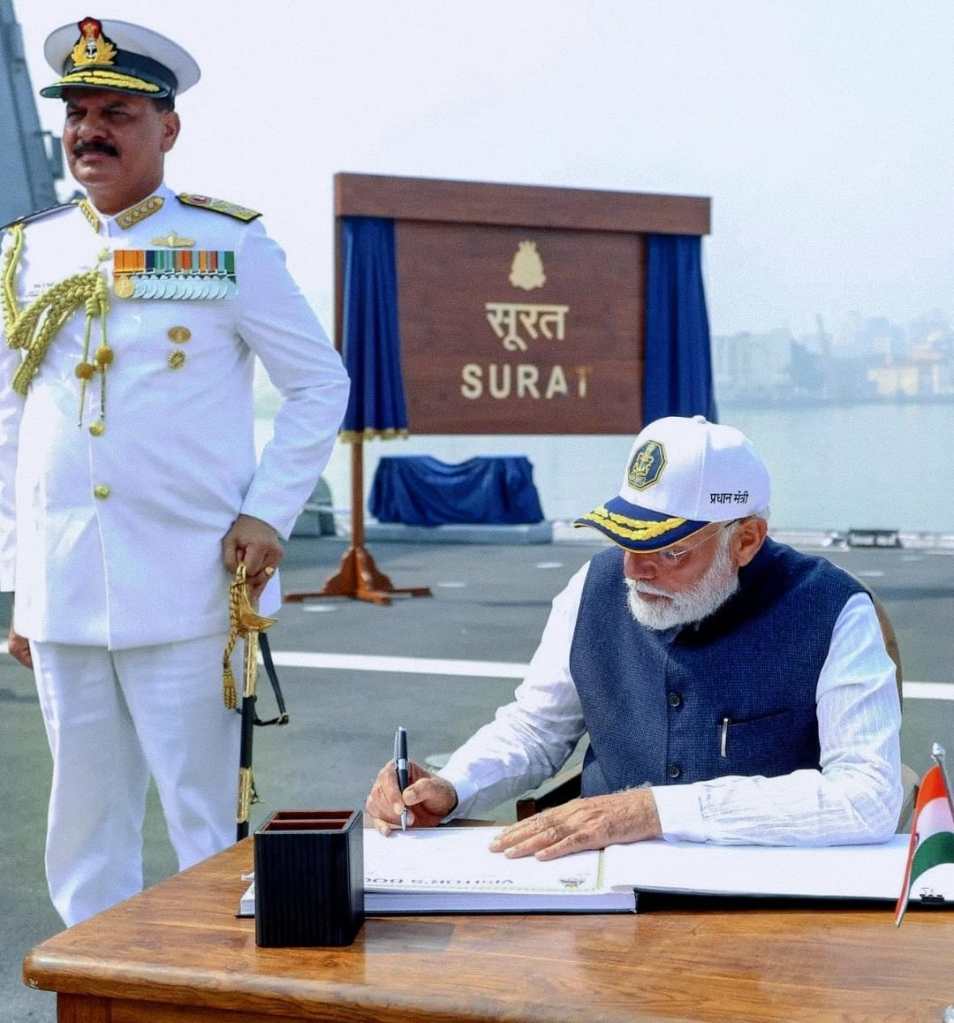
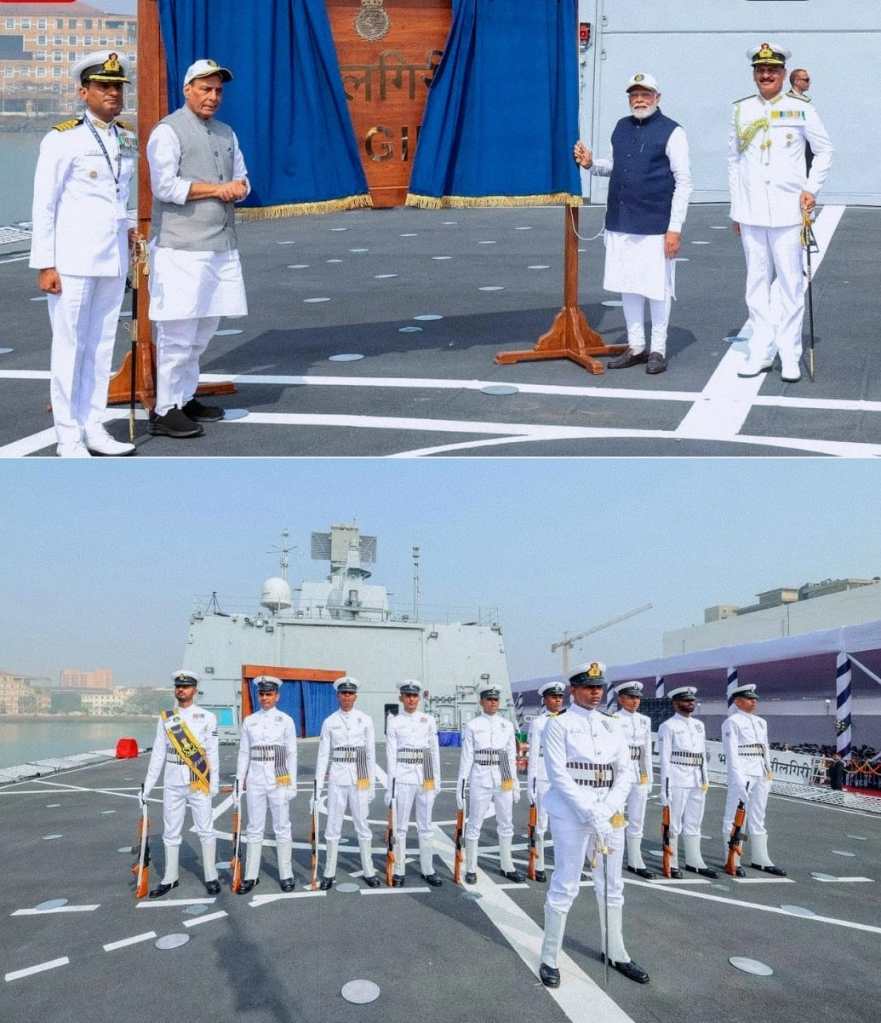
Beyond space, India’s naval forces have surged ahead with unparalleled vigor. In a landmark event, three state-of-the-art vessels were commissioned into the Indian Navy: INS Surat, INS Nilgiri, and INS Vagsheer. These additions signify India’s commitment to maritime security, self-reliance, and global partnerships.
INS Surat, a stealth-guided missile destroyer, embodies the pinnacle of Project 15B under Mazagon Dock Shipbuilders Limited. It improves on its predecessors with advanced stealth features, increased firepower, and survivability, marking a significant leap in India’s surface fleet capabilities. Similarly, INS Nilgiri, the lead vessel of the Project 17A class of stealth frigates, combines indigenous shipbuilding expertise with cutting-edge technology. Designed for reduced radar visibility and enhanced aviation capabilities, it represents a new generation of naval engineering.
Meanwhile, INS Vagsheer, the final submarine of the Kalvari-class under Project 75, is a testament to India’s modular design approach. Its versatility, from anti-submarine warfare to intelligence gathering, ensures operational adaptability for decades to come. Together, these vessels bolster India’s maritime doctrine, encapsulated in the SAGAR (Security and Growth for All in the Region) initiative, which prioritizes an open, secure, and inclusive Indo-Pacific.
Prime Minister Narendra Modi’s emphasis on indigenization has catalysed remarkable progress in defense manufacturing. Over the past decade, 39 out of 40 naval vessels were built in Indian shipyards, reinforcing the Make in India initiative. From the INS Vikrant aircraft carrier to Tejas fighter jets and advanced submarines, India’s defense sector has emerged as a global force. Today, India exports defense equipment to over 100 countries, with contributions exceeding ₹1.25 lakh crore annually.
The economic ripple effects of these advancements are staggering. Shipbuilding, for instance, has a six-fold employment multiplier effect, generating direct and indirect jobs across industries. Every rupee invested in the sector circulates ₹1.82 within the economy, showcasing its potential as a growth engine. With over 60 ships under construction, worth approximately ₹1.5 lakh crore, the naval sector exemplifies the synergy between economic development and strategic security.

The strategic significance of maritime modernization cannot be overstated. With a coastline spanning over 7,500 kilometers and a critical role in safeguarding global trade routes, India’s naval dominance in the Indian Ocean Region is indispensable. Enhanced capabilities, such as the stealth features of INS Surat and the modular design of INS Vagsheer, ensure India’s preparedness to address threats ranging from piracy to humanitarian crises. Additionally, the navy’s role as a first responder in regional emergencies further cements India’s reputation as a reliable global partner.
In tandem with naval modernization, India’s advancements in space signal a broader ambition to redefine its global standing. The Chandrayaan-4 mission and plans to retrieve lunar samples highlight ISRO’s progressive vision. These endeavours are not mere technological feats; they represent India’s aspiration to contribute meaningfully to humanity’s collective journey beyond Earth.
The resonance between India’s achievements in space and sea is striking. Both domains reflect a strategic emphasis on self-reliance, innovation, and global engagement. By prioritizing indigenous solutions, whether through advanced satellite technology or locally-built naval vessels, India is asserting its ability to compete and collaborate on the global stage.
As the nation strides forward, its focus on sustainability, security, and self-sufficiency remains unwavering. These values resonate in every satellite launched and every ship commissioned. The dual advancements in space and naval domains not only showcase India’s technological prowess but also its commitment to shaping a peaceful and prosperous global future.
In essence, while leadership provides direction, it is the collective effort of visionaries, scientists, engineers, and seafarers that propels India toward greatness. The convergence of space exploration and maritime modernization is a testament to the nation’s relentless pursuit of excellence. With each milestone, India charts a path not just for itself but for a world that increasingly looks to it for inspiration and innovation.
The stars and the seas have become India’s allies, whispering tales of ambition and achievement. Together, they herald a future where the nation stands as a beacon of progress, illuminating the vast expanse of human potential.
Visit arjasrikanth.in / @DrArjasreekanth for more insights
 SOCIAL PERSPECTIVES