
Vijayawada’s Resounding Call: Uniting Tradition, Identity, and a Vision for Cultural Sovereignty”
When a movement chooses its epicenter, it does so with purpose and precision. Vijayawada, a city synonymous with its strategic position as the gateway to South India, found itself the chosen stage for an event that aimed to alter the cultural and political trajectory of an entire region. The Vishva Hindu Parishad (VHP), with its ambitious ‘Haindava Sankharavam,’ turned this bustling hub into a crucible for ideological transformation. The choice of Kesarapalli, near Gannavaram, wasn’t merely geographic—it was symbolic. A bridge between tradition and modernity, this site became the ground zero for rallying a cause deeply rooted in history yet sharply focused on contemporary challenges.
The ‘Haindava Sankharavam,’ translating to the “battle cry of Hinduism,” was more than just an event; it was a declaration. Designed to resonate far beyond Vijayawada’s borders, the gathering drew an astonishing three lakh participants from every mandal and village in Andhra Pradesh. The intent was unmistakable: transcend caste divides, unify Hindus under a shared cultural and religious identity, and reignite the flames of Sanatana Dharma. The rally’s demands, articulated with clarity and conviction, touched a nerve—protection of temple properties, autonomy from government control, and a resolute stand against what the VHP perceives as systemic neglect.

The heart of the rally’s narrative revolved around temple autonomy. For decades, Hindu religious institutions have operated under government oversight, a framework introduced to ensure transparency and curb corruption. Yet, to the VHP and many of its supporters, this oversight is a shackle, a symbol of inequity when compared to the freedoms enjoyed by churches and mosques. The demand for legislative amendments to free temples from state control isn’t new, but the fervours at Kesarapalli added an urgency to the cause. The nine-point declaration adopted during the event was both a roadmap and a rallying cry: remove non-Hindu employees from temple administration, recover alienated temple properties, and channel temple revenues exclusively toward the propagation of Hindu religion.
This isn’t just about management; it’s about reclaiming a heritage. The rally highlighted a long-standing grievance that Hindu temples, unlike other religious institutions, are often treated as administrative entities rather than spiritual sanctuaries. Critics, however, caution against the potential pitfalls of such autonomy, fearing privatization and exclusion. They argue that temple revenues must serve the broader public good, particularly marginalized communities. Yet, the VHP counters this with a vision of self-reliance and self-determination—a framework where temples are managed by religious councils instead of bureaucratic machinery, ensuring both accountability and reverence.

The event’s significance extends beyond cultural revivalism; it’s intricately tied to political dynamics. For a region historically resistant to Hindutva ideologies, the ‘Haindava Sankharavam’ marks a bold push into uncharted territory. Andhra Pradesh, with its complex interplay of caste, religion, and politics, presents both a challenge and an opportunity. The state’s recent political climate, rife with debates over temple management and allegations of misgovernance, has created a fertile ground for the Sangh Parivar’s message. Political allies have found common cause in advocating for the protection of Sanatana Dharma, adding momentum to the VHP’s agenda.
The choice of Vijayawada as the epicentre was a masterstroke. Positioned at the crossroads of Andhra Pradesh, Tamil Nadu, Karnataka, and Telangana, the city serves as a logistical hub and a symbolic gateway. By organizing such a massive event here, the VHP underscored its intent to make Vijayawada a launchpad for its southern strategy. The participation of prominent spiritual leaders lent the event an air of legitimacy, while their presence reinforced the movement’s spiritual and cultural underpinnings.
Critics, however, warn of the potential risks of conflating cultural preservation with political ambitions. The demands for autonomy, while resonating with many, must navigate a delicate balance between tradition and inclusivity. The call to safeguard Sanatana Dharma and protect Hindu culture must also address the complexities of caste dynamics, ensuring that the movement unites rather than divides.
The rhetoric at Kesarapalli wasn’t limited to temple autonomy. VHP leaders painted a broader picture of grievances, alleging systemic injustices against Hindus in the state. References to historical struggles, such as the Ram Janmabhoomi movement, evoked a sense of continuity, linking the present cause to a larger narrative of resurgence. The emphasis on unity and identity resonated deeply, creating an emotional and ideological connect with the participants.
For the BJP and its allies, the ‘Haindava Sankharavam’ is more than a cultural initiative; it’s a strategic opportunity. Expanding the Hindutva footprint in southern states has long been a challenge, but the event signals a concerted effort to overcome resistance. The presence of influential political and spiritual leaders from across the region underscores a coordinated push for acceptance and consolidation. By aligning cultural preservation with political objectives, the rally seeks to carve out a new space for Hindutva in the south.
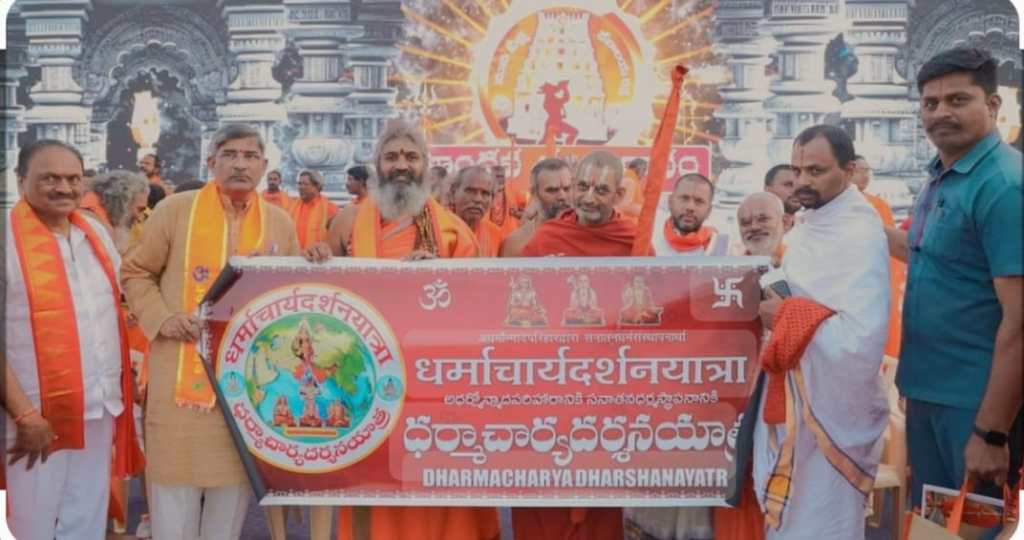
As the chants of Sanatana Dharma echoed through Kesarapalli, the ‘Haindava Sankharavam’ became more than just an event—it became a movement. The demands for autonomy and the calls for unity reflect a deep-seated desire to reclaim cultural and spiritual sovereignty. The success of this movement will depend on its ability to balance tradition with modern governance, navigate the complexities of caste and community, and articulate a vision that resonates across diverse demographics.
In the evolving narrative of Hindu nationalism, the ‘Haindava Sankharavam’ marks a pivotal chapter. By choosing Vijayawada as its launchpad, the VHP has signalled its intent to create ripples that extend far beyond Andhra Pradesh. Whether these ripples become waves will depend on the movement’s ability to translate its vision into actionable change, uniting people not just by religion but by a shared sense of purpose and identity.
Visit arjasrikanth.in / @DrArjasreekanth for more insights
 SOCIAL PERSPECTIVES