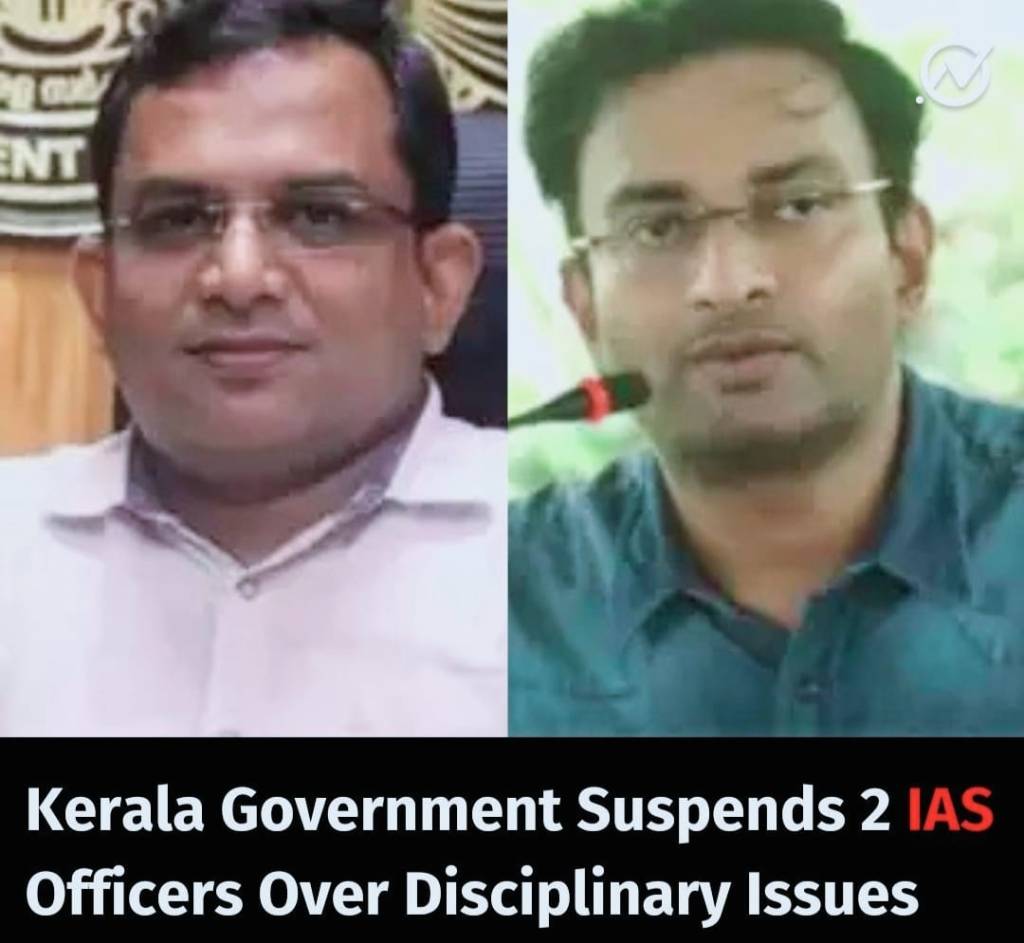
A WhatsApp Group and A Viral “Collector Bro” Clash Led to Suspensions, Sparking Questions on Bureaucratic Discipline in the Digital Age
The recent suspension of two senior Indian Administrative Service (IAS) officers in Kerala, K Gopalakrishnan and N Prashant, has ignited a vigorous debate about the ethics of public administration, the boundaries of social media conduct, and the secular ethos that underpins India’s civil services. These suspensions, justified by allegations of misconduct and breaches of discipline, transcend mere disciplinary actions. They expose the complex interplay of identity politics, religious sensitivity, and the perils of digital expression in the lives of public officials. Together, these cases invite a critical reassessment of what it means to serve as a public official in today’s hyper-connected, socially fragmented world.
K Gopalakrishnan, who served as the Director of Industries and Commerce, faced suspension over allegations that he created a WhatsApp group named “Mallu Hindu Officers,” supposedly exclusive to Hindu officers. This act was viewed as potentially divisive and fundamentally at odds with the secular and inclusive values expected within the All India Services. Although the group reportedly existed only for a short time before being deleted, the incident was met with immediate backlash. Many viewed it as a breach of the secular principles that are integral to India’s civil services. Critics argued that the creation of such a group displayed poor judgment and undermined the ethos of impartiality and inclusiveness that public servants are expected to uphold.
In his defense, Gopalakrishnan asserted that his phone had been hacked, suggesting that the group was created without his consent. However, a police investigation cast doubt on this claim. Forensic analysis revealed that his phone had been reset multiple times before being handed over to authorities, erasing any potential evidence that might support his version of events. This discovery added to the suspicions surrounding Gopalakrishnan, prompting authorities to conclude that his actions—whether intentional or not—could foster division within the administrative cadre. His suspension was thus viewed as a message from the Kerala government underscoring the importance of a unified and secular bureaucracy and emphasizing that any conduct, inadvertent or otherwise, that threatens communal harmony cannot be tolerated in public office.
The suspension of Gopalakrishnan underscores the delicate and often contentious role that religion and personal identity play within public service. In Kerala, a state celebrated for its diversity and its commitment to secular values, any perceived deviation from these principles is treated with zero tolerance. The suspension of Gopalakrishnan is not merely a punitive measure; it is a reaffirmation of the state’s stance on maintaining an unyielding secular character within its administrative ranks. The incident serves as a reminder of the expectations placed upon public servants in a secular democracy, where any indication of religious or communal bias can erode public trust in government institutions.
N Prashant, known for his popular online persona as “Collector Bro,” found himself embroiled in controversy of a different sort, though equally divisive. Known for his active engagement on social media, Prashant was suspended after a heated altercation with his senior, A Jayathilak, the Additional Chief Secretary of Finance. Taking to Facebook, Prashant publicly accused Jayathilak of manipulating media reports against him. In a series of posts, Prashant referred to Jayathilak as the “real mental patient of Madampally,” a phrase borrowed from a popular Malayalam film. Though he later deleted this post, the damage was done, with the incident drawing widespread public attention and sparking polarized opinions.
Prashant did not stop there. In another post, he likened himself to a “farmer pulling out weeds,” implicitly referring to his senior in derogatory terms. His provocative language and open defiance only heightened tensions within the IAS community. In its suspension order, the Chief Secretary cited Prashant’s conduct as severely lacking discipline and stated that his remarks were unbecoming of an IAS officer, jeopardizing the unity within the civil service. Prashant’s case serves as a cautionary tale for public officials about the double-edged nature of social media, where the allure of personal expression must be tempered by a commitment to professional decorum and institutional loyalty.
While Prashant’s active social media presence allowed him a unique form of public engagement and endeared him to many citizens, it also revealed the risks of digital platforms for those in public service. The line between personal and professional life becomes exceedingly thin in the public eye, especially when high-ranking officials air internal grievances or engage in personal spats online. For Prashant, social media—intended as a tool for public outreach—became the setting for a very public confrontation, highlighting how quickly digital expression can become a liability for institutional cohesion and integrity.
The Kerala government’s swift and decisive response to these incidents reflects a commitment to upholding discipline and unity within its administrative structure. Chief Minister’s endorsement of the suspensions, following the recommendations of Chief Secretary, sends a powerful message: public service is grounded in professionalism, impartiality, and unity. Any behavior that threatens to undermine these values will not be tolerated. By addressing these incidents firmly, the Kerala government reinforces the principle that personal identity and digital expression must never interfere with the integrity of public service.
The broader implications of the suspensions of Gopalakrishnan and Prashant go beyond the boundaries of Kerala’s bureaucracy. Gopalakrishnan’s case highlights the growing need for greater sensitivity around religious and communal issues within the ranks of India’s civil services. As public servants in a secular democracy, civil servants are bound by a duty to act without bias or allegiance to religious identities that could compromise their impartiality. The controversy surrounding Gopalakrishnan’s actions serves as a stark reminder of the essential role of secularism in maintaining public trust in government institutions.
Prashant’s case, on the other hand, brings into focus the challenges posed by social media for public servants. While digital platforms offer unprecedented opportunities for officials to interact with citizens, they also demand a level of restraint and professionalism. The fallout from Prashant’s digital outbursts underscores how, without careful handling, social media can quickly become a source of division rather than a tool for constructive engagement.
The cases of K Gopalakrishnan and N Prashant bring into sharp relief the complexities of maintaining ethical integrity, secularism, and unity within the civil services in an era of social media and identity politics. By holding these officers accountable, the Kerala government reaffirms its commitment to a code of conduct that is grounded in secularism, discipline, and professionalism. These cases compel a rethinking of governance standards, highlighting the need for updated codes of conduct that address the realities of digital expression and the challenges of personal identity within public service.
Visit arjasrikanth.in for more insights
 SOCIAL PERSPECTIVES