“From Coastal Dreams to Global Streams – The Unwavering Vision Fuelling Adani’s Quest to Anchor India’s Future on the High Seas”
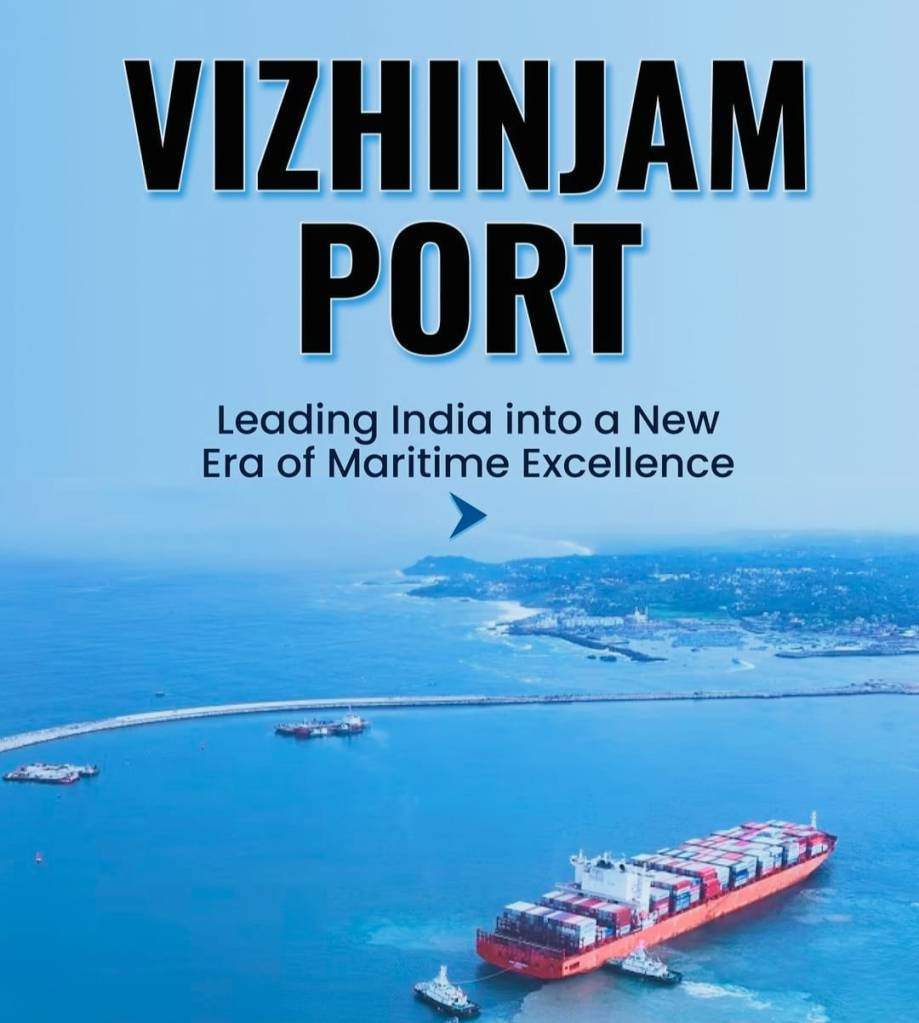
Few projects embody India’s modern aspirations quite like the Vizhinjam International Seaport, strategically located near Thiruvananthapuram, Kerala. Helmed by Gautam Adani and the Adani Group, this port represents more than mere infrastructure; it is a bold statement of India’s intent to establish itself as a core player in global maritime trade. As one of the nation’s first semi-automated ports, Vizhinjam showcases advanced technologies that align India with the most sophisticated port systems worldwide. Its operational journey has been marked by resilience and dedication from Gautam and Karan Adani, who navigated challenges ranging from environmental concerns to community opposition and operational complexities to bring this ambitious vision to life.
Vizhinjam’s impact on India’s maritime sector is profound, with the potential to reduce dependency on other international transshipment hubs such as Colombo, Singapore, and Dubai. The port’s partial operationalization in November 2023 marked a significant milestone, setting the stage for India to emerge as a logistical powerhouse in the region. With a vision cantered on elevating India’s role in global trade, the Adani Group has pushed forward with resolute determination, overcoming hurdles with an unshakable commitment to transforming the country’s trade capabilities.

The port’s strategic design aims to make India more self-reliant in the logistics sector. By establishing a direct transshipment option domestically, Vizhinjam offers Indian exporters and importers a more efficient route, reducing costs and transit times. Vizhinjam is strategically poised as India’s gateway to Asia’s trade corridors, with its location along the East-West shipping corridor granting it unique access to a significant portion of global shipping traffic. This advantage, coupled with the port’s impressive 18-meter natural draft (extendable to 20 meters), allows it to accommodate ultra-large cargo vessels without extensive dredging—a crucial operational and cost-saving feature.
Environmental sustainability forms a core component of Vizhinjam’s vision. The port’s geographical characteristics, such as low littoral drift and natural sedimentation, reduce dredging needs, minimizing environmental impact while enhancing cost-efficiency. This aligns with the Adani Group’s larger commitment to sustainability, and under Karan Adani’s guidance, Vizhinjam aims to be among the world’s greenest ports by 2028, incorporating renewable energy solutions and sustainable practices.

Financially, the Adani Group’s investment underscores a significant commitment to the project. Phase 1 of Vizhinjam, with a projected cost of ₹8,600 crore, is just the beginning of a long-term vision. The project’s 39-year concession period reflects the group’s belief in India’s potential to become a critical player in international commerce. By 2024, Vizhinjam is projected to handle over one million TEUs annually, propelling it to the top ranks of South Asia’s transshipment hubs and anchoring India’s influence in global trade.
Vizhinjam’s transformative potential extends beyond its immediate operational impact, creating economic opportunities across Kerala’s logistics, warehousing, fuel supply, and cargo handling sectors. The port is expected to catalyse substantial job creation, attract investments, and spur socio-economic growth throughout the region. This aligns with the objectives of “Maritime India Vision 2030” and “Maritime Amrit Kaal Vision 2047,” underlining India’s ambitions to become a leading logistics hub and a global trade enabler by mid-century.

A significant component of Vizhinjam’s operational strategy is its semi-automation, which integrates state-of-the-art machinery and digital systems to streamline port operations. In early trials, the port successfully docked ‘Zhen Hua 15’ in October 2023 and the ‘San Fernando’ container ship shortly afterward, handling over 1,900 containers with impressive speed and accuracy. This semi-automated model accelerates the port’s ability to handle large container volumes efficiently, placing Vizhinjam on par with global leaders in maritime logistics.
Addressing community concerns has been integral to the Adani Group’s approach. Fishing communities in Kerala have voiced concerns regarding the project’s impact on coastal erosion and their livelihoods. In response, the Adani Group has taken proactive steps to engage with these communities, seeking to balance development with local welfare. This approach highlights the group’s commitment to responsible development that considers the well-being of all stakeholders—a crucial factor in sustaining long-term relationships and garnering community support.
Vizhinjam’s realization has been anything but straightforward. First proposed over two decades ago, the project encountered numerous delays before the Adani Group took the reins in 2015. Under Gautam Adani’s leadership, the project has navigated a complex landscape of political challenges, environmental concerns, and logistical obstacles. Despite these challenges, the Adani Group has remained steadfast in its pursuit, transforming Vizhinjam into a symbol of India’s resilience and potential in the global maritime industry.
As Vizhinjam prepares for its official launch on December 3, 2023, it marks a new era in India’s maritime history. The port’s deep-water capacity, cutting-edge technology, and strategic location make it an attractive destination for global shipping lines, setting a benchmark for cargo handling efficiency. Beyond infrastructure, Vizhinjam embodies the Adani Group’s broader vision of India as a global trade leader, aligning with the country’s ambitions for maritime leadership by 2047. By placing Kerala on the logistics map, Vizhinjam not only drives regional growth but also reinforces India’s strategic importance in global trade dynamics.

Vizhinjam International Seaport is a landmark project with transformative potential for India’s maritime sector. As one of India’s most advanced ports, Vizhinjam will enhance the nation’s competitiveness, creating job opportunities, attracting investment, and advancing regional growth. Statistics underscore this ambition: with an annual handling capacity projected at over one million TEUs by 2024, Vizhinjam positions itself as a South Asian leader in transshipment. Its environmental innovations aim to make it one of the greenest ports globally by 2028. Vizhinjam’s journey reflects a broader narrative of resilience and ambition, illustrating the power of vision and determination in shaping India’s global future in commerce.
visit arjasrikanth.in for more insights
 SOCIAL PERSPECTIVES