
“Unveiling Defiance: A Silent Stand Against Tehran’s Morality and Dress Code Struggle “
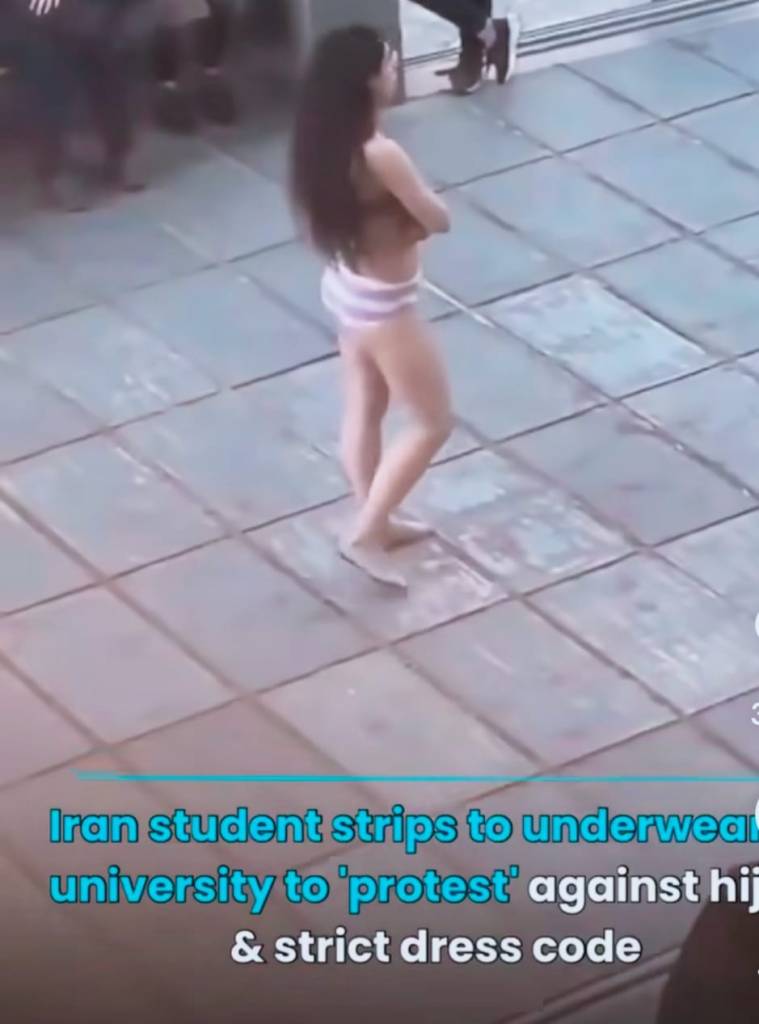
The recent incident at Tehran’s Islamic Azad University has struck a deep chord in Iranian society and beyond, reigniting the longstanding debate over personal freedoms and state-imposed morality. This discourse, often simmering beneath the surface of Iranian society, burst into the global spotlight when a young Iranian woman, in an audacious act of protest, stripped down to her underwear on campus. This act reportedly followed a heated confrontation with the Basij paramilitary forces—a conservative militia—who allegedly pressured her to adhere to Iran’s strict dress code for women. The incident, unfolding in a country where the hijab remains a symbol of religious and political control, has become a powerful, if brief, emblem of resistance against the limitations imposed on women in Iranian society.
Activist accounts detail that the situation began when Basij personnel allegedly demanded that the woman adjust her attire to comply with Iran’s mandated dress codes. These regulations, enforced stringently by the country’s morality police, have often sparked tension among citizens, particularly young women seeking greater personal freedom. When the encounter escalated, her headscarf and some clothing were reportedly torn, leaving her feeling trapped, humiliated, and, perhaps most significantly, devoid of control over her own body. Her subsequent choice to remove her remaining clothing, standing defiantly in her underwear, transformed her into an unexpected symbol of defiance, capturing the attention and respect of onlookers and the broader global community. The silent power of her act—unmediated by words—conveyed a profound message of resistance to oppressive norms and the personal toll of enforced conformity.
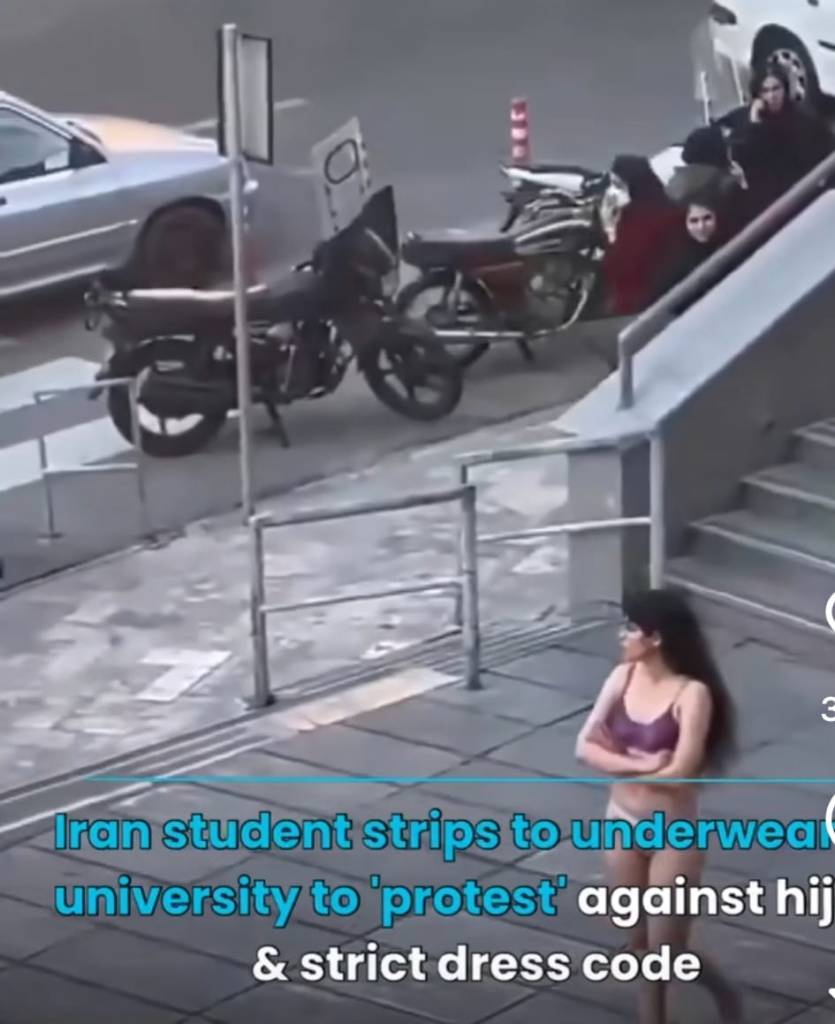
The incident, taking place on November 2, quickly gained traction across social media, where videos of the protest went viral. It sparked passionate discussions across Iran and beyond, raising universal questions about individual rights and state authority. In Iran, women’s attire has long served as a battleground where religious, political, and social agendas intersect. This latest incident underscores the often precarious reality faced by Iranian women who must navigate dress codes that subject them to constant scrutiny. Many voices online praised her bold stand, seeing it as emblematic of the courage required to resist such constraints. At the same time, the incident has deepened discourse on the balance between personal freedom and respect for cultural or religious norms in a society marked by its complex history and the coexistence of modern and traditional values.
Iranian authorities, however, have portrayed the incident in starkly different terms. Seyed Amir Mahjob, a spokesperson for Islamic Azad University, responded publicly, confirming that the woman had been detained and later transferred to a psychiatric facility. This official response—implying that her actions were rooted in psychological distress rather than purposeful protest—has provoked further criticism from rights groups. Many argue that labelling her defiance as a mental health issue seeks to deflect from the larger grievances of Iranian women and invalidate her protest. Organizations like Amnesty International have voiced strong opposition to this treatment, calling for her immediate release and demanding an impartial investigation into alleged abuse and mistreatment by the authorities.
For many Iranians and international observers, the incident echoes the tragic case of Mahsa Amini, a young woman who died in police custody in 2022 after being detained for allegedly violating the hijab law. Amini’s death sparked nationwide protests, evolving into one of the largest social movements in Iran since the 1979 Islamic Revolution. These demonstrations highlighted widespread discontent with the country’s morality police and their strict enforcement methods, revealing a population increasingly unwilling to tolerate the limitations imposed upon them. Although the government responded to these protests with heavy-handed tactics—including mass arrests and alleged violence—the movement left a lasting impact, strengthening a collective sense of resilience and resistance among Iranian women.
The young woman’s protest at Islamic Azad University has rekindled that same spirit of defiance, demonstrating that the desire for change remains as potent as ever. For many Iranian women, the enforced hijab is not merely a symbol of tradition; it represents a broader sense of repression, a constant reminder of their limited agency over their own bodies and lives. While some embrace the hijab as an expression of faith and cultural identity, others feel trapped by laws that dictate their appearance and subject them to public scrutiny.

As images and stories of this protest circulate, the young woman’s act is being seen as both an individual outcry and a broader call for reform. Internationally, her defiance has rallied supporters who argue that mandated dress codes are an infringement on basic human rights, including the right to self-expression and freedom from intimidation. Her stand has resonated deeply, with advocates and public figures alike emphasizing the need for Iran to honor women’s rights and reform its approach to social governance.
Within Iran, however, views on the hijab remain divided. For some, it represents a deeply-held religious obligation and a foundation for moral integrity in society. Adherents see the hijab as a way to promote modesty and respect, considering it a vital component of Iran’s cultural identity in an era of rapid globalization and change. To others, however, especially younger Iranians, mandatory dress codes have become symbols of an authoritarian regime that restricts personal freedoms and imposes traditional values onto a population increasingly drawn to modern ideals of autonomy.

As this young woman’s fate remains uncertain, international human rights organizations and diplomatic entities are closely monitoring the situation. Her protest has thrust Iran’s internal struggles into the global arena once again, underscoring the power of global solidarity in supporting human rights. Amnesty International and other organizations have called for greater transparency and accountability, stressing the urgency of reform to prevent further incidents of abuse and repression.
This incident at Tehran’s Islamic Azad University marks a critical moment in Iran’s evolving narrative of resistance, where the voices for change are becoming harder to silence. As more Iranian women defy the hijab mandate, walking openly in public without headscarves, a clear shift in public sentiment is emerging—one that the morality police may increasingly struggle to control. The young woman’s act of protest, though fleeting, has become a symbol of a broader, shared yearning for freedom and respect.

In conclusion, her defiant stand has sparked conversations around the world, drawing renewed attention to Iran’s challenging journey between personal freedom, religious mandates, and women’s rights. Her silent protest speaks to the depth of frustration felt by many and embodies a broader struggle for dignity and self-expression. While the nation grapples with a range of perspectives on tradition and modernity, this incident serves as a testament to the unyielding spirit of those who dare to challenge the status quo, calling for a society that respects individual choice and values human dignity.
Visit arjasrikanth.in for more insights
 SOCIAL PERSPECTIVES