
Booze, Black Markets, and Budgets: Andhra Pradesh’s Liquor Policy Rollercoaster
In India, the liquor business is a bewildering maze of state-specific rules, taxes, and regulations that often leave consumers scratching their heads. The price of the same bottle of whiskey can range wildly depending on where you are in the country. In Karnataka, for example, a staggering 80% tax is levied on the maximum retail price (MRP) of alcohol, while in Goa, the tax is a more reasonable 50%. This discrepancy results in a bizarre scenario where a bottle of whiskey costs ₹130 in Goa but skyrockets to ₹513 in Karnataka. These vast price differences have fuelled rampant liquor smuggling and black-market activities as people cross state borders for cheaper alcohol.
Despite the chaos, liquor remains a cash cow for state governments, accounting for around 13% of total state tax revenues in the 2024 fiscal year. This brings us to Andhra Pradesh, a state that has struggled with its liquor policies for years. After an ambitious yet costly attempt at liquor prohibition that slashed revenues by ₹20,000 crore, the state is now set to roll out a new liquor policy on October 16. This policy promises sweeping changes aimed at curbing illegal sales and generating more than ₹5,500 crore for the state’s coffers. But will it work?
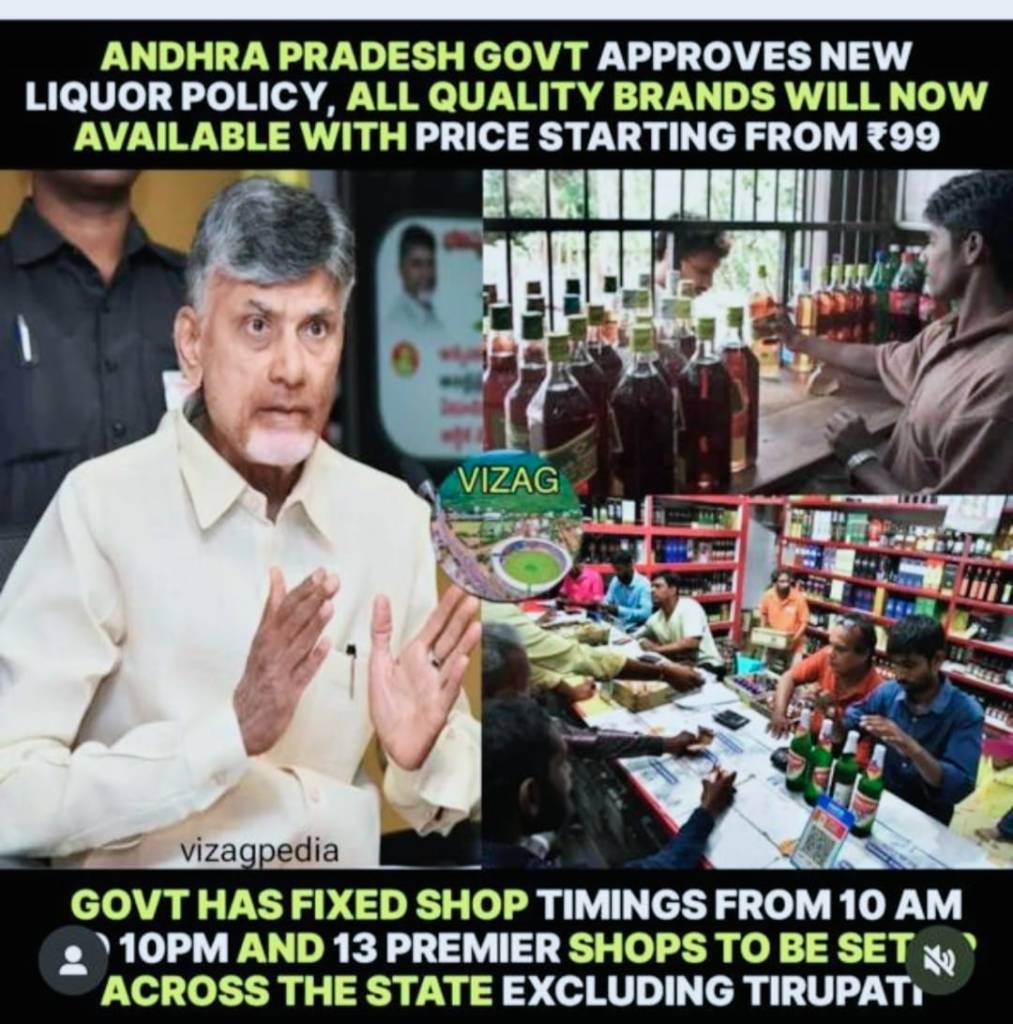
A few years ago, Andhra Pradesh tried to tackle alcohol consumption by taking control of the retail liquor business. The state reduced the number of liquor shops from 4,380 to 3,500 and hiked prices in an attempt to reduce demand. The plan backfired. Alcohol consumption did decline, but instead of victory over vice, the state witnessed a surge in smuggling and black-market sales. People simply turned to cheaper, untaxed liquor . The black market thrived, defeating the very purpose of the policy.
This time around, Andhra Pradesh hopes to avoid similar pitfalls. The new policy will open up the liquor market to private retailers, granting licenses to operate 3,736 shops. Applicants will need to pay a non-refundable fee of ₹2 lakh per shop, with no limit on how many licenses one person can hold. The state also plans to introduce low-cost liquor, priced as low as ₹99, to make legal alcohol more accessible and undercut illegal sales. Retailers will earn a 20% margin on the issue price of liquor, including beer and wine, but they’ll also be saddled with a hefty annual retail excise tax (RET) ranging from ₹5 lakh in small towns to ₹8.5 lakh in larger cities, set to rise by 10% in the second year.

While the policy looks good on paper—cheaper alcohol, more revenue, fewer black-market sales—its implementation raises concerns. During the bidding process for liquor licenses, many shops struggled to attract interest. Out of 85,000 applications submitted, nearly 900 shops received no bids at all. Some districts, like Tirupati, Nellore, and Vishakhapatnam, reported zero applications for many outlets, while others, like Vijayanagaram, saw a flood of over 800 bids.
Critics worry that the policy might lead to monopolies, where a few players dominate the market in certain districts, stifling competition. Additionally, the combination of high taxes and low prices might force shops into unprofitable situations, pushing some retailers toward shady practices to stay afloat.
Andhra Pradesh is treading a delicate line. While the state has already pocketed around ₹1,700 crore in license fees, the long-term sustainability of these shops is uncertain. Will they be able to operate profitably, or will they collapse under the weight of high taxes and cheap pricing?
And then there’s the spectre of political syndicates. Even before the new policy fully takes effect, license holders have reported intimidation and pressure from local leaders demanding a share of their profits—up to 20% in some cases. This is especially prevalent in constituencies like Vijayawada and Guntur, where syndicates are offering to buy out licenses for sums as high as ₹1 crore. In other cases, political figures have warned new entrants that they won’t be able to operate unless they comply with these demands.
The stakes are high, not just for the state government but for everyone involved. Andhra Pradesh’s Chief Minister has vowed to crack down on these coercive tactics, but whether that promise will hold remains to be seen. The state’s experience will serve as a case study for other regions grappling with similar issues. If successful, Andhra Pradesh could revolutionize liquor regulation by striking a balance between generating revenue and reducing illegal activity. If it fails, however, it may simply end up empowering the very black market it seeks to eliminate.

In conclusion, Andhra Pradesh’s new liquor policy is an ambitious effort to clean up a complicated and corrupt industry. But with political syndicates threatening new license holders and black-market forces lurking in the background, the state faces a tough road ahead. Whether it will succeed or stumble remains to be seen. The eyes of the nation will be watching closely as Andhra Pradesh attempts to rewrite the rules of the game.
Visit arjasrikanth.in for more insights
 SOCIAL PERSPECTIVES
2 responses to “Whiskey Wars: Can Andhra Pradesh’s New Liquor Policy Survive the Black Market and Political Syndicates?”
Always the common man is the affected person. Anyway he has to merry.
LikeLike
Thank you for your valued feed back and observations
LikeLike