
“Balancing Migration, Indigenous Rights, and National Integrity—The Court’s Landmark Verdict on Section 6A Sparks Hope and Uncertainty in Assam”
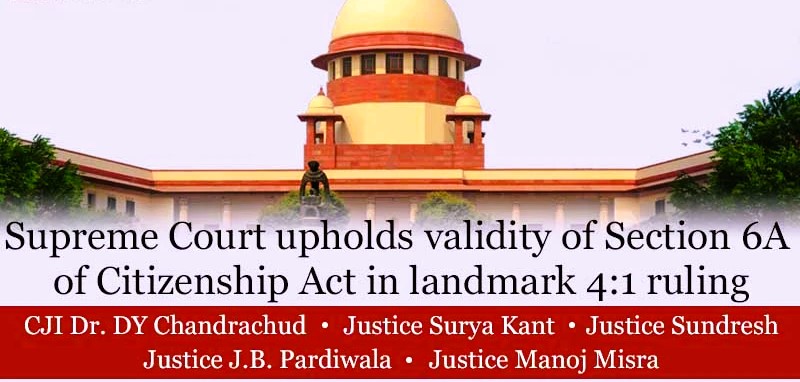
In a pivotal ruling for Assam and India, the Supreme Court has delivered a landmark judgment that directly addresses the long-debated issues of citizenship and immigration in the north-eastern state. By a 4-1 majority, the court upheld Section 6A of the Citizenship Act, a provision born from the 1985 Assam Accord. This section allows individuals who migrated to Assam between January 1, 1966, and March 25, 1971, to apply for Indian citizenship after a 10-year waiting period. The judgment is a significant step in regulating the complex interplay between migration, citizenship, and indigenous rights in Assam, a state that has long grappled with these often-contradictory forces.
The Assam Accord emerged from a period of significant political unrest in the 1970s and early 1980s, driven by concerns over illegal immigration from neighboring Bangladesh (formerly East Pakistan). Assamese nationalists, worried about the potential erosion of their cultural identity, led widespread protests, demanding the identification and deportation of immigrants. The Assam Accord, signed as a compromise between the central government and Assamese leaders, established different cut-off dates for determining citizenship in Assam, distinct from the rest of India.

Section 6A, part of this agreement, introduced a unique framework for citizenship in Assam. It was intended to ease tensions by allowing a significant number of immigrants to gain citizenship after a specified period. However, it has remained a source of contention. Critics argue that it alters Assam’s demographic, cultural, and political landscape by allowing immigrants from this period to settle permanently. Despite these criticisms, the Supreme Court’s decision has provided this provision with a firm legal foundation.
The ruling represents a balancing act between preserving the rights of migrants and addressing the concerns of indigenous populations. The court recognized the need to safeguard Assam’s cultural heritage while simultaneously upholding the human rights of those who have made the state their home. This acknowledgment reflects the broader complexity of migration and citizenship issues across India. However, Assam, in particular, faces the unique challenge of maintaining a delicate balance between these competing interests. The court upheld March 25, 1971, as the cut-off date for determining citizenship eligibility, offering a legal framework for assessing immigrant status in a region where the issue of identity is a constant source of tension.
The court’s decision comes at a time when Assam’s political landscape is deeply polarized around citizenship matters. The implementation of the National Register of Citizens (NRC) and the Citizenship Amendment Act (CAA) has already ignited intense debates and protests. Critics of the NRC process claim it has been mismanaged, leading to the arbitrary exclusion of many long-time residents of Assam. The CAA has also been criticized for its potential to discriminate against certain communities, especially Muslims. Through its ruling, the Supreme Court reaffirmed the importance of constitutional principles in guiding decisions on citizenship, providing hope for a fair resolution to these controversies.
However, the ruling has elicited mixed reactions across the political spectrum. On one hand, many see it as a necessary step toward formalizing the citizenship of thousands of immigrants, with the potential to ease long-standing tensions. On the other hand, there are concerns about how the process will unfold. The risk of renewed unrest is real if the citizenship process is not handled with sensitivity and transparency.
Despite the court’s validation of Section 6A, broader anxieties about Assam’s future remain unresolved. A dissenting opinion from one of the judges signals that the constitutional validity of the provision could still be challenged in the future. Moreover, the ruling leaves unanswered questions regarding immigrants who arrived after 1971, an issue that is likely to continue fuelling political and social tensions in the state.
The significance of this judgment extends beyond legal interpretation; it touches the core of Assam’s identity crisis. For decades, questions of who belongs and who does not have dominated the state’s political discourse. Assam has always been a unique part of India, a melting pot of cultures, languages, and traditions. Yet, the continuous inflow of migrants has exacerbated fears among indigenous populations about the potential erosion of their cultural and economic rights. The court’s decision to uphold Section 6A emphasizes the ongoing need for a citizenship framework that is fair, transparent, and sensitive to these deep-rooted concerns.
As the discourse surrounding citizenship in Assam evolves, it is essential for all stakeholders—political leaders, civil society, and citizens alike—to engage in meaningful and constructive dialogue. While the court’s ruling has provided legal clarity, it is now up to Assam’s leaders to ensure that this decision fosters peace and unity rather than division. Transparency in the NRC process, equitable implementation of citizenship provisions, and clear communication with affected populations will be crucial to maintaining stability in the years ahead.
In conclusion, the Supreme Court’s ruling on Section 6A of the Citizenship Act is a landmark decision with far-reaching implications for Assam and India as a whole. It provides a legal framework for addressing the long-standing citizenship issues in Assam while recognizing the importance of protecting the region’s cultural identity. As the state moves forward, it must carefully navigate the intricate dynamics of migration, citizenship, and identity to ensure justice and dignity for all residents. The path ahead may be complex, but with this ruling, Assam has an opportunity to build a more inclusive and balanced future.
Visit arjasrikanth.in for more insights
 SOCIAL PERSPECTIVES